Are Award-Winning Physicists Making Quantum Mechanics Even Weirder, and Is This the End of Physics as We Know It?
TL;DR
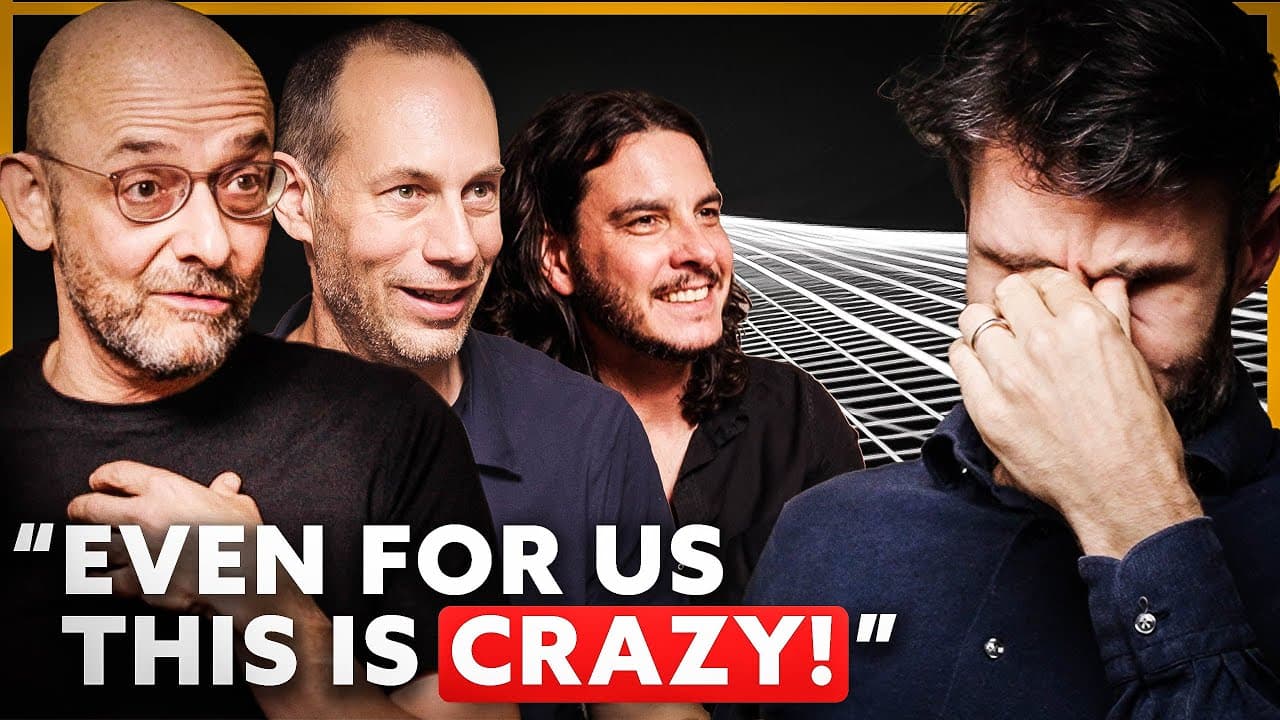
New no-go theorems challenge quantum mechanics by suggesting that even performed measurements may have no absolute outcome shared by every observer. Award-winning physicists Časlav Brukner, Eric Cavalcanti, and Renato Renner extend Wigner’s Friend scenarios by placing observers inside quantum models, leaving no common outside perspective. The proposed experiments remain very hard to test, so read on to understand the paradoxes and the difficult choices they create for quantum reality.
Transcript
but then you start doubting that observation so when a spin up was measured you say we have to we have to be critical then was that really a measur exactly even performed measurements have no absolute outcome Vienna Austria this is where I met three awardwinning Quantum physicists who are basically proposing a new approach to physics here you see m... Read More
Key Insights
- The no-go theorems challenge the absoluteness of facts in quantum mechanics, suggesting that measurement outcomes may not be absolute for all observers.
- Bell's theorem already showed that locality and realism cannot both be true, but these new theorems add the absoluteness of facts to the list of challenged assumptions.
- The Wigner's Friend experiment raises questions about whether a measurement outcome for one observer is a fact for all observers.
- The experiments proposed are hard to test but are crucial for understanding the fundamental nature of reality.
- The discussion touches on various interpretations of quantum mechanics, including many-worlds, QBism, and relational quantum mechanics.
- There's a debate on whether consciousness plays a role in collapsing the quantum wave function, though no definitive theory exists.
- The Heisenberg cut, or the boundary between observer and system, remains a subject of debate with no clear criteria.
- The conversation suggests a shift towards a subjective physics where the observer's perspective is central to understanding reality.
Install to Summarize YouTube Videos and Get Transcripts
Explore YouTube Video Summarizer or Get YouTube Transcript Extractor
Questions & Answers
Q: What new challenges do the no-go theorems pose for quantum mechanics?
The theorems challenge the idea that performed measurements have absolute outcomes for every observer. By including observers within quantum models, they produce scenarios with no common outside perspective from which all events can be described consistently.
Q: How do the new theorems relate to Bell-type problems?
In the described Wigner’s Friend scenario, a friend can report having obtained a definite outcome without revealing which outcome occurred. When another observer assigns that hidden result together with their own observed outcome, Bell-type problems arise.
Q: What is the Wigner’s Friend thought experiment?
Wigner’s Friend places a friend and a quantum system inside a perfectly isolated laboratory while another observer remains outside. The friend sees a definite result, but the outside observer can still describe both the friend and the system as being in a superposition.
Q: Why might measurement outcomes not be absolute for all observers?
An observer inside a laboratory can experience a definite measurement outcome while an outside observer still treats the laboratory as a quantum superposition. The proposed scenarios suggest there may be no transformation to a single common perspective that makes both descriptions absolute.
Q: What happens when observers are placed inside quantum models?
Observers such as Alice, Bob, Charlie, and Debbie become parts of the quantum scenarios instead of remaining outside them. This allows an observer to observe another observer, with further quantum boxes drawn around each level indefinitely.
Q: How is quantum theory contrasted with relativity in the discussion?
Relativity allows Alice and Bob to experience events differently while coordinate transformations preserve intersubjective agreement within overlapping patches. In the quantum scenarios discussed, the events themselves become relative, and no common perspective has been found.
Q: What is the Heisenberg cut problem in Wigner’s Friend scenarios?
The boundary between the quantum system and the classical observer is unclear. Because another quantum box can always be drawn around an observer, it remains undecided where the observed system ends and the observer begins.
Q: Why are the proposed quantum experiments difficult to evaluate?
The physicists’ proposed experiments are described as very hard to put to the test. Until they can be tested, the discussion mainly forces difficult choices about how quantum theory and quantum reality should be interpreted.
Summary & Key Takeaways
-
Physicists propose new no-go theorems that challenge the absoluteness of facts in quantum mechanics, suggesting that measurement outcomes may not be universal. These ideas extend the Wigner's Friend thought experiment and question the applicability of quantum mechanics to all physical systems.
-
The discussion explores interpretations of quantum mechanics, such as many-worlds and QBism, and considers the role of consciousness in measurement. The Heisenberg cut, or the boundary between observer and system, remains debated with no clear criteria.
-
The conversation points towards a subjective physics where the observer's perspective is central, suggesting that our understanding of reality may be more fragmented and subjective than previously believed.
Read in Other Languages (beta)
Share This Summary 📚
Summarize YouTube Videos and Get Video Transcripts with 1-Click
Try YouTube Summary with ChatGPT & Claude or YouTube Transcript Generator
Explore More Summaries from Essentia Foundation 📚
Summarize YouTube Videos and Get Video Transcripts with 1-Click
Try YouTube Summary with ChatGPT & Claude or YouTube Transcript Generator