Pi hiding in prime regularities
TL;DR
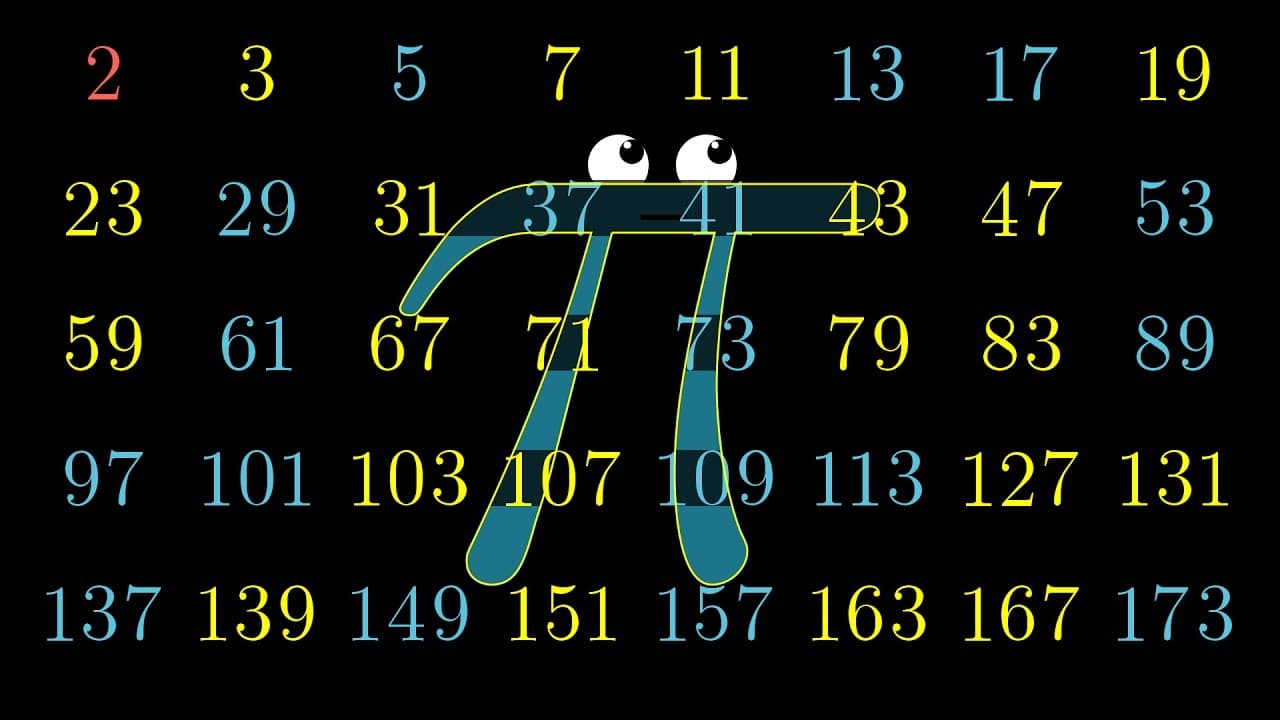
Explores the interconnection between pi, prime numbers, and complex numbers.
Transcript
This is a video I've been excited to make for a while now. The story here braids together prime numbers, complex numbers, and pi in a very pleasing trio. Quite often in modern math, especially that which flirts with the Riemann zeta function, these three seemingly unrelated objects show up in unison, and I want to give you a little peek ... Read More
Key Insights
- The video explores the relationship between pi, prime numbers, and complex numbers, illustrating how these seemingly unrelated concepts are interconnected through the Riemann zeta function.
- A formula for pi is derived through an alternating infinite sum, highlighting the hidden presence of circles in mathematical expressions involving pi.
- The distribution of prime numbers within the complex plane reveals a regularity that aids in understanding the relationship between lattice points and circle areas.
- Gaussian integers, a set of complex numbers with integer components, play a crucial role in understanding the distribution of lattice points on a plane.
- Prime numbers can be categorized based on their ability to be expressed as the sum of two squares, with those one above a multiple of four being factorable into Gaussian primes.
- A function, chi, is introduced to categorize numbers based on their divisibility by four, playing a pivotal role in simplifying the expression of lattice point counts.
- The video presents a method for counting lattice points on rings with specific radii, revealing a systematic approach rooted in prime number distribution.
- The exploration bridges algebraic and analytic number theory, showcasing how these branches intersect through the study of complex numbers and prime distributions.
Install to Summarize YouTube Videos and Get Transcripts
Explore YouTube Video Summarizer or Get YouTube Transcript Extractor
Questions & Answers
Q: What is the main focus of the video?
The video focuses on exploring the intricate relationship between pi, prime numbers, and complex numbers. It demonstrates how these concepts are interconnected through the Riemann zeta function and provides a formula for pi using an alternating infinite sum, revealing the hidden presence of circles in mathematical expressions.
Q: How are Gaussian integers relevant to the video?
Gaussian integers, which are complex numbers with integer components, are crucial in understanding the distribution of lattice points on a plane. The video uses Gaussian integers to explain how prime numbers factor within the complex plane, which in turn aids in understanding the relationship between lattice points and circle areas.
Q: What role do prime numbers play in the video?
Prime numbers are categorized based on their ability to be expressed as the sum of two squares. Those that are one above a multiple of four can be factored into Gaussian primes, revealing a regularity that helps understand lattice point distribution. This categorization is key to deriving the formula for pi presented in the video.
Q: What is the significance of the chi function introduced in the video?
The chi function is used to categorize numbers based on their divisibility by four, playing a pivotal role in simplifying the expression of lattice point counts. It is a multiplicative function that helps organize and simplify the complex calculations involved in determining the number of lattice points on circles.
Q: How does the video bridge different branches of number theory?
The video bridges algebraic and analytic number theory by illustrating their intersection through the study of complex numbers and prime distributions. It explores how the algebraic structure of Gaussian integers and the analytic properties of the chi function and Riemann zeta function come together to reveal deeper insights into the distribution of primes and the calculation of pi.
Q: What mathematical concepts are intertwined in the video?
The video intertwines several mathematical concepts, including pi, prime numbers, complex numbers, Gaussian integers, and the Riemann zeta function. It explores how these concepts are related through number theory, particularly focusing on how primes factor in the complex plane and how this relates to lattice point distribution.
Q: What is the ultimate goal of the exploration in the video?
The ultimate goal of the exploration is to derive a formula for pi using an alternating infinite sum and to understand the hidden presence of circles in mathematical expressions involving pi. The video aims to highlight the intricate relationship between pi, prime numbers, and complex numbers through the lens of number theory.
Q: Why is the video considered intricate and complex?
The video is considered intricate and complex due to the deep mathematical concepts it explores, such as the Riemann zeta function, Gaussian integers, and the categorization of prime numbers. It delves into the interplay between algebraic and analytic number theory, requiring a nuanced understanding of how these fields intersect to reveal insights into the distribution of primes and the calculation of pi.
Summary & Key Takeaways
-
The video delves into the connection between pi, prime numbers, and complex numbers, revealing a fascinating interplay through the Riemann zeta function. A formula for pi is derived using an alternating infinite sum, showcasing the hidden role of circles in mathematical expressions.
-
The concept of Gaussian integers, complex numbers with integer components, is introduced to explain the distribution of lattice points on a plane. Prime numbers are categorized based on their ability to be expressed as the sum of two squares, with those one above a multiple of four being factorable into Gaussian primes.
-
A function called chi is used to categorize numbers based on their divisibility by four, simplifying the expression of lattice point counts. The video bridges algebraic and analytic number theory, illustrating their intersection through the study of complex numbers and prime distributions.
Read in Other Languages (beta)
Share This Summary 📚
Summarize YouTube Videos and Get Video Transcripts with 1-Click
Try YouTube Summary with ChatGPT & Claude or YouTube Transcript Generator
Explore More Summaries from 3Blue1Brown 📚
Summarize YouTube Videos and Get Video Transcripts with 1-Click
Try YouTube Summary with ChatGPT & Claude or YouTube Transcript Generator