How to Build AI Agents with n8n and CreAI
TL;DR
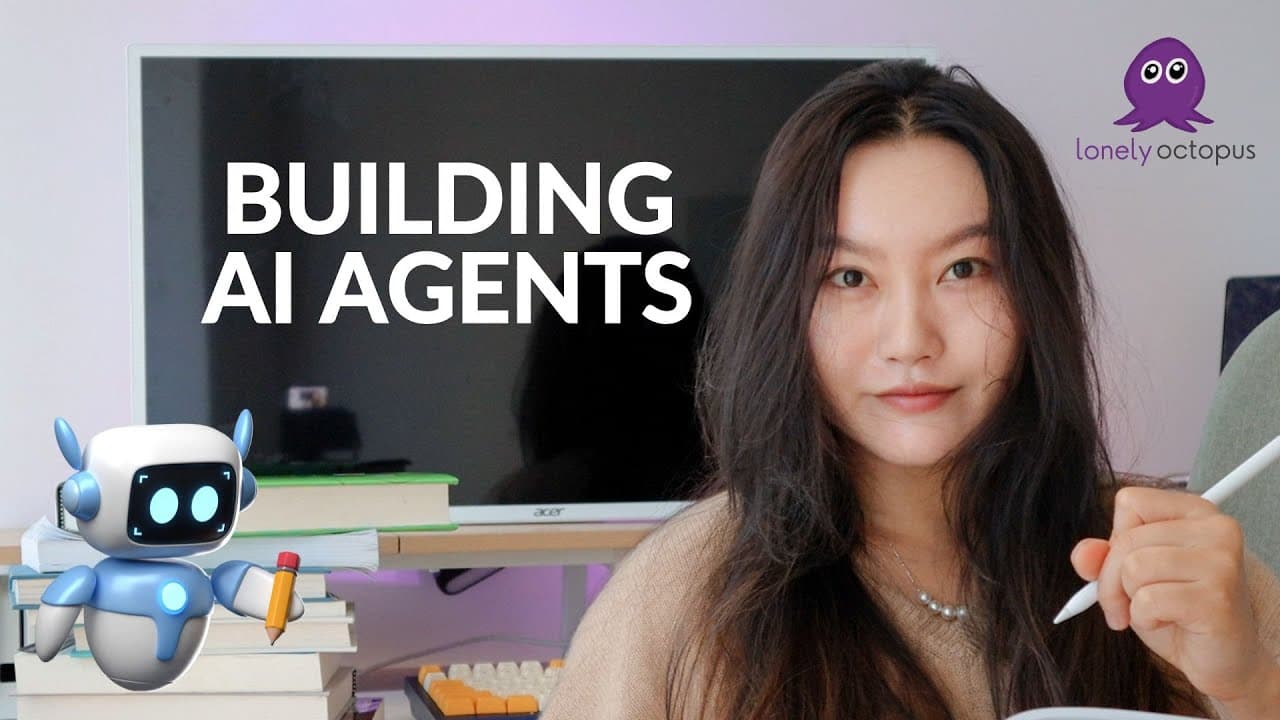
Build AI agents by first deciding whether a task needs autonomous decision-making or only a predefined workflow, then choose an accessible no-code tool such as n8n or a more flexible code-based option such as CreAI. The demonstration connects a Telegram bot to a calendar and returns scheduled events, including an 8:00–9:00 a.m. livestream. Read on to understand the tradeoffs, prompts, tools, and practical applications.
Transcript
okay friends how's it going all right so today what how are you guys all doing today hello everyone hope you're all having a good day hello from Vancouver Canada hello is Tina Loi girl not that I'm aware of but my camera seems to keep flipping out on me okay so welcome welcome to today's live stream oh gosh why is this doing that okay don't move do... Read More
Key Insights
- The livestream covers the principles of building AI agents, emphasizing the difference between true agents and simple automated workflows.
- No-code tools like 'n8n' allow users to build AI agents without extensive programming knowledge, though they come with limitations and costs.
- Understanding prompt engineering is crucial for creating effective AI agents, as it guides the agent's interactions and tool usage.
- Code-based solutions like CreAI offer more flexibility, control, and cost-effectiveness compared to no-code platforms.
- The session demonstrates building a simple AI agent workstream using 'n8n', showcasing its capabilities and limitations.
- Complex workflows can be constructed using frameworks such as those suggested by Anthropic, which categorize systems into workflows and agents.
- The livestream highlights the importance of choosing the simplest solution to achieve a desired outcome, whether using workflows or agents.
- The session includes a demonstration of an AI-based behavioral interview assistant, showcasing practical applications of AI agents.
Install to Summarize YouTube Videos and Get Transcripts
Explore YouTube Video Summarizer or Get YouTube Transcript Extractor
Questions & Answers
Q: How do you build AI agents with n8n or code-based tools?
Start by determining whether the task requires an autonomous agent or a predefined workflow. You can then build an accessible visual workstream with n8n, while code-based tools such as CreAI or AutoGen offer more power and flexibility.
Q: What is the difference between an AI agent and a simple workflow?
An AI agent can make decisions and choose tools dynamically, while a workflow follows a predefined path. The livestream stresses that many systems described online as agents are actually no-code workstreams.
Q: How does n8n help create an AI agent workstream?
n8n provides a visual, no-code interface for connecting an AI system with tools and services. The demonstrated workstream uses a Telegram bot to retrieve calendar events and help prioritize tasks.
Q: What could the demonstrated Telegram bot do?
The bot could answer questions about scheduled calendar events through Telegram. In the demonstration, it identified an 8:00–9:00 a.m. livestream, a 6:30–7:30 p.m. assistant interview, and an unlisted 7:40–8:40 a.m. event in Hong Kong time.
Q: What limitations of no-code AI agent tools are discussed?
The speaker describes current no-code tools as useful but finicky. They can make agent building more accessible, but the experience is presented as less powerful and reliable than working with code-based tools.
Q: Why are CreAI and AutoGen recommended for building AI agents?
CreAI and AutoGen are recommended to people who know code or want to explore code-based development. The speaker says these options are more powerful and less finicky than no-code tools.
Q: Why is prompt engineering important for AI agents?
Prompt engineering defines the instructions and constraints that guide an agent’s interactions and tool use. Effective prompts help shape how the agent makes decisions and performs its assigned tasks.
Q: What practical AI agent application is presented besides the n8n workstream?
The session also presents an AI-based behavioral interview assistant. It demonstrates how an agent can dynamically generate interview questions for a practical real-world use case.
Summary & Key Takeaways
-
The livestream provides an in-depth guide on building AI agents, focusing on both no-code and code-based approaches. It begins by explaining the principles and differences between AI agents and simple workflows, emphasizing the importance of understanding these concepts before building.
-
A practical demonstration using 'n8n' shows how to create a simple AI agent workstream, highlighting its features and limitations. The session also covers prompt engineering and its significance in guiding AI agent interactions and tool usage.
-
The session concludes by discussing the benefits of using code-based solutions like CreAI for more flexibility and control. Additionally, it showcases a behavioral interview assistant, illustrating the practical applications of AI agents in real-world scenarios.
Read in Other Languages (beta)
Share This Summary 📚
Summarize YouTube Videos and Get Video Transcripts with 1-Click
Try YouTube Summary with ChatGPT & Claude or YouTube Transcript Generator
Explore More Summaries from Tina Huang 📚



Summarize YouTube Videos and Get Video Transcripts with 1-Click
Try YouTube Summary with ChatGPT & Claude or YouTube Transcript Generator