How to Create State Tables and Diagrams for Circuits
TL;DR
State tables and diagrams are essential for understanding sequential circuits, as they illustrate the relationship between present states, next states, and outputs. By constructing these tools, you can effectively manage state transitions and better analyse circuit behaviour, especially with various flip-flop configurations.
Transcript
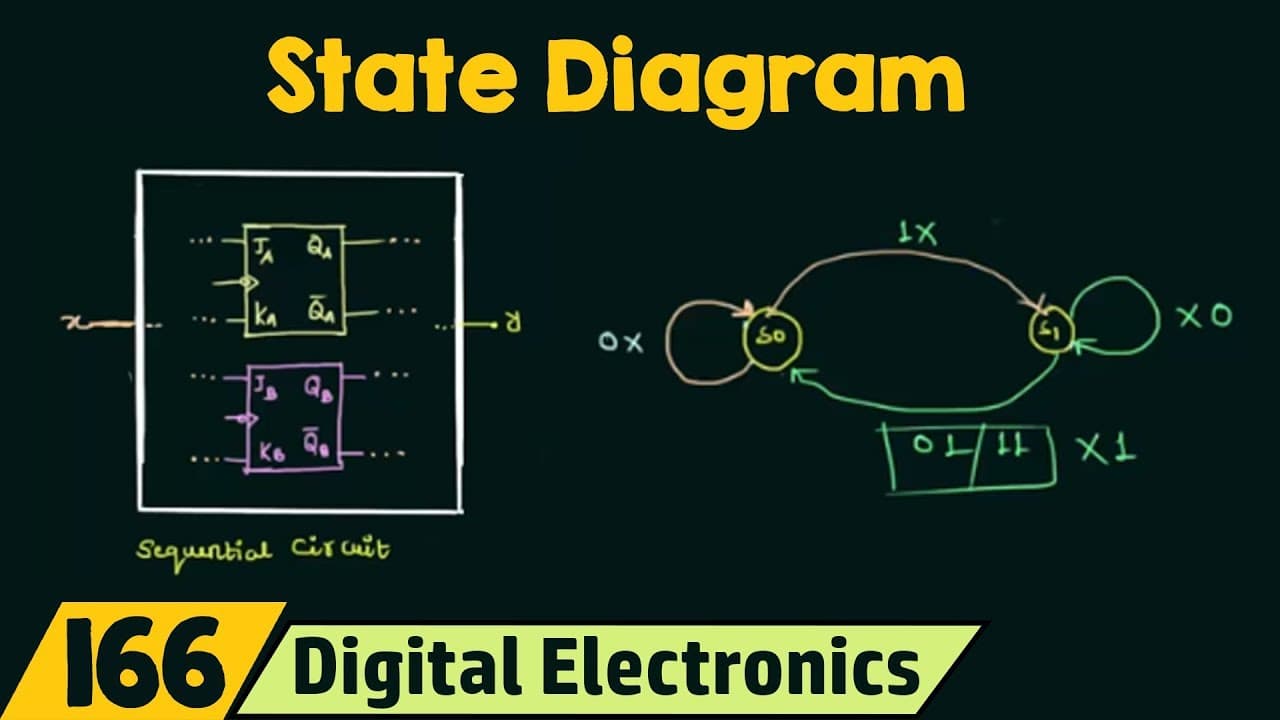
welcome to this very important presentation in this lecture we will study three things the first one is a state table the second one is a state diagram and the last one is a state equation I am having a sequential circuit on the left hand side of my screen and it is actually not a complete sequential circuit because I have not shown the internal ci... Read More
Key Insights
- 🉑 State tables provide crucial information about the connection between present states, next states, and outputs in a sequential circuit.
- 🆘 State diagrams visually represent the states and transitions in a sequential circuit, helping to understand the circuit's behavior.
- 🔢 The number of states in a sequential circuit is determined by the number of flip-flops used.
- 🔢 State equations describe the next state based on the present state and input values, providing a mathematical representation of the circuit's behavior.
- 🉑 Understanding state tables, state diagrams, and state equations is essential for designing and analyzing sequential circuits.
- 🔢 Sequential circuits can become more complex as additional flip-flops and input values are introduced.
- 🎨 Revising and practicing these concepts is crucial for solving problems in sequential circuit design.
Install to Summarize YouTube Videos and Get Transcripts
Explore YouTube Video Summarizer or Get YouTube Transcript Extractor
Questions & Answers
Q: What is the purpose of a state table in a sequential circuit?
A state table provides information about the connection between present states, next states, and outputs in a sequential circuit. It helps to understand the circuit's behavior and how flip-flops are connected.
Q: How is a state diagram created from a state table?
A state diagram represents different states and their transitions using bubbles and arrows. Each state is assigned a bubble, and arrows indicate the transitions between states. Input and output values are also shown in the diagram.
Q: How can the number of states in a sequential circuit be determined?
The number of states in a sequential circuit can be determined by looking at the number of flip-flops used. Each flip-flop represents a possible state, and the total number of states is calculated as 2 to the power of the number of flip-flops.
Q: How are state equations used in sequential circuits?
State equations describe the next state of a sequential circuit based on the present state and input values. The equations represent the combination of the present state and inputs that result in a specific next state.
Key Insights:
- State tables provide crucial information about the connection between present states, next states, and outputs in a sequential circuit.
- State diagrams visually represent the states and transitions in a sequential circuit, helping to understand the circuit's behavior.
- The number of states in a sequential circuit is determined by the number of flip-flops used.
- State equations describe the next state based on the present state and input values, providing a mathematical representation of the circuit's behavior.
- Understanding state tables, state diagrams, and state equations is essential for designing and analyzing sequential circuits.
- Sequential circuits can become more complex as additional flip-flops and input values are introduced.
- Revising and practicing these concepts is crucial for solving problems in sequential circuit design.
- The next presentation will delve into more complex sequential circuits and their corresponding state diagrams.
Summary & Key Takeaways
-
The presentation explains the concept of a state table, which shows the relationship between present states, next states, and outputs in a sequential circuit.
-
It demonstrates how to create a state diagram based on the information from the state table, representing different states and their transitions using bubbles and arrows.
-
The presentation also introduces state equations, which describe the next state as a combination of the present state and input values.
Read in Other Languages (beta)
Share This Summary 📚
Summarize YouTube Videos and Get Video Transcripts with 1-Click
Try YouTube Summary with ChatGPT & Claude or YouTube Transcript Generator
Explore More Summaries from Neso Academy 📚






Summarize YouTube Videos and Get Video Transcripts with 1-Click
Try YouTube Summary with ChatGPT & Claude or YouTube Transcript Generator