Interstellar Asteroid Oumuamua Update for 11/10/2018
TL;DR
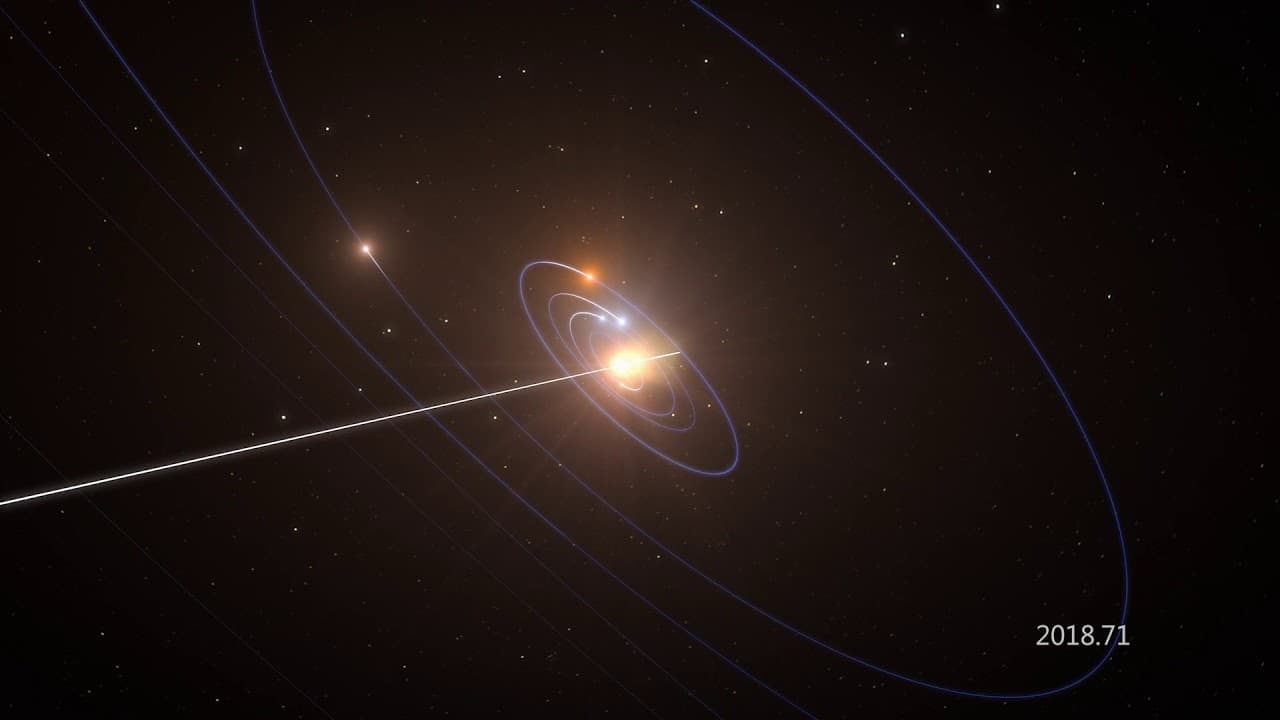
'Oumuamua was probably an unusual natural asteroid or comet, although its unexplained acceleration left open the remote possibility of an artificial origin. No cometary outgassing or associated spin changes were observed, while one paper found that sunlight could produce the acceleration if the object were a thin, low-mass sheet less than a millimeter thick. Read on to compare the natural, light-sail, and alien-probe explanations.
Transcript
The story of 1I/2017 U1 or ‘Oumuamua seems to grow stranger at every passing turn. Not only is the object the first detected interstellar visitor to our solar system, it’s also turning out to be very puzzling, to the point that some are suggesting that it may be of alien origin, though that possibility is not well accepted, it’s just a possibility,... Read More
Key Insights
- 🍃 'Oumuamua's acceleration as it left the solar system is not easily explained by conventional natural objects.
- ☄️ The absence of observed outgassing suggests 'Oumuamua is not a comet.
- 🙂 The behavior of 'Oumuamua could be consistent with a light sail, but this does not necessarily imply an artificial origin.
- 👨🔬 There is a remote possibility that 'Oumuamua could be artificial, but more research is needed to confirm or deny this hypothesis.
- ❓ The trajectory and proximity of 'Oumuamua to Earth could be coincidental, and it may not have any relation to human civilization.
- 🤨 The changes in brightness observed with 'Oumuamua raise further questions about its nature.
- 🖤 The lack of definitive information about 'Oumuamua may prevent us from ever knowing its true nature.
Install to Summarize YouTube Videos and Get Transcripts
Explore YouTube Video Summarizer or Get YouTube Transcript Extractor
Questions & Answers
Q: Was 'Oumuamua an alien spacecraft?
The artificial-object hypothesis was described as only a remote possibility. The speaker concludes that 'Oumuamua was overwhelmingly likely to be a natural object, perhaps an unfamiliar type of asteroid or comet.
Q: Why did 'Oumuamua's acceleration puzzle researchers?
'Oumuamua did not slow down as much as expected during its encounter with the Sun, although it did not dramatically speed up. Researchers therefore sought a force beyond the expected motion to explain the apparent acceleration.
Q: Could cometary outgassing explain 'Oumuamua's motion?
Outgassing could have pushed 'Oumuamua, but none was observed, and modeling suggested that the object was not quite like a comet. The paper also argued that outgassing should have changed its spin, yet no such changes were seen; however, slow or unobserved outgassing remained possible.
Q: How could sunlight have accelerated 'Oumuamua?
Shmuel Bialy and Abraham Loeb proposed that pressure from sunlight could create the observed acceleration if 'Oumuamua had the right geometry and a low mass. Their calculations indicated that it would need to resemble an extremely thin sheet less than a millimeter thick.
Q: Could a sheet less than a millimeter thick survive interstellar travel?
The authors examined the mechanical stresses such an object would face during long-distance travel through interstellar space. They found that an object less than a millimeter thick could survive for a substantial period.
Q: What natural process might create a thin, sail-like object?
The transcript says an unknown natural process in a protoplanetary disk or similar environment might produce such a structure. It compares that possibility with Pele's hair, a volcanic rock formed when nature stretches molten lava into hair-like strands.
Q: Why did 'Oumuamua's trajectory attract attention?
'Oumuamua passed within a quarter of an astronomical unit of the Sun and then came within .15 astronomical units of Earth. That path could resemble a useful intercept course for a probe examining Earth, but the transcript emphasizes that it could simply be random chance.
Q: Why might we never know what 'Oumuamua was?
'Oumuamua was speeding away, and the speaker considered a realistic interception unlikely except perhaps in the far future. Its observed brightness changes and apparent tumbling also remained poorly explained, leaving too little information for a definitive identification.
Summary & Key Takeaways
-
'Oumuamua, the first detected interstellar object, is puzzling scientists due to its unusual behavior and acceleration as it left the solar system.
-
The possibility of 'Oumuamua being a comet with outgassing as the cause of its acceleration has been ruled out, leading researchers to explore other explanations.
-
A paper suggests that 'Oumuamua's behavior could be consistent with a light sail, but this does not necessarily indicate an artificial origin.
Read in Other Languages (beta)
Share This Summary 📚
Summarize YouTube Videos and Get Video Transcripts with 1-Click
Try YouTube Summary with ChatGPT & Claude or YouTube Transcript Generator
Explore More Summaries from John Michael Godier 📚



Summarize YouTube Videos and Get Video Transcripts with 1-Click
Try YouTube Summary with ChatGPT & Claude or YouTube Transcript Generator