What Is MiMo-VL-7B? Xiaomi's 7B Model Beats Larger AI
TL;DR
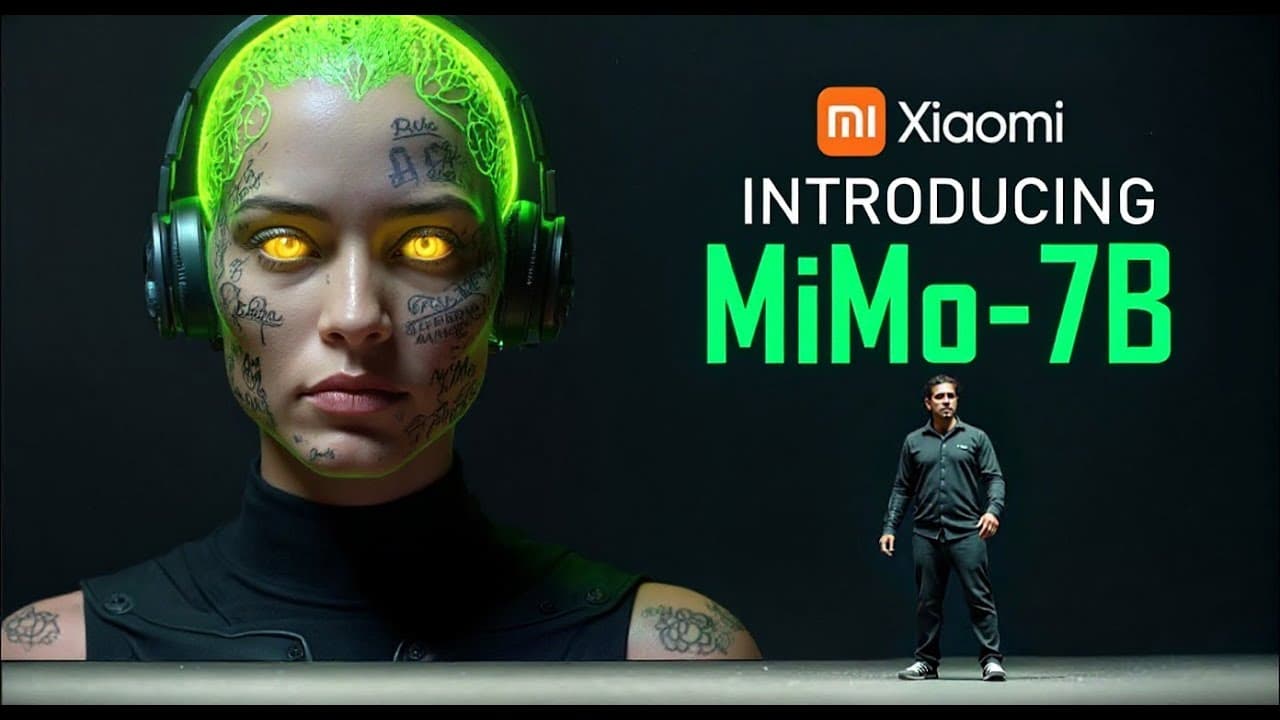
Xiaomi's MiMo-VL-7B is a 7-billion-parameter open-source vision-language model that matches or beats models ten times larger, like Qwen2.5-VL-72B and QVQ-72B. It reads images, videos, and text, reasons step by step, and runs on consumer hardware. Trained on 2.4 trillion tokens across four phases plus reinforcement learning, it closes the gap with GPT-4o and Gemini Pro.
Transcript
Last week, you needed a server rack to pull off top tier AI vision and reasoning. Today, a 7 billion parameter Rebel does it on a gaming rig and still schools models 10 times larger. Xiaomi just cracked the formula. Mimo VL7B sees every pixel, reads every line, thinks out loud, and refuses to play by the old size rules. Here's the wild story behind... Read More
Key Insights
- MiMo-VL-7B is a vision-language model with only 7 billion parameters that performs like models of 30 to 70 billion parameters, meaning far less hardware is needed to run or fine-tune it while still outperforming systems ten times its size.
- The model has three main parts: a vision transformer that sees images at monitor resolution, a small projector that translates visual output into language the text side understands, and the MiMo 7B language backbone tuned from the start for step-by-step reasoning.
- Training ran across four phases burning 2.4 trillion tokens, starting with a frozen vision and language stack while the projector learned from 300 billion image-caption pairs, then progressively unfreezing and expanding to 1.4 trillion tokens of mixed visual and text data.
- The memory buffer, or sequence length, was raised from 8,000 tokens in phase three to 32,000 tokens in phase four, letting the model read an entire textbook chapter, view a high-resolution photo, and still produce explanations running for pages.
- Data curation was rigorous: Xiaomi filtered with perceptual hashes to avoid test-set overlap, recaptioned images and videos, kept only knowledge-dense pairs, added blurry or handwritten OCR text for resilience, and synthesized Chinese-interface screenshots.
- Mixed on-policy reinforcement learning (MORL) scored answers two ways: verifiable rewards for tasks checkable by rule or calculator like bounding boxes and algebra, and separate trained reward models for open-ended tasks judged on thousands of human-ranked answers.
- Reinforcement learning lifted benchmark scores measurably, raising MMMU from 64.6% to 66.7%, CharXiv from 54-plus to 56.5, and counting accuracy from 87% to over 90%, while adding more than 20 ELO points in arena-style human-preference showdowns.
- The model excels at GUI grounding, hitting about 80% on Visual Web Bench neck-and-neck with GPT-4o, 90-plus center accuracy on ScreenSpot v2, and 56% on OSWorld grounding, letting it locate on-screen buttons and output runnable JSON action traces.
Install to Summarize YouTube Videos and Get Transcripts
Explore YouTube Video Summarizer or Get YouTube Transcript Extractor
Questions & Answers
Q: What is MiMo-VL-7B?
MiMo-VL-7B is an open-source vision-language model from Xiaomi with only 7 billion parameters. A vision-language model is a brain that can look at photos, watch videos, read text, then talk about all of it in one coherent stream. Most models that do this well are huge, at 30 or 70 billion parameters or more, but Xiaomi squeezed similar capability into 7 billion, meaning far less hardware is needed to run or fine-tune it while still outperforming models ten times larger.
Q: How does MiMo-VL-7B work internally?
MiMo-VL-7B has three major parts that constantly hand data back and forth. First is a vision transformer, a neural network layer that sees images at the same resolution as a good monitor, so details are not blurred away before the model thinks. Second is a small projector, a slab of code whose only job is to translate visual output into a language the text side understands. Last is the MiMo 7B language backbone, which writes sentences and explains itself step by step, tuned from the start for reasoning rather than quick replies.
Q: How was MiMo-VL-7B trained?
Xiaomi trained MiMo-VL-7B in four phases, burning through 2.4 trillion tokens. Phase one froze the vision and language parts while the projector learned from 300 billion image-caption pairs. Phase two unfroze the vision piece and added 167 billion lines of mixed web pages, textbooks, and PDF snippets. Phase three fed in 1.4 trillion tokens covering nearly everything photographable or writable, keeping sequence length at 8,000 tokens. Phase four raised the buffer to 32,000 tokens and flooded the mix with synthetic chain-of-thought reasoning data.
Q: What is mixed on-policy reinforcement learning (MORL)?
MORL is the reinforcement learning gauntlet Xiaomi ran after supervised fine-tuning. The model answers new questions and gets scored two ways. Some tasks have verifiable rewards checkable by a rule or calculator, like measuring how well a predicted bounding box overlaps the right object, or plugging an algebra answer into math verify. Open-ended tasks use separate trained reward models, one text-only and one accepting images, built on thousands of human-ranked answers. The loop is on-policy, meaning each answer's reward is measured instantly and used to update the model with fresh experience.
Q: How does MiMo-VL-7B compare to larger models on benchmarks?
MiMo-VL-7B matches or beats models ten times larger. On the MMMU mixed-subject benchmark it scores 66.7% after reinforcement learning, up from 64.6%. On Olympiad Bench it hits 59.4 on math and 71.5 on the diagram-heavy slice, matching or beating Qwen2.5-VL-72B and QVQ-72B preview, both ten times larger. On CharXiv it jumps from 54-plus to 56.5, and counting accuracy climbs from 87 to over 90. It now snaps at the heels of closed systems like GPT-4o and Gemini Pro.
Q: Can MiMo-VL-7B control graphical user interfaces?
Yes, MiMo-VL-7B has strong GUI skills. On Visual Web Bench, which asks models to locate information inside full web pages, it nails about 80%, neck-and-neck with GPT-4o. It pinpoints buttons on ScreenSpot v2 screenshots with 90-plus center accuracy and handles the brutal OSWorld grounding test at 56%, edging past a specialized GUI model called UI-TARS. In one demo it acted as a personal shopper, parsed a store screenshot, clicked the right color swatch, scrolled, selected trim, pressed the wish list icon, and produced a runnable JSON action trace.
Q: Why does MiMo-VL-7B matter for the AI industry?
MiMo-VL-7B proves the gap between hobbyist-sized open models and top proprietary stacks is closing faster than almost anyone predicted a year ago. It shows that curation matters, since mixing reasoning-heavy data later in pre-training keeps squeezing gains instead of plateauing. It shows on-policy reinforcement remains stable on small models and keeps improving deep into the sample count. It also shows perception, grounding, and reasoning can advance together if reward signals are juggled carefully, meaning top-tier AI no longer requires 70B parameters or cloud servers.
Q: What are the limitations or challenges of MiMo-VL-7B?
Xiaomi admits that trying to improve everything at once is delicate. Tasks that reward long chain-of-thought, such as multi-step physics, push the model to write more, while grounding tasks where brevity is king tug the other way. Xiaomi is still tuning that balance but already sees steady gains by shuffling the curriculum, effectively teaching counting on Mondays, proofs on Tuesdays, and mixing on Fridays so the model forgets nothing. To prevent cheating, they normalize rewards to a zero-to-one range and scale gradients by answer length.
Summary & Key Takeaways
-
MiMo-VL-7B is Xiaomi's open-source vision-language model that packs the capability of 30 to 70 billion parameter systems into just 7 billion, so it runs and fine-tunes on far less hardware. It sees images, watches videos, reads text, and explains its reasoning out loud in one coherent stream.
-
Its architecture combines a vision transformer that preserves image detail, a projector that translates visual data into language, and a reasoning-tuned MiMo 7B backbone. Training spanned four phases across 2.4 trillion tokens, freezing then unfreezing components, expanding memory from 8,000 to 32,000 tokens, and adding synthetic chain-of-thought reasoning data.
-
After supervised fine-tuning, mixed on-policy reinforcement learning scored answers with verifiable rewards and human-preference reward models, boosting benchmarks and adding over 20 ELO points. The model matches Qwen2.5-VL-72B and QVQ-72B, rivals GPT-4o on GUI tasks, and Xiaomi released both checkpoints and the 50-plus task evaluation harness.
Read in Other Languages (beta)
Share This Summary 📚
Summarize YouTube Videos and Get Video Transcripts with 1-Click
Try YouTube Summary with ChatGPT & Claude or YouTube Transcript Generator
Explore More Summaries from AI Revolution 📚



Summarize YouTube Videos and Get Video Transcripts with 1-Click
Try YouTube Summary with ChatGPT & Claude or YouTube Transcript Generator