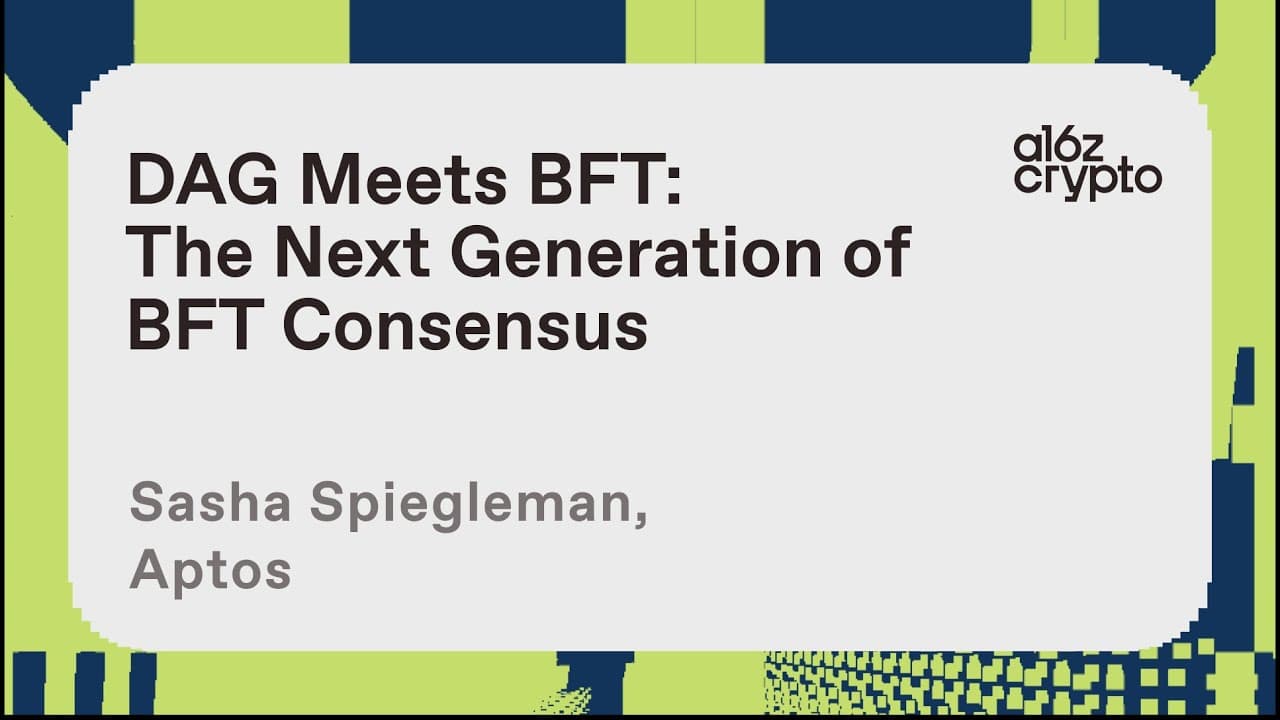
DAG Meets BFT: The Next Generation of BFT Consensus with Alexander Spiegelman | a16z crypto research
TL;DR
DAG-based BFT consensus can improve blockchain efficiency by separating efficient DAG construction from protocols that order its nodes. Alexander “Sasha” Spiegelman describes a round-based DAG where each validator contributes at most one node per round and references n−F nodes from the prior round, alongside Narwhal, Tusk, and Bullshark. Bullshark adds a common-case fast path, while the broader approach addresses resilience, fairness, chain quality, and garbage collection. Read on for the mechanics.
Transcript
welcome everyone to the restart of the a16z research seminar series um very happy for our first talk this fall to introduce Sasha spiegelman uh at Aptos uh who I think will be enlightening us on recent advances in dag based consensus so Sasha all yours all right so yeah thank you for the introduction and please feel free to stalk me at any point fo... Read More
Key Insights
- ⚾ DAG-based consensus protocols offer efficient and scalable solutions for consensus in blockchain systems.
- 💨 Bullshock protocol introduces a fast path to reduce latency, while Task protocol provides optimal resilience and post-quantum safety.
- 🍻 Weak links and garbage collection ensure fairness and efficient usage of system resources.
Install to Summarize YouTube Videos and Get Transcripts
Explore YouTube Video Summarizer or Get YouTube Transcript Extractor
Questions & Answers
Q: How do DAGs work with BFT consensus?
Validators build a shared, round-based directed acyclic graph, and a consensus protocol runs on top of that structure to order its nodes. Each node carries transaction information or related metadata and refers to n−F nodes from the previous round.
Q: What is the round-based DAG described by Alexander Spiegelman?
Each round contains at most one node from each validator. Every node references n−F nodes from the preceding round and carries either transaction data or metadata about those transactions.
Q: How is the DAG built using reliable broadcast?
A validator prepares a node containing its transactions and reliably broadcasts it. After delivering n−F nodes from other validators, it creates a node for the next round, references those prior-round nodes, adds new transaction information, and broadcasts again.
Q: Do validators vote when adding nodes to the DAG?
No voting process is used at this stage. A validator prepares and reliably broadcasts its node, and recipients add the delivered node to their local view of the DAG.
Q: What roles do Narwhal, Tusk, and Bullshark play?
Narwhal focuses on building the DAG efficiently. Tusk is presented as a practical implementation of DAG-Rider, while Bullshark is the latest protocol discussed for running on top of the DAG.
Q: How does Bullshark reduce consensus latency?
Bullshark preserves the asynchronous properties described for the earlier approach while adding a fast path. That path reduces latency in the common case.
Q: What guarantees does the DAG-based consensus approach provide?
The foundational work describes asynchronous atomic broadcast on top of the DAG with zero communication overhead. It also claims optimal resilience and complexity, post-quantum safety, and one-round latency.
Q: What performance did the Aptos implementation reach?
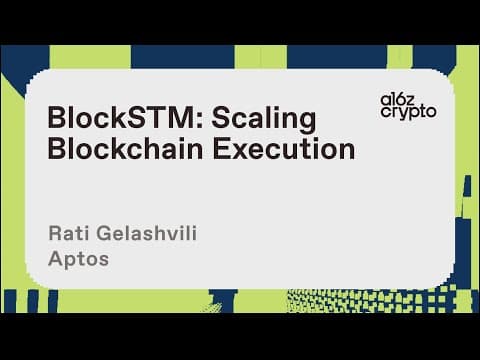
The speaker reports 160,000 transactions per second for execution with Block-STM. The implemented Narwhal-and-Tusk consensus also reached the same 160,000-transactions-per-second figure, illustrating the importance of balancing components in a pipelined blockchain architecture.
Summary & Key Takeaways
-
The speaker introduces the concept of DAG (directed acyclic graph) and its role in solving consensus in blockchain systems.
-
Two protocols, Bullshock and Task, are presented as efficient approaches to building and ordering the DAG.
-
Bullshock offers a fast path to reduce latency, while Task provides optimal resilience and post-quantum safety.
-
The talk also addresses the challenges of fairness, garbage collection, and liveness in implementing the protocols.
Read in Other Languages (beta)
Share This Summary 📚
Summarize YouTube Videos and Get Video Transcripts with 1-Click
Try YouTube Summary with ChatGPT & Claude or YouTube Transcript Generator
Explore More Summaries from a16z crypto 📚
Summarize YouTube Videos and Get Video Transcripts with 1-Click
Try YouTube Summary with ChatGPT & Claude or YouTube Transcript Generator