Why Do Generic AI Prompts Fail Professional Teams?
TL;DR
Effective AI adoption starts with identifying painful, repetitive workflows and designing prompts around the required context, tools, goals, and outputs. Generic one-line templates may provide an entry point, but the speaker argues that teams need continuous experimentation, practical use cases, and scalable prompting principles to keep pace with rapidly improving models.
Transcript
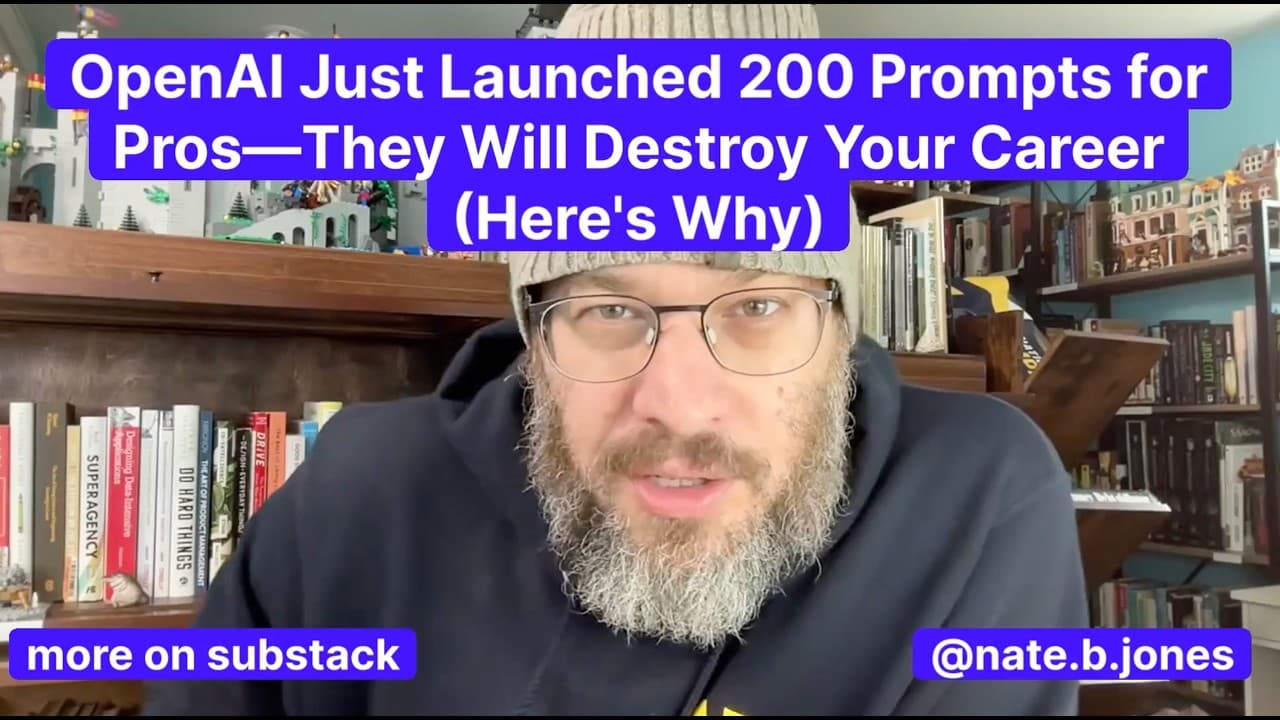
ChatGpt launched an absolutely terrible resource for prompting and I think it deserves more attention because we need to talk about how bad AI education is today and how much is dependent on getting it right. And Chad GPT is a leader in the space. They're seen as an influencer as the first mover. People will look to things like the Chat GPT prompt ... Read More
Key Insights
- Generic prompt templates are inadequate for complex professional tasks when they omit the organization’s data, systems, jurisdictions, constraints, and desired decisions. The speaker’s GDPR and CCPA example illustrates how a short research request can produce documentation without addressing the company’s actual compliance workflow.
- Effective AI training is grounded in workflow pain points rather than isolated prompting exercises. The speaker recommends locating tasks with many manual cycles and limited results, then using those tasks to make AI instruction tangible, relevant, and connected to the team’s expected impact.
- AI adoption is an ongoing learning process because model capabilities are developing quickly. The speaker warns that employees who treat two or three lines of prompting as complete expertise may miss opportunities discovered by people who continually test models, tools, images, and workflows.
- A useful prompt is designed to support a workflow, not merely retrieve general information. It should provide relevant context, define the goal, reflect the real inputs and constraints, and request an output that helps users advance a specific business process or decision.
- Departmental workflows contain many potential AI applications, including converting product documents into technical requirements, improving sales pipeline predictions through tool use, taking interview notes, creating standardized review forms, and generating consistent question sets while keeping humans responsible for candidate assessment.
- Model selection is less important than the way a team applies the model to work. The speaker argues that Copilot can contribute far beyond email when users define useful workflows, even if they believe another model has stronger reasoning or specialized capabilities.
- The main AI adoption gap is human capability, according to the speaker. Some workers may resist training, while others may assume minimal training is sufficient, leaving organizations unable to recognize or use much of the AI opportunity already available within their departments.
- Simple prompts can serve as introductory examples only when educators clearly label them as a starting point. The speaker says instruction should connect each prompt to a workflow and explicitly teach scalable principles such as supplying context and establishing a clear goal.
Install to Summarize YouTube Videos and Get Transcripts
Explore YouTube Video Summarizer or Get YouTube Transcript Extractor
Questions & Answers
Q: Why do generic AI prompts fail professional teams?
Generic AI prompts fail when professional work depends on context that the template does not include. The speaker’s compliance example omits the company’s data schema, geographic footprint, processing practices, storage locations, existing technology stack, and regulatory distinctions. Such a prompt may return a general checklist with links, but it does not necessarily help engineers and legal teams make decisions within their actual workflow.
Q: How should managers begin AI training for their teams?
Managers should begin by examining the team’s existing workflow and identifying pain points with many manual cycles and weak results. Training can then focus on applying AI to those concrete problems. This approach makes the instruction relevant from the start, reveals what context and tools are needed, and connects prompting practice to the impact that the department is expected to deliver.
Q: What information should a professional AI prompt include?
A professional prompt should include enough context to represent the real task, a clear goal, relevant inputs and constraints, and a useful output specification. For a compliance task, the speaker suggests considering the organization’s data schema, countries of operation, data processing, storage locations, and existing stack. The prompt should advance a business workflow rather than simply reproduce a general web research request.
Q: How can AI improve engineering and product workflows?
AI can help engineering teams turn product documents into stronger, consistently structured technical requirements. The task should be grounded in the documents the team receives, the required format, and the standards engineers must follow. This workflow-oriented use is more useful than asking a model for generic engineering advice because it targets an existing handoff problem and produces an output the team can immediately review.
Q: How can AI support sales and hiring workflows?
AI can support sales teams by using tools to assist with pipeline predictions, according to the speaker. In hiring, it can take notes, prepare standardized review forms, and generate consistent interview question sets. These applications can reduce administrative burden while leaving people at the center of the interview process, where they can focus their attention on evaluating candidates rather than repeatedly preparing supporting materials.
Q: Does the choice of AI model matter more than the workflow?
The speaker argues that the workflow matters more than the specific model. A team that clearly understands what it wants to accomplish can use Copilot for substantial business tasks rather than limiting it to email. Different models may perform differently on a particular experiment, but productive adoption still depends on defining the work, supplying context, using available tools, and evaluating the resulting output.
Q: Why is minimal prompt training risky for employees?
Minimal training can create false confidence that knowing a few short prompts is equivalent to understanding AI. The speaker describes this as being trapped in the messy middle of adoption. Because capabilities are developing rapidly, workers who stop learning may be surprised by what more experimental users accomplish with images, tools, structured outputs, and complete workflows. Continuous curiosity and practice are therefore presented as essential.
Q: Can simple prompt templates still be useful for beginners?
Simple templates can be useful as an entry point if educators explain that they are only the beginning. The speaker recommends showing how each example connects to a real workflow and identifying the principles embedded within it, including context and a clear goal. Learners also need a visible progression toward more capable practices, so an introductory prompt does not become the limit of their AI education.
Summary & Key Takeaways
-
The speaker criticizes OpenAI’s pack of 200 professional prompts because its short, generic templates omit important operational context. A compliance prompt, for example, combines GDPR and CCPA while overlooking data schemas, storage locations, processing practices, geographic footprints, and existing technology, producing a research checklist instead of workflow-specific intelligence.
-
The proposed alternative is an AI curriculum grounded in each department’s real work. Teams should identify repetitive manual cycles, weak results, and workflow bottlenecks, then practice applying AI to concrete tasks such as technical requirements, sales pipeline predictions, interview notes, standardized reviews, and consistent candidate questions.
-
The speaker argues that model choice matters less than how intelligently a team uses the available model. Organizations should treat AI as a workflow engine, preserve human judgment where needed, experiment with emerging capabilities, and teach context, goals, and other reusable principles instead of presenting a few templates as sufficient training.
Read in Other Languages (beta)
Share This Summary 📚
Summarize YouTube Videos and Get Video Transcripts with 1-Click
Try YouTube Summary with ChatGPT & Claude or YouTube Transcript Generator
Explore More Summaries from AI News & Strategy Daily | Nate B Jones 📚






Summarize YouTube Videos and Get Video Transcripts with 1-Click
Try YouTube Summary with ChatGPT & Claude or YouTube Transcript Generator