How to Hack a Balance Scale Using a Microcontroller
TL;DR
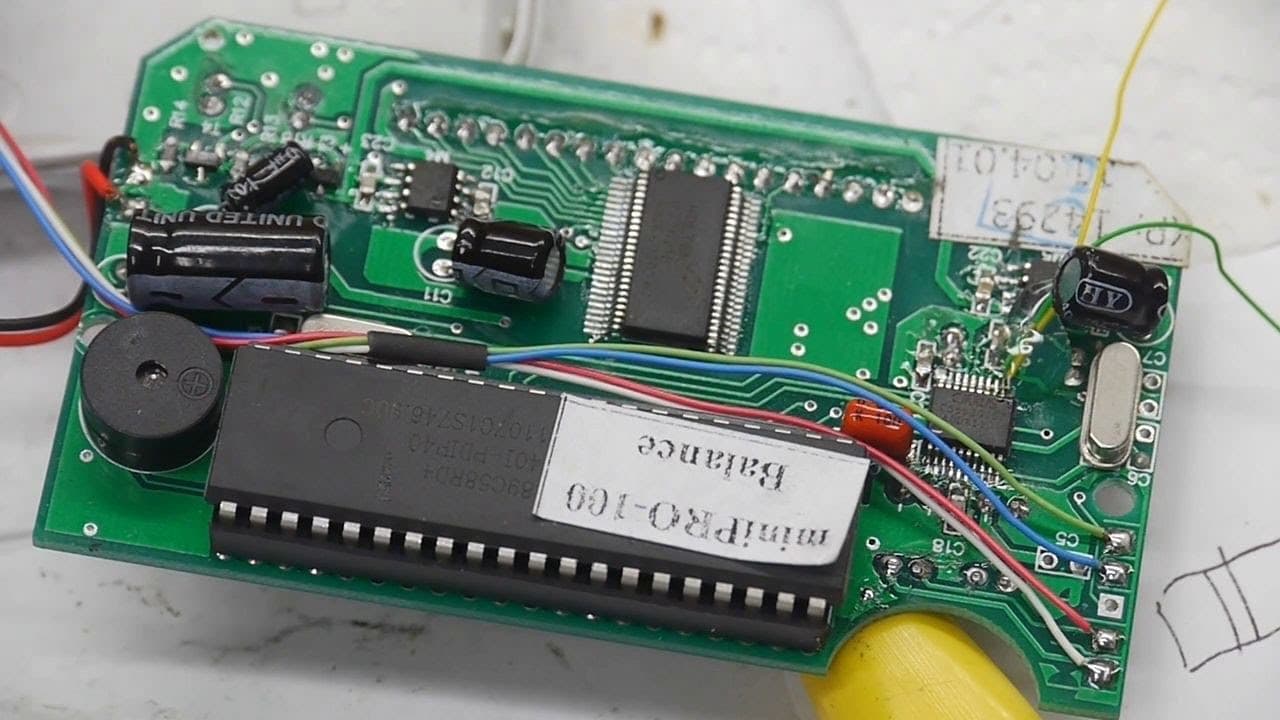
To hack a balance scale without an electronic interface, disassemble it to access the strain gauge and circuit board. By using a Parallax Propeller microcontroller, you can tap into the data from the 24-bit analog to digital converter, allowing you to control the dispensing of materials accurately based on weight.
Transcript
hey everyone for my current project I'd like to use a microcontroller to dispense a material onto a balance like this and then have the microcontroller stop the dispensing when it's weighed out a certain amount of material so to do that this this scale doesn't have any electronic interface so today's task was to crack this thing open and figure out... Read More
Key Insights
- 🏂 Disassembling the balance revealed a circuit board with a strain gauge, analog to digital converter, voltage regulators, LCD driver, and microcontroller.
- ⚡ Tapping into the analog signal path was challenging due to the absence of an interface and the need to interrupt the reference voltage.
- 🏃 The author used a parallax propeller chip, running at 80 MHz, to extract data from the analog to digital converter and control the weighing process.
Install to Summarize YouTube Videos and Get Transcripts
Explore YouTube Video Summarizer or Get YouTube Transcript Extractor
Questions & Answers
Q: How does the microcontroller interact with the balance?
The microcontroller reads data from the strain gauge through the 24-bit analog to digital converter. It then sends the data to the display RAM and controls the dispensing process based on the weight.
Q: Why is it challenging to tap into the analog signal path?
The analog signal path goes directly from the strain gauge to the analog to digital converter. Tapping into this path would require interrupting the reference voltage going into the Wheatstone bridge, which is difficult to accomplish.
Q: What alternative solution did the author use to extract data from the analog to digital converter?
The author used a parallax propeller, a 32-bit architecture chip with eight cores and no interrupts. By programming the chip in assembly language, the author was able to capture the data from the analog to digital converter.
Q: How did the author ensure the scale would not be harmed during the project?
The author connected the propeller chip, which runs on 3.3 volts, to the scale using current limiting resistors to prevent excessive current flow. This helped protect the scale from potential damage.
Summary & Key Takeaways
-
The content shows the process of disassembling a balance without electronic interface to access the strain gauge and circuit board.
-
The circuit board consists of a strain gauge, 24-bit analog to digital converter, voltage regulators, LCD driver, and a microcontroller.
-
The author explores different methods to tap into the signal and extract data from the analog to digital converter.
Read in Other Languages (beta)
Share This Summary 📚
Summarize YouTube Videos and Get Video Transcripts with 1-Click
Try YouTube Summary with ChatGPT & Claude or YouTube Transcript Generator
Explore More Summaries from Applied Science 📚





Summarize YouTube Videos and Get Video Transcripts with 1-Click
Try YouTube Summary with ChatGPT & Claude or YouTube Transcript Generator