How Can You Spot Beliefs Quietly Running Your Life? | Gregg Braden Motivation in 4 Hours
TL;DR
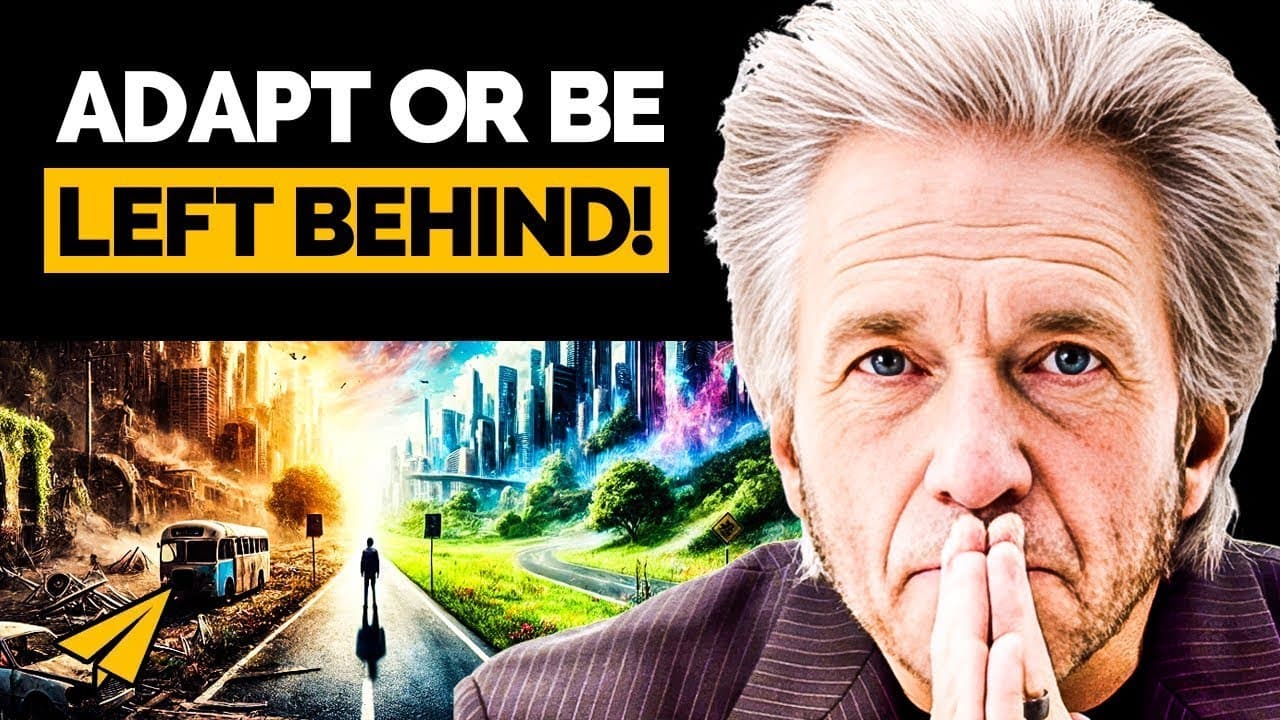
You can spot beliefs quietly running your life by examining the systems and choices you depend on, identifying their underlying assumptions, and asking whether they remain sustainable in a changing world. Gregg Braden specifically challenges “survival of the fittest” and says nature thrives on cooperation. He frames today as a chance to reconsider where 5,000 years of thinking have led. Read on for his approach to questioning old beliefs.
Transcript
The World Isn't falling apart it's breaking open the systems we've relied on the economy education even science are failing because they were built on outdated beliefs this isn't an end it's a call to evolve in this speech Greg Braden exposes the illusion of survival of the fittest and proves that nature thrives on cooperation ancient Cycles predic... Read More
Key Insights
- Beliefs based on outdated systems, such as 'survival of the fittest,' still influence modern life.
- Cooperation, rather than competition, is essential for thriving in nature and society.
- Ancient cycles and wisdom predicted current global shifts, urging us to adapt.
- New scientific discoveries challenge long-held assumptions about evolution and human life.
- Mainstream systems like education and economics are crumbling due to outdated beliefs.
- Heart-based coherence can influence global consciousness and foster peace.
- The current generation has the opportunity to bridge old systems and create a sustainable world.
- Crisis signifies opportunity for change, allowing us to redefine our future through conscious choices.
Install to Summarize YouTube Videos and Get Transcripts
Explore YouTube Video Summarizer or Get YouTube Transcript Extractor
Questions & Answers
Q: How can you identify beliefs that are quietly controlling your life?
Examine the systems and choices you rely on, then identify the beliefs beneath them. Gregg Braden recommends looking at which systems still work, which do not, and whether new discoveries have overturned assumptions you previously treated as true.
Q: Why does Gregg Braden challenge “survival of the fittest”?
Braden presents “survival of the fittest” as an outdated belief and argues that nature thrives on cooperation. His broader point is that beliefs once accepted as true should be reconsidered when new discoveries contradict them.
Q: What does Gregg Braden mean when he says the world is “breaking open”?
He means that the world is not simply falling apart; systems that are no longer sustainable are breaking down as conditions change. He specifically names the economy, education, and science as systems shaped by outdated beliefs.
Q: What is a “deep truth” in Gregg Braden’s talk?
Drawing from physicist Niels Bohr, Braden describes a deep truth as one whose negation can also be a deep truth. He uses this idea to explain how new discoveries can overturn prior beliefs and become new deep truths.
Q: Why does Gregg Braden say mainstream education resists new discoveries?
Braden says there is reluctance, and sometimes outright resistance, in mainstream classrooms, textbooks, documentaries, and media to sharing new discoveries. He stresses that teachers are not at fault because they are bound by what school boards permit them to teach.
Q: How can a major difficulty contain its own solution?
Braden cites Niels Bohr’s statement that every great and deep difficulty bears its own solution. He interprets this to mean that examining the problem closely can reveal the answer, although doing so may require changing how we think.
Q: What opportunity does the present generation have?
Braden says this is a rare opportunity to see where the thinking and choices of the last 5,000 years have led. People can examine the systems they depend on, determine which remain workable, and make new choices instead of relying on old ways.
Q: How do ancient cycles relate to current global change?
Braden says indigenous traditions have anticipated a major period of change for 5,000 years. He connects it to cyclic changes in Earth’s tilt, angle, wobble, orbit, and position in space, which he says affect food production, resource sharing, and how people solve emerging problems.
Summary & Key Takeaways
-
Beliefs rooted in outdated systems are quietly influencing our lives. Gregg Braden argues that cooperation, not competition, is key to thriving. He emphasizes the need to adapt to new scientific discoveries and ancient wisdom, urging us to evolve and make conscious, heart-based choices to create a sustainable future.
-
Mainstream systems like education and economics are crumbling due to outdated beliefs. Braden highlights how new scientific discoveries challenge long-held assumptions about evolution and human life, advocating for a shift in thinking to solve modern problems.
-
Heart-based coherence can influence global consciousness and foster peace. The current generation has the opportunity to bridge old systems and create a sustainable world, with crisis serving as a catalyst for redefining our future through conscious choices.
Read in Other Languages (beta)
Share This Summary 📚
Summarize YouTube Videos and Get Video Transcripts with 1-Click
Try YouTube Summary with ChatGPT & Claude or YouTube Transcript Generator
Explore More Summaries from Evan Carmichael 📚




Summarize YouTube Videos and Get Video Transcripts with 1-Click
Try YouTube Summary with ChatGPT & Claude or YouTube Transcript Generator