How to guarantee product market fit for SaaS success
TL;DR
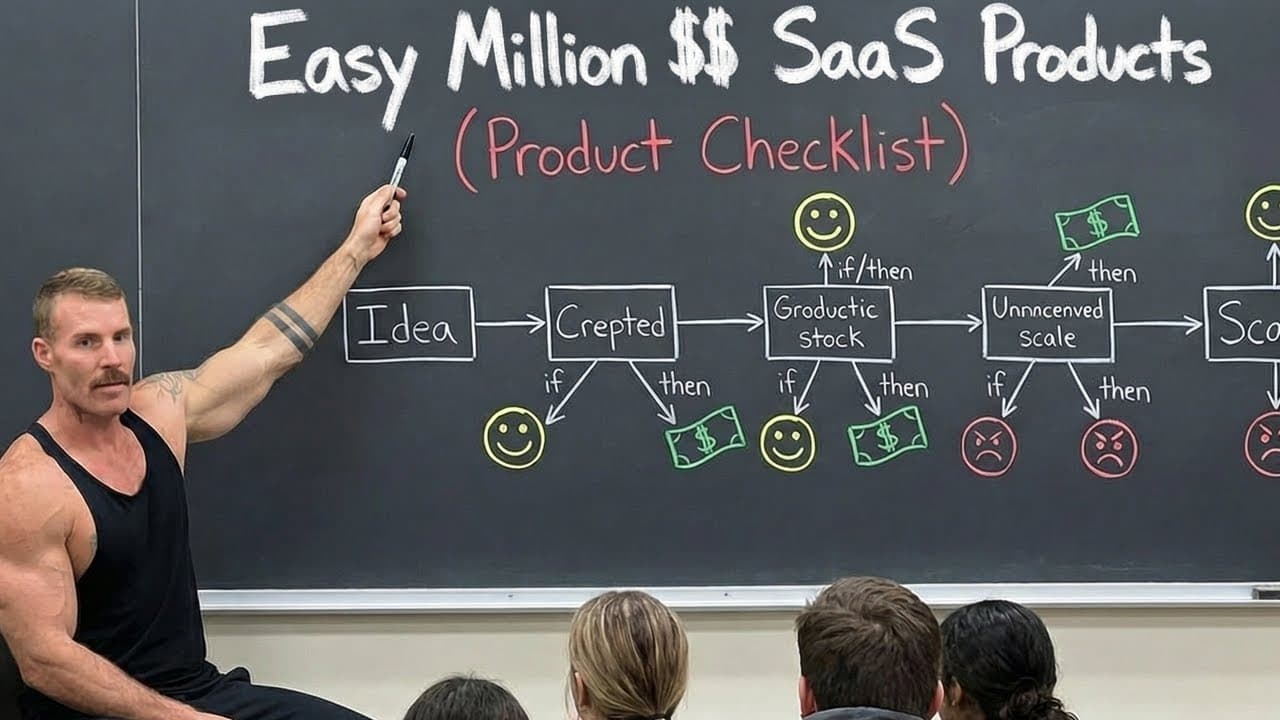
Product market fit is achieved when 20 to 50 customers would be extremely upset if you turned off the product because it delivers a critical result. You must nail a target market, ensure consistent results for customers, and confirm the market is large enough for your revenue goals before marketing. This checklist helps you avoid influencer style failures.
Transcript
Look, on this channel, I talk SAS and tech entrepreneurship. But if you're a business owner of any kind, if you do not get what I put in this video, you're going to fail just like all these influencer businesses. So, I know what you're thinking. Why am I mentioning influencer businesses? Because it's a perfect example of what I need to teach you to... Read More
Key Insights
- Product market fit is defined as a set of 20 to 50 customers who would freak out if the product failed, indicating high value and stickiness.
- The first step is to nail the target customer and ensure the product delivers a result every time, even if you have to set it up for them.
- If customers do not experience consistent results, the product does not have product market fit and should not be marketed further.
- Market size must align with revenue goals; a small niche can work for a million dollars a year, while larger goals require broader reach.
- Avoid influencer style launches where customers do not get lasting results and refuse to pay long term.
- Demonstrating 3 to 5 percent revenue increases when the product is applied is a practical proof of value.
- The product should scale only after 100 percent proof of consistent results, not before marketing begins.
- Achieving product market fit is presented as a prerequisite to successful marketing and long term growth.
Install to Summarize YouTube Videos and Get Transcripts
Explore YouTube Video Summarizer or Get YouTube Transcript Extractor
Questions & Answers
Q: How can I determine if my target customer will consistently get results from my product?
To determine consistency, test the product with a defined group of target customers and measure whether they get the intended result every time. If the result fails even once, reassess the problem and solution until you can deliver the outcome 100 percent of the time. Only after this can you consider marketing.
Q: What indicates a market is large enough to support my SaaS business goals?
The market size should be enough to reach your revenue target, whether that target is one million or ten million dollars per year. You should be able to acquire sufficient customers within the target market and maintain growth rates, indicating the market can sustain long term demand for your product.
Q: Why is it important to demonstrate a concrete numeric benefit like a 3 to 5 percent increase?
A concrete numeric benefit provides tangible proof of value and helps justify ongoing purchases. Demonstrating a measurable improvement shows that customers gain real, repeatable results, making it easier to retain them and grow revenue through continued use and expansion.
Q: What should you do before marketing a SaaS product to ensure you don’t fail like influencer launches?
Before marketing, confirm that every target customer segment gets a consistent result with the product. Avoid big marketing pushes until you have proven results with real customers. This reduces the risk of high hype but poor long term retention that leads to failure after initial excitement.
Q: How many customers are needed to define product market fit, according to the video?
The definition used in the video cites a collection of 20 to 50 customers who would actively be upset if the product were turned off. This group demonstrates the product’s critical value and helps establish a scalable, retainable base for growth.
Q: What is the role of the target market in achieving product market fit?
The target market focuses efforts on buyers who will reliably use the product and derive value. By nailing this group first, you ensure the product delivers the expected results consistently, which is essential before expanding to broader customer segments.
Q: What is the risk of marketing a product that does not deliver consistent results?
Marketing such a product risks attracting users who do not see value, leading to quick churn and the perception that the product is unreliable. This undermines trust, wastes resources, and makes it very difficult to create a scalable business.
Q: How does the speaker describe successful product market fit in practical terms?
Successful product market fit means a product that consistently delivers value to a defined, reachable customer group, causing repeat purchases or continued use. It is shown by stable or rising revenue, strong user retention, and a market where customers would actively defend the product if access were removed.
Summary & Key Takeaways
-
Product market fit is defined as a group of 20 to 50 customers who would fiercely demand the product and would be upset if access was removed. This signals a highly valuable, scalable product for the market. Achieving this requires strong, repeatable customer results before marketing.
-
A clear target market is essential. The product must work for those customers every time, ideally when you or the team demonstrates use for them. Results cannot rely on users alone, and the team must ensure 100% result delivery first.
-
Market size matters. The potential customer base must be large enough to meet revenue goals, whether that is a million or tens of millions, by choosing the right market segment and scale strategy.
Read in Other Languages (beta)
Share This Summary 📚
Summarize YouTube Videos and Get Video Transcripts with 1-Click
Try YouTube Summary with ChatGPT & Claude or YouTube Transcript Generator
Explore More Summaries from Alex Becker Business 📚





Summarize YouTube Videos and Get Video Transcripts with 1-Click
Try YouTube Summary with ChatGPT & Claude or YouTube Transcript Generator