How to Grow SaaS From Validation to 1,000 Customers
TL;DR
Validate a SaaS idea before building by showing target customers a simple concept and asking whether they would pay, including whether they would prepay an annual subscription. Then build only the basic functionality and work directly with the first 10 customers, prioritizing measurable results before attempting repeatable acquisition, marketing, infrastructure, or larger-scale growth.
Transcript
So, everyone on Interwebs is going to tell you the key to starting a successful SAS business, but if you really think about it, boils down to just one thing. You have to have customers. If you don't have customers paying you for your SAS business, you don't have a successful SAS business. So, that's why you need a go to market strategy to not just ... Read More
Key Insights
- SaaS success depends on paying customers, because a product without customers generating recurring revenue is not a successful SaaS business. A go-to-market strategy must therefore define how the company will acquire customers at each stage rather than treating growth as one continuous, unchanging process.
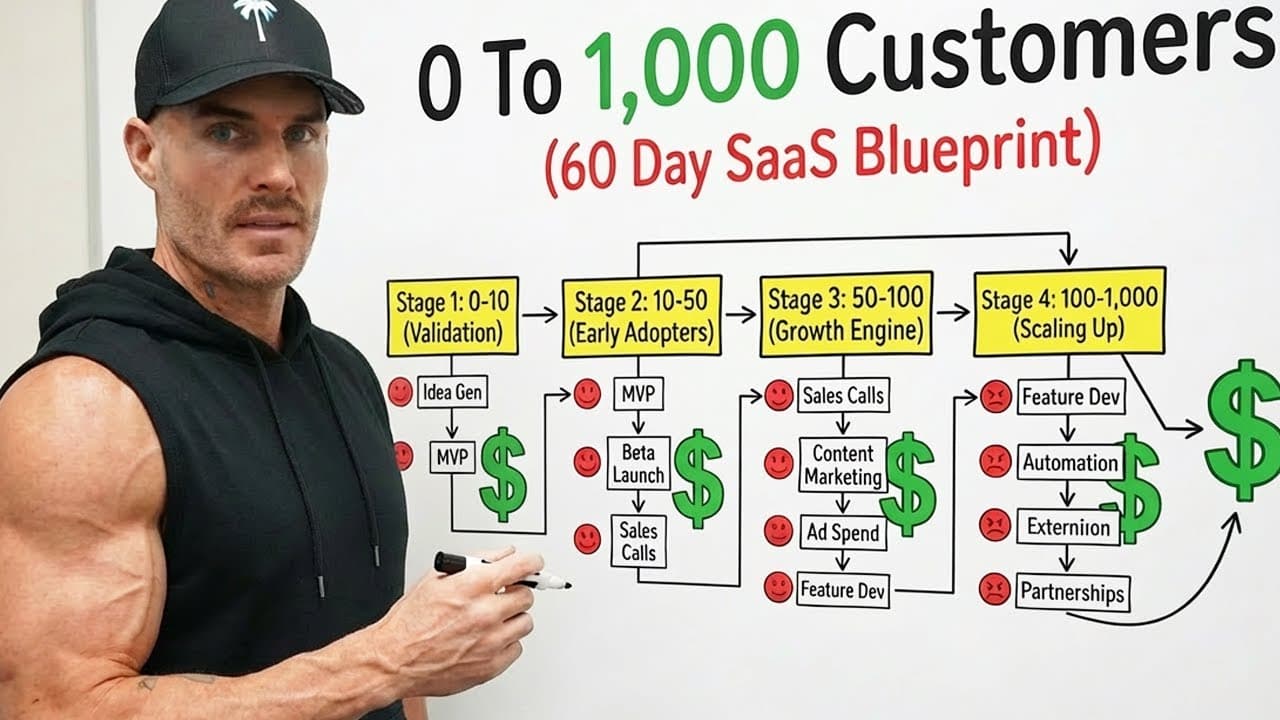
- SaaS growth occurs in distinct phases, including MVP validation, acquiring the first 10 customers, moving from 10 to roughly 30, marketing from 30 to 100, and building infrastructure before pursuing about 1,000 customers. Each phase requires a different operational focus.
- Customer milestones can be replaced by monthly recurring revenue goals, because the number of customers needed depends on the business model. A mass-market product may require tens of thousands of customers, while an enterprise product may generate substantial revenue from only a few hundred.
- MVP validation begins with defining a target customer and presenting a rough product concept before committing to full development. The concept can be vibe coded or simply drawn, provided it clearly shows the proposed solution to businesses experiencing the specific problem.
- Payment intent is stronger validation than general interest, because prospects are asked whether they would pay to solve the problem. The example sales conversation tested whether customers would pay $3,000 upfront for a product priced at $300 per month, without actually collecting payment.
- The first product should be rudimentary and limited to essential functionality, because its immediate purpose is to produce customer results rather than provide polished signup, billing, or interface features. The Hyros example initially connected opt-ins, payment information, and the originating advertisement.
- The first 10 customers should receive direct founder involvement, because this stage is intended to establish whether the product produces meaningful results. Revenue is not presented as the primary objective at this point, since evidence of successful outcomes is necessary before broader scaling.
- Customer results are the foundation of durable SaaS growth, because customers will not continue paying for years when the product fails to deliver value. Results must be established before the business invests heavily in repeatable acquisition, marketing, automated service, and larger-scale infrastructure.
Install to Summarize YouTube Videos and Get Transcripts
Explore YouTube Video Summarizer or Get YouTube Transcript Extractor
Questions & Answers
Q: How should a founder validate a SaaS idea before building it?
A founder should first identify the target customer and the specific problem the proposed SaaS product will solve. The founder can then vibe code, draw, or otherwise create a rough concept and show it to relevant businesses. Validation comes from asking whether those businesses would pay consistently for the solution, including whether they would prepay an annual subscription, before investing in full development.
Q: How can a SaaS founder test whether customers will actually pay?
A founder can simulate a straightforward sales conversation that describes the customer’s problem, presents the proposed solution, and asks for a concrete payment commitment. In the example, prospects were asked whether they would pay $3,000 upfront for an annual subscription to a product priced at $300 per month. No payment was collected, but affirmative responses provided evidence of purchase intent.
Q: Why should SaaS companies use different go-to-market strategies at each stage?
Different stages present different constraints. An unbuilt product needs demand validation, while a new product needs its first customers and proof that it delivers results. A company with more customers needs consistent acquisition and marketing, and a company approaching 100 customers needs infrastructure that serves people effectively without extensive manual work. Applying later-stage tactics too early can leave the underlying product poorly designed.
Q: What should a SaaS founder prioritize with the first 10 customers?
The founder should prioritize working directly with the first 10 customers and ensuring that the basic product delivers meaningful results. The immediate goal is not maximizing revenue or rapidly scaling acquisition. Close involvement allows the founder to understand how customers use the product, identify what prevents success, and establish the evidence needed to support retention and future growth.
Q: What should the first version of a SaaS product include?
The first version should include only the basic functionality required to solve the validated customer problem. It can be rudimentary, unattractive, and missing polished signup or billing systems. The initial Hyros product focused on tracking an opt-in, connecting that person to money received through a payment processor, and attributing the result back to the advertisement that generated the customer.
Q: Why are customer results essential for scaling SaaS?
Customer results are essential because SaaS companies depend on customers continuing to pay over long periods. If the product does not create useful outcomes, customers have no reason to keep their subscriptions. A company without proven results therefore lacks a reliable foundation for retention or expansion, even if it can initially attract customers through sales or marketing activity.
Q: When should a SaaS company begin building scalable infrastructure?
Scalable infrastructure becomes important as the company approaches roughly 100 customers and can no longer depend on the founder manually serving everyone. At that stage, systems must help customers obtain results without direct intervention for every account. The company should reach this point after validating the idea, building the basic product, acquiring early customers, and establishing a more consistent acquisition process.
Q: Should SaaS growth be measured by customer count or recurring revenue?
Customer count is useful for explaining growth stages, but monthly recurring revenue can be a more appropriate milestone because pricing and market structure vary. A mass-market product may need tens of thousands of customers to generate substantial revenue, while an enterprise product may need only a few hundred. The transcript suggests thinking in stages such as the first $10,000 in monthly recurring revenue through $1 million per month.
Summary & Key Takeaways
-
SaaS growth should be managed in distinct phases because the company’s priorities change as it gains customers. The progression begins with validating an idea, continues through acquiring and serving the first 10 customers, and later shifts toward consistent acquisition, marketing, scalable infrastructure, and growth to roughly 1,000 customers or an equivalent revenue goal.
-
During the MVP phase, founders should define the target customer, create a rough representation of the proposed product, and present it to businesses experiencing the identified problem. Asking whether prospects would pay, including whether they would prepay an annual subscription, provides stronger evidence of demand than building the complete product before speaking with customers.
-
The first product should provide only the basic functionality needed to produce the intended result. The first 10 customers are valuable because the founder can work with them directly, observe how the product performs, and improve it. Proven customer results create the foundation required for retention, repeatable acquisition, marketing, and subsequent scaling.
Read in Other Languages (beta)
Share This Summary 📚
Summarize YouTube Videos and Get Video Transcripts with 1-Click
Try YouTube Summary with ChatGPT & Claude or YouTube Transcript Generator
Explore More Summaries from Alex Becker Business 📚
![You'll HATE It, But It Will Make You Rich In A Year [Full Blueprint] thumbnail](/_next/image?url=https%3A%2F%2Fi.ytimg.com%2Fvi%2FVVPECdnzXSA%2Fhqdefault.jpg&w=750&q=75)
Summarize YouTube Videos and Get Video Transcripts with 1-Click
Try YouTube Summary with ChatGPT & Claude or YouTube Transcript Generator