How to Scale Meta Ads With a Stronger Offer
TL;DR
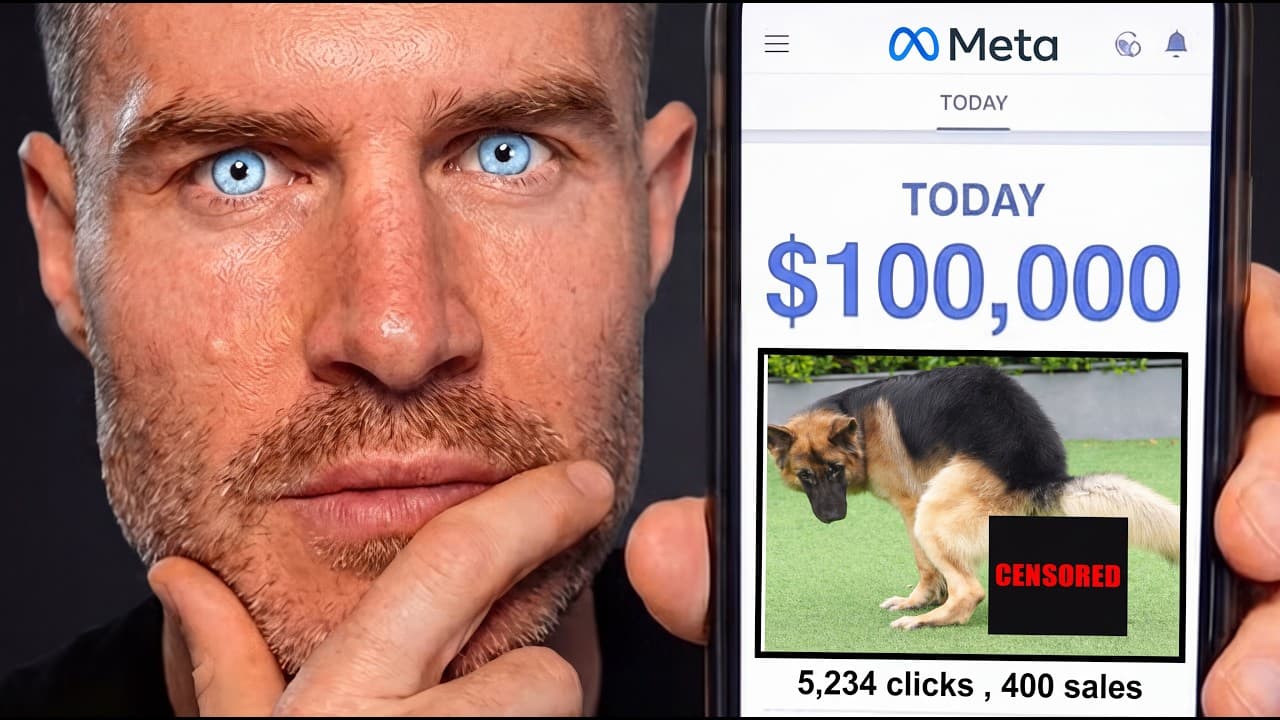
Build a cold-traffic offer that promises a clear, distinctive result with minimal customer effort, then guarantee and prove that outcome. The presenter argues that this offer structure matters more than sophisticated targeting or constant creative testing, and says it enabled his businesses to scale even when the ads and landing pages were simple.
Transcript
I SUCK DICK in terms of meta ads. I'm actually quite bad at that. Right there is what we call a pattern interrupt in the industry. That's your first lesson for today. Next ones are going to cost you. But look, meta ads. I kind of suck a big bag of ass at them. That's the last time I'm going to reference sucking anything in this video. By the way, g... Read More
Key Insights
- The central scaling mechanism is a compelling offer, not advanced work inside the advertising account. The presenter says an advertiser should be able to repeat the offer, show the resulting outcomes, and still produce conversions even with simple creative and imperfect landing pages.
- Cold traffic is fundamentally different from website traffic because cold viewers did not seek out the company or product. They may not know the seller, trust the business, or understand the category, so the offer must earn attention and communicate its value immediately.
- A scalable advertising offer promises a clear result with as little perceived customer effort as possible. The result should also sound meaningfully different from what competitors promise, because similar claims from many agencies or service providers become difficult for viewers to distinguish.
- Proof and guarantees reduce the skepticism surrounding a cold-traffic promise. In the Hyros example, the company first produced results for about 20 businesses, collected testimonials, and then supported its promised improvement with evidence and a results-based guarantee.
- Advertising should sell the desired outcome rather than merely describe the underlying product category. Hyros was positioned on its website as an attribution software company, but its ads focused on improving advertising returns rather than asking cold viewers to become interested in tracking itself.
- Reduced implementation effort can strengthen an offer because prospects may value an outcome without wanting another technical project. Hyros addressed this concern by offering to install the tracking for customers, making the promised advertising improvement feel easier to obtain.
- Simple advertisements can keep working when the underlying offer remains persuasive. The presenter says he used straightforward iPhone footage and repeated a similar camera-based ad for Hyros for six or seven years, rather than depending on constant production of elaborate new creative.
- Broad automated targeting reduces the importance the presenter assigns to detailed audience selection. He argues that advertisers can let the platform's AI operate broadly, while concentrating their strategic effort on structuring, guaranteeing, and proving an offer that cold prospects can understand quickly.
Install to Summarize YouTube Videos and Get Transcripts
Explore YouTube Video Summarizer or Get YouTube Transcript Extractor
Questions & Answers
Q: How do you structure an offer for cold Meta ads?
Structure the offer around one clear result that cold viewers already want. Present that result simply, make it feel achievable without substantial customer effort, and distinguish it from the similar promises made by competitors. Then guarantee the promised outcome and support it with proof, such as documented customer results or testimonials. The ad should be able to state the offer directly and show the evidence without requiring a complex explanation.
Q: Why does offer quality matter more than Meta ad tactics?
The presenter argues that targeting methods, large volumes of creative tests, and other changes inside the advertising account cannot compensate for an unconvincing offer. A strong offer gives the ad a direct message: it names the desired result, reduces perceived effort, provides proof, and limits customer risk through a guarantee. That structure allowed him to scale businesses despite using simple ads and landing pages he considered poor.
Q: How should cold-traffic ads differ from a company website?
A company website often serves visitors who already recognize the business, understand the product, or intentionally searched for the category. Cold-traffic viewers have not shown that intent. They may not know the company, believe its claims, or want to spend time learning technical details. Cold ads should therefore lead with a simple, results-focused offer instead of reproducing the company's ordinary website positioning or linking viewers to a generic offer.
Q: What makes an advertising offer clear and distinctive?
A clear and distinctive offer identifies a specific result, explains that the customer can obtain it with limited effort, and avoids sounding like every competing advertisement. The presenter summarizes the required components as results, reduced effort, uniqueness, a guarantee, and proof. Each element addresses a cold viewer's limited attention or skepticism, making the proposition easier to understand and more credible when encountered unexpectedly on an advertising platform.
Q: How did Hyros turn tracking into a stronger ad offer?
Hyros did not lead its cold advertising with a general promise of better tracking, even though attribution was the product being sold. It presented its tracking method as new technology and connected it to a result advertisers cared about: better advertising returns. The company promised improved ad return or no payment, supported that promise with outcomes from about 20 businesses, collected testimonials, and offered to perform the setup.
Q: Why are guarantees and proof important in Meta ads?
Cold viewers do not necessarily know the seller or believe the advertised promise, so a claim alone may not overcome their skepticism. A guarantee reduces the perceived financial risk, while proof demonstrates that the promised result has occurred for actual businesses. In the Hyros example, the company gathered results from about 20 businesses before using their testimonials and offering a results-based guarantee in its advertising proposition.
Q: Can simple Meta ads scale a business effectively?
Simple Meta ads can scale when they communicate a strong offer and demonstrate the promised result, according to the presenter. He describes using iPhone footage, speaking directly to the camera, and repeating a similar Hyros advertisement for six or seven years. His broader claim is that polished creative cannot replace offer quality, while an effective proposition can continue converting even when the advertisement and landing page are relatively basic.
Q: What should advertisers prioritize when Meta ads stop scaling?
Advertisers should first reconsider how the offer is structured for cold traffic rather than focusing only on targeting, creative volume, or account adjustments. The presenter recommends identifying the result prospects want, expressing it in the clearest possible terms, minimizing the effort required to receive it, and making it different from competing claims. The revised offer should then include credible proof and a guarantee that reduces the prospect's risk.
Summary & Key Takeaways
-
The presenter attributes his Meta ads success to offer design rather than advanced account management. His central claim is that advertisers should create an offer strong enough to convert when an ad simply states the promised result and shows evidence, reducing dependence on sophisticated creative production, targeting tactics, or polished landing pages.
-
Cold audiences differ from people who intentionally visit a company website. They are interrupted, unfamiliar with the seller, skeptical of the claims, and surrounded by distractions. Advertising offers must therefore communicate one clear result immediately, minimize the effort required from customers, and distinguish themselves from competing offers that sound similar.
-
The Hyros example turns tracking from a technical product into a results-focused offer. Instead of advertising better attribution, the company promised better advertising return or no payment, supported the claim with results from about 20 businesses, and offered to handle setup. This combined clarity, uniqueness, proof, a guarantee, and reduced effort.
Read in Other Languages (beta)
Share This Summary 📚
Summarize YouTube Videos and Get Video Transcripts with 1-Click
Try YouTube Summary with ChatGPT & Claude or YouTube Transcript Generator
Explore More Summaries from Alex Becker Business 📚
Summarize YouTube Videos and Get Video Transcripts with 1-Click
Try YouTube Summary with ChatGPT & Claude or YouTube Transcript Generator