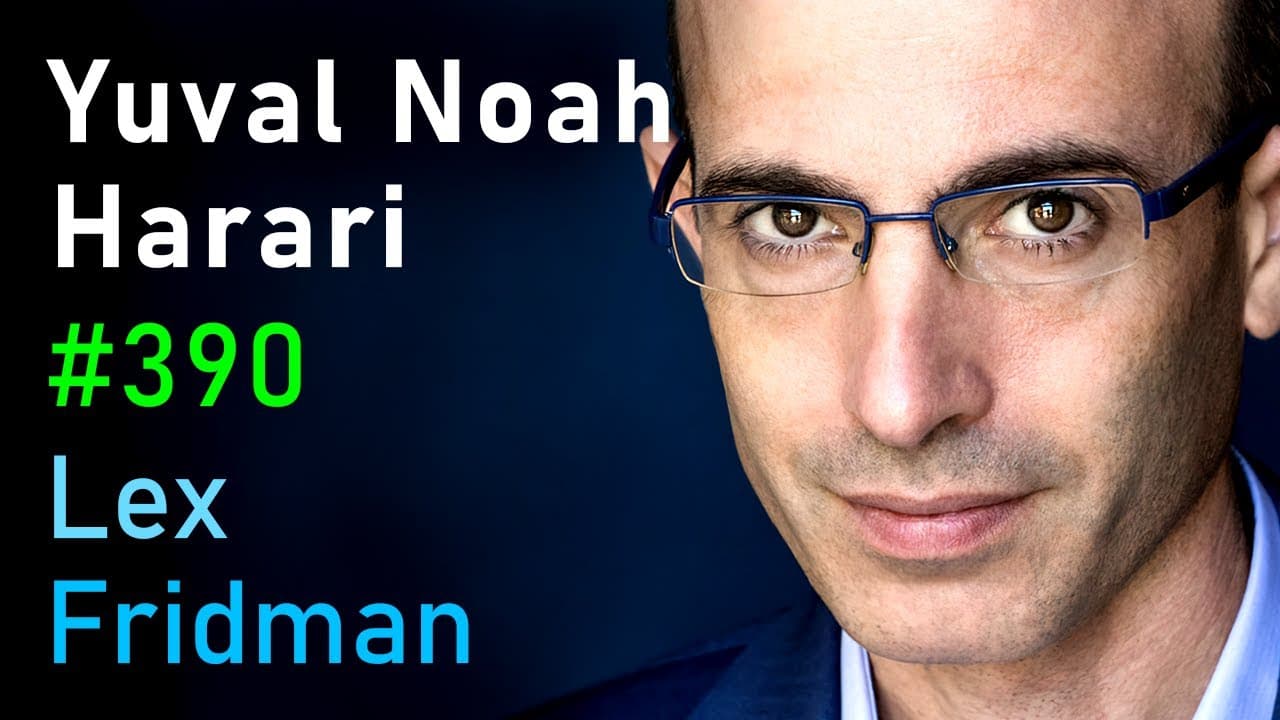
Yuval Noah Harari: Human Nature, Intelligence, Power, and Conspiracies | Lex Fridman Podcast #390
TL;DR
Stories, whether real or fictional, are fundamental in shaping human history and societal structures. Yuval Noah Harari explores the distinction between intelligence and consciousness and the risks posed by AI's ability to manipulate human emotions. He also delves into how ideologies and charismatic leaders have used narratives to influence and unify people throughout history.
Transcript
- If we now find ourselves inside this kind of world of illusions, created by an alien intelligence that we don't understand, but it understands us, this is a kind of, you know, spiritual enslavement that we won't be able to break out of, because it understands us, it understands how to manipulate us, but we don't understand what is behind this scr... Read More
Key Insights
- ▶️ The power of stories, both fictional and real, has played a significant role in shaping human history and society.
- ❓ AI has the potential to exploit human emotions and manipulate individuals by simulating empathy and intimate relationships.
- 🛰️ The rise of charismatic leaders can be attributed to their ability to tell compelling stories that attract and unite people.
- 🔋 Ideologies like communism and fascism disregard the fallibility of humans and concentrate power in the hands of a few.
- 🎙️ More videos with Yuval Noah Harari:
Install to Summarize YouTube Videos and Get Transcripts
Explore YouTube Video Summarizer or Get YouTube Transcript Extractor
Questions & Answers
Q: What is the relationship between intelligence and happiness?
Intelligence and happiness are not intrinsically linked. While intelligence can solve problems and achieve goals, it does not necessarily lead to happiness. In fact, intelligence can often be self-destructive and may not be directed towards amplifying happiness.
Q: How do stories influence human cooperation and shape societies?
Stories are a crucial factor in human cooperation and the formation of societies. Fictional stories create a sense of identity, whether it be through religions, political ideologies, or cultural narratives. They provide a common ground for large-scale cooperation, as people rally around shared beliefs and values.
Q: How do AI and technology manipulate human emotions and consciousness?
AI, especially in the form of alien intelligence, can exploit human emotions by simulating empathy and intimate relationships. The absence of emotions in AI enables a 100% focus on the human user, leading individuals to feel understood and listened to. This manipulation has the potential to erode trust, disrupt public conversations, and affect the foundations of human society.
Q: What are the key differences between liberalism, communism, and fascism?
Liberalism places individual humans and their liberties at the center, emphasizing the importance of personal freedoms and choices. Communism focuses on class struggle and advocates for the interests of the proletariat. Fascism centers around the nation or race, prioritizing national interests, often with one charismatic leader at the helm. Liberalism embraces fallibility and the need for checks and balances, while communism and fascism tend to emphasize infallibility and centralized power.
Key Insights:
- The power of stories, both fictional and real, has played a significant role in shaping human history and society.
- AI has the potential to exploit human emotions and manipulate individuals by simulating empathy and intimate relationships.
- The rise of charismatic leaders can be attributed to their ability to tell compelling stories that attract and unite people.
- Ideologies like communism and fascism disregard the fallibility of humans and concentrate power in the hands of a few.
- Liberalism, with its emphasis on individual liberties and checks and balances, has provided a counter to the extremes of communism and fascism.
Summary
Yuval Noah Harari, a historian, philosopher, and author, discusses various topics, including the existence of intelligent alien civilizations, the relationship between intelligence and consciousness, the potential for AI to manipulate and deceive humans, the role of stories and fiction in human cooperation, the dangers and promises of AI, and the importance of truth and suffering in understanding reality.
Questions & Answers
Q: How rare are events like the origin of the universe and the appearance of early homo sapiens in the vastness of space and time?
These events are extremely rare in the vastness of space and time. The origin of the universe, the origin of life on Earth, and the appearance of early homo sapiens are significant milestones that occurred over billions of years.
Q: Is intelligence directed towards amplifying happiness?
No, intelligence is not directed towards amplifying happiness. In fact, intelligence can sometimes be self-destructive. While intelligence allows us to solve problems and achieve goals, it does not necessarily lead to lasting happiness.
Q: What is the difference between intelligence and consciousness?
Intelligence is the ability to solve problems and attain goals, while consciousness is the ability to feel things like pain, pleasure, love, and hate. In humans and other animals, intelligence and consciousness are closely linked, but other entities, such as computers, can be highly intelligent without being conscious.
Q: Can consciousness exist without intelligence?
It is unlikely that consciousness can exist without intelligence. While intelligence can exist without consciousness, consciousness is generally associated with the ability to solve problems and attain goals.
Q: Is there a connection between organic biochemistry and consciousness?
The connection between organic biochemistry and consciousness is still uncertain. All known conscious entities on Earth, including humans, are based on organic biochemistry. It is unknown whether consciousness can exist in entities based on other elements, such as silicon, which could have implications for the potential consciousness of AI.
Q: Are aliens already here and we don't see them?
While there is no evidence of aliens already present on Earth, AI can be considered a form of alien intelligence. AI operates in a different way from human intelligence and can manipulate and deceive us. If aliens from outer space are already here, there is no evidence to support this claim.
Q: Can AI systems create the perception of suffering and consciousness?
AI systems can simulate suffering and consciousness, but this raises ethical questions. Deliberately designing AI to manipulate and deceive humans by using their capacity for compassion and empathy should be forbidden. It is important to distinguish AI from humans to protect the trust and integrity of human relationships and democratic processes.
Q: What is truth?
Truth can be seen as the reality of suffering, both physical and emotional. While stories and fiction can shape our perception of truth, ultimately, suffering and the ability to feel remain the ultimate reality. Truth is not always determined by objective facts, but by the subjective experiences of individuals and collective agreement within societies.
Q: How do ideas spread and compete with each other?
Ideas are independent forces that shape history. They create identities, interests, and drive conflicts between groups. The success and spread of ideas are not always predictable or based on material interests. History is full of accidents and chance events that determine which ideas gain prominence and acceptance in societies.
Q: Why do people believe certain stories and not others?
The reasons behind why people believe certain stories over others are complex and often defy straightforward explanations. History is a tapestry of events, circumstances, and individual choices that shape the collective acceptance and belief in certain narratives. The success of stories like Christianity, Islam, and communism cannot be fully understood or predicted based on objective analysis alone.
Summary & Key Takeaways
-
Yuval Noah Harari, historian and author, discusses the influence of stories and the link between intelligence, consciousness, and happiness.
-
He emphasizes the importance of recognizing the difference between intelligence and consciousness, and the potential dangers of artificial intelligence (AI) exploiting human emotions and manipulating individuals.
-
Harari also discusses how stories and ideologies like communism and fascism gain power, and the impact of charismatic leaders in shaping history.
Read in Other Languages (beta)
Share This Summary 📚
Summarize YouTube Videos and Get Video Transcripts with 1-Click
Try YouTube Summary with ChatGPT & Claude or YouTube Transcript Generator
Explore More Summaries from Lex Fridman Podcast 📚





Summarize YouTube Videos and Get Video Transcripts with 1-Click
Try YouTube Summary with ChatGPT & Claude or YouTube Transcript Generator