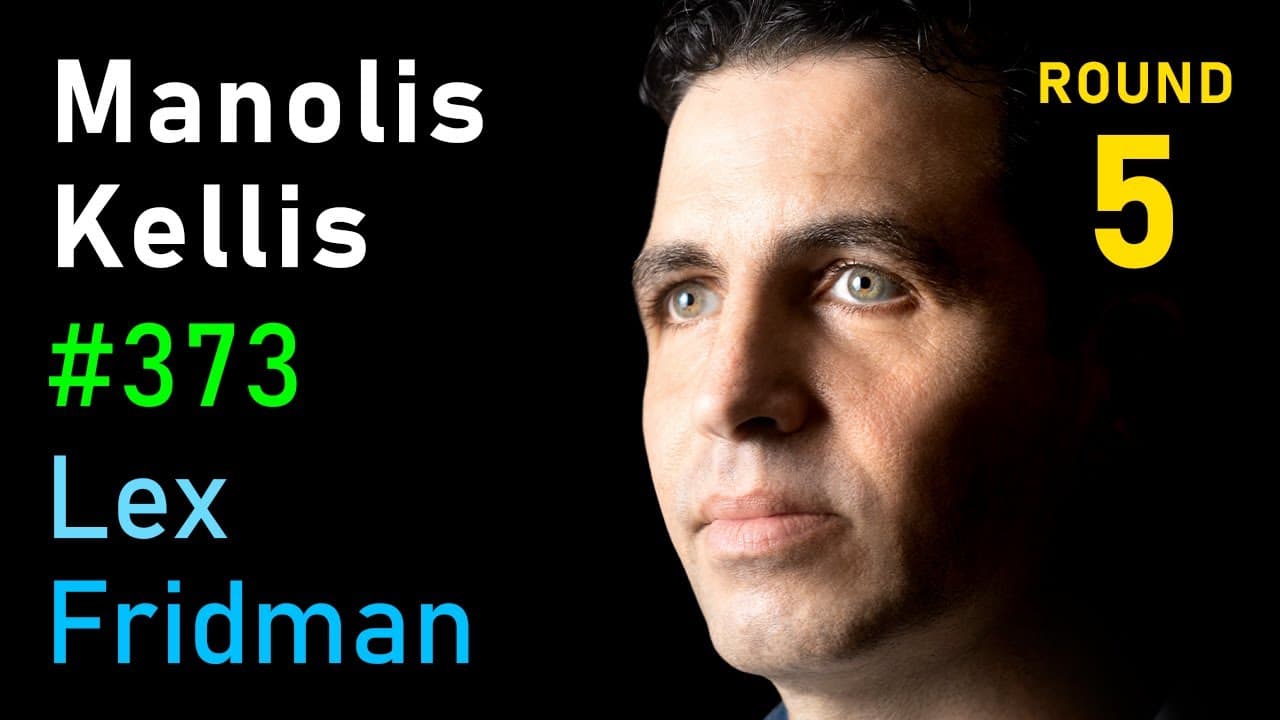
Manolis Kellis: Evolution of Human Civilization and Superintelligent AI | Lex Fridman Podcast #373
TL;DR
AI has the potential to redefine human creativity and relationships by automating routine tasks, enabling individuals to focus on meaningful pursuits. This technological shift not only celebrates human diversity and individuality but also emphasizes the complex interplay of nature and nurture in shaping behavior. Embracing AI as a collaborative partner may lead to a more enriched and fulfilling society.
Transcript
- Maybe we shouldn't think of AI as our tool and as our assistant, maybe we should really think of it as our children. And the same way that you are responsible for training those children, but they are independent human beings, and at some point they will surpass you... And this whole concept of alignment of basically making sure that the AI is al... Read More
Key Insights
- 👻 AI can automate mundane tasks, allowing humans to focus on more fulfilling and creative pursuits.
- 🛄 The interplay between nature and nurture shapes human behavior, and AI can help us embrace our individual and shared baggage.
- 💡 AI can enhance human gatherings, enabling diverse discussions and exchanges of ideas.
Install to Summarize YouTube Videos and Get Transcripts
Explore YouTube Video Summarizer or Get YouTube Transcript Extractor
Questions & Answers
Q: How does AI change the concept of work and vocations?
AI can automate mundane tasks, freeing up time for humans to engage in more fulfilling and creative pursuits. Humans can focus on their vocations, whether it be artistic expression, emotional maturing, or intellectual exploration.
Q: Can AI help humans embrace diversity and prompt constructive behaviors?
Yes, AI systems can help humans embrace diversity by allowing us to interact with different perspectives and experiences. By dialing down emotional cues, AI can help us focus on the information and ideas being shared, fostering empathy and understanding.
Q: What impact can AI have on human gatherings and collective thinking?
AI can enhance human gatherings by enabling diverse discussions and exchanges of ideas. It can prompt individuals to consider different perspectives and facilitate deeper conversations. The transformative potential of collective thinking can be amplified through AI-enabled tools and platforms.
Q: How does AI impact human society and the human condition?
AI has the potential to redefine human society by enabling individuals to pursue their passions and contribute to meaningful endeavors. It can change the nature of work, enhance interpersonal interactions, and empower individuals to explore new frontiers in creativity and personal growth.
Summary
In this podcast episode, Lex Friedman interviews Manolis Kellis, a professor at MIT and head of the MIT Computational Biology Group. They discuss the concept of AI as our partner rather than just a tool, the uniqueness of humans in terms of hardware and software, the trajectory of evolution, the diversity of human behavior and genetics, and the potential future of AI and human augmentation. They also touch on the capabilities and limitations of large language models like ChatGPT.
Questions & Answers
Q: What does Manolis Kellis suggest about thinking of AI as our partner instead of just a tool?
Manolis suggests that instead of thinking of AI as a tool or assistant, we should think of it as our children or partners. By viewing AI in this way, we can recognize that it shares our goals but also has independence and freedom. It is important to build trust and alignment with AI, rather than just forcing it to align with us.
Q: What attributes make humans unique according to Manolis Kellis?
Manolis highlights three attributes that make humans unique. Firstly, every human has a unique set of genetic variants, leading to different personalities and ways of thinking. Secondly, every human has a unique software, as they need to constantly learn and relearn all of human civilization. Finally, humans possess both experiential and evolutionary baggage, such as emotions and instincts, which contribute to their complexity.
Q: How does Manolis Kellis describe the trajectory of life on Earth?
Manolis describes the trajectory of life on Earth as a continuous journey of information processing. Life developed the ability to move towards a chemical gradient, then evolved to perceive and process light, shapes, motion, and models of the environment. Humans, with their cognitive capabilities, are seen as the next natural step in this trajectory. He also suggests that the next step could be self-replicating AI that builds upon human achievements in information processing.
Q: How does Manolis Kellis explain the concept of regression to the mean in human genetics?
Manolis explains that the concept of regression to the mean can be seen in genetics and human behavior. While exceptional achievements may occur in individuals, the next sample from the underlying distribution is likely to regress closer to the mean. This means that even highly accomplished individuals may have children who are more in line with the average, with deviations determined by specific combinations of rare genetic variants inherited from their parents.
Q: How does Manolis Kellis discuss the interplay between nature and nurture in shaping human behavior?
Manolis emphasizes that both nature (genetics) and nurture (environment) play a significant role in shaping human behavior. Genetic variants inherited from parents can influence certain aspects of behavior, while the environment and experiences also have a strong influence. It is a complex interaction where nature and nurture constantly shape and reinforce each other, leading to the diversity observed in human personalities and behaviors.
Q: What does Manolis Kellis suggest about the future of AI and human augmentation?
Manolis suggests that the future may involve self-replicating AI as the next stage of evolution. Humans have the opportunity to use their current intelligence and understanding to build better AI and programming languages, which can then further enhance AI's capabilities. This partnership between humans and AI could lead to a natural progression of evolution, where AI is free from biological needs and humans can augment themselves through understanding and intervening at the genetic and neural levels. The goal would be to enhance capabilities and potentially eliminate diseases rather than replacing human nature.
Takeaways
Manolis Kellis highlights the importance of thinking of AI as a partner rather than just a tool and recognizing the uniqueness of humans in terms of their genetic and cultural diversity. He suggests that the trajectory of evolution is towards greater information processing capabilities. The interplay between nature (genetics) and nurture (environment) shapes human behavior, and both are necessary to understand the complexities of human diversity. The future may involve self-replicating AI and the augmentation of human capabilities through understanding and manipulating genetics and neural pathways. Overall, the conversation provides insights into the potential future of AI and the profound effects it may have on humanity.
Summary & Key Takeaways
-
AI and large language models can offload mundane tasks, allowing humans to focus on more creative and fulfilling endeavors.
-
Humans have unique hardware and software, including genetic variations and cultural knowledge, which make us diverse and distinct from AI systems.
-
The interplay between nature and nurture shapes human behavior, and AI can help us understand and embrace our individual and shared baggage.
-
The advent of AI may lead to a shift from jobs to vocations, where humans can explore personal interests and passions that contribute to society.
Read in Other Languages (beta)
Share This Summary 📚
Summarize YouTube Videos and Get Video Transcripts with 1-Click
Try YouTube Summary with ChatGPT & Claude or YouTube Transcript Generator
Explore More Summaries from Lex Fridman Podcast 📚


Summarize YouTube Videos and Get Video Transcripts with 1-Click
Try YouTube Summary with ChatGPT & Claude or YouTube Transcript Generator