What Are the Rules for Resistors in Series and Parallel?
TL;DR
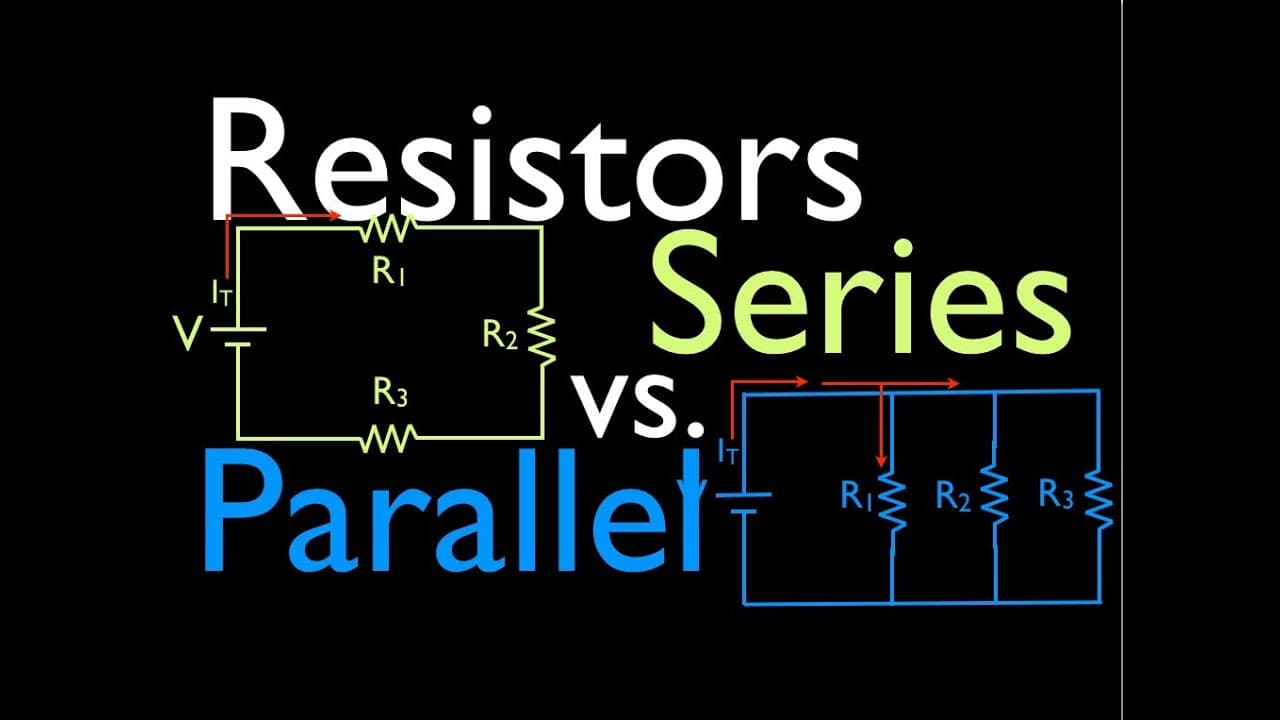
The rules for resistors state that in series circuits, the total voltage is the sum of voltage drops across each resistor, while in parallel circuits, each resistor has the same voltage drop as the source. Additionally, current remains constant in series, but splits among branches in parallel, and equivalent resistance is calculated by simply adding resistances in series and using a specific formula in parallel.
Transcript
okay in today's video I'm going to go over the rules concerning resistors in series and resistors in parallel these are the two series diagrams we're going to use excuse me the two circuit diagrams we're going to use on left-hand side we have our resistors in series and on the right side we have our resistors in parallel I'm going to go over the ru... Read More
Key Insights
- ⚡ Voltage rule: In series, battery voltage equals sum of resistor drops; in parallel, each resistor has equal voltage.
- ❓ Current behavior: In series, current remains the same throughout the circuit; in parallel, it splits among branches.
- 🪜 Equivalent resistance: Series resistors add up their resistances; parallel resistors utilize a more complex equation.
Install to Summarize YouTube Videos and Get Transcripts
Explore YouTube Video Summarizer or Get YouTube Transcript Extractor
Questions & Answers
Q: What is the voltage rule for resistors in series?
The voltage rule in series circuits states that the battery voltage equals the total sum of all resistor voltage drops, showing energy distribution throughout the circuit.
Q: How does current behave in parallel resistor circuits?
In parallel circuits, current splits among branches, with each resistor receiving a portion of the total current flowing from the battery.
Q: How do you calculate equivalent resistance in series circuits?
The equivalent resistance in series circuits is found by adding up the individual resistances of each resistor in the circuit.
Q: Can Ohm's law be applied to both series and parallel resistor circuits?
Yes, Ohm's law, V=IR, can be used in both series and parallel circuits to calculate voltage, current, and resistance.
Summary & Key Takeaways
-
Resistors in series: Voltage rule states the battery voltage equals the sum of resistor voltage drops.
-
Resistors in parallel: Each resistor has equal voltage drop as the battery voltage.
-
Current: In series, current is the same throughout; in parallel, it splits among branches.
Read in Other Languages (beta)
Share This Summary 📚
Summarize YouTube Videos and Get Video Transcripts with 1-Click
Try YouTube Summary with ChatGPT & Claude or YouTube Transcript Generator
Explore More Summaries from Step by Step Science 📚

Summarize YouTube Videos and Get Video Transcripts with 1-Click
Try YouTube Summary with ChatGPT & Claude or YouTube Transcript Generator