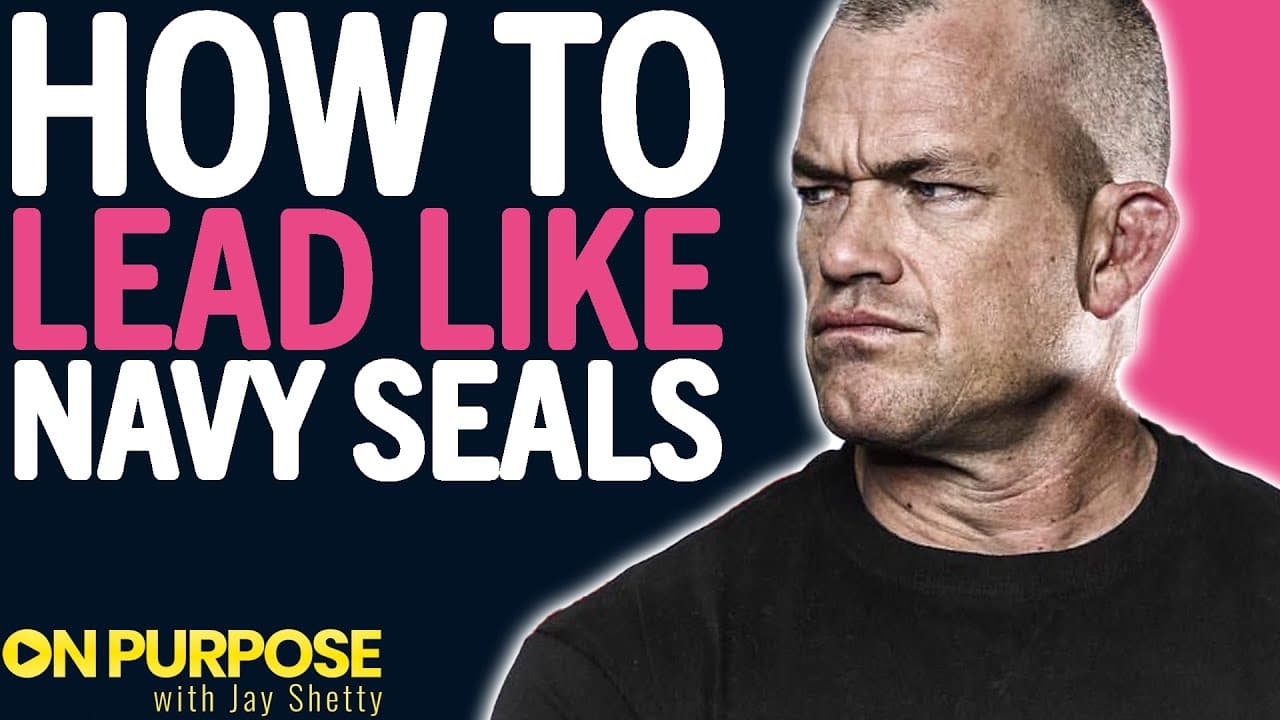
Jocko Willink ON: Leading Like a Navy Seal & Taking Extreme Ownership of Every Problem in Your Life
TL;DR
Discipline beats procrastination: when the alarm goes off, Jocko Willink turns his brain off, skips the internal debate, and does what he is supposed to do, because hesitation brings regret hours later. The retired Navy SEAL officer also says leaders are both born and made, and that losing friends in combat was the hardest thing he has faced.
Transcript
if you're saying okay when my alarm clock goes off in the morning i hit the snooze button three or four times i don't want to start my day i don't want to go face that hard workout and that kind of procrastination that kind of overthinking and having a debate in your own head in those situations i just turn my brain off and i do what i'm supposed t... Read More
Key Insights
- Discipline is Jocko Willink's answer to procrastination and overthinking. Instead of debating whether to hit snooze or skip a hard workout, he turns his brain off, acts immediately, and avoids the regret of a wasted morning two or three hours later.
- Losing friends in combat is the hardest thing Willink says he has ever been through. He calls it soul-crushing, yet the mission had to continue because the war does not end when you lose people you care about.
- No guidance existed at Willink's SEAL team for handling a combat death. When Mark Lee was killed in 2006, there were notification protocols, but no one had taught what to do emotionally, so Willink had to figure it out himself.
- Returning to the mission was Willink's response to loss. His team stood down for a couple of days to mourn and celebrate Mark Lee's life, then went back to work, which he believed Mark would have wanted.
- Full grieving often comes later than the immediate response. Willink says processing the loss of a friend takes more than a couple of days, and for him it happened months later, once he was back in America.
- Every person's problem is the biggest emergency in their own world. Willink learned this from his child's school problem and avoids looking down on situations that seem less extreme than combat.
- Leaders in business carry real pressure even when lives are not at stake. Willink notes that livelihoods depend on decisions made by leaders responsible for hundreds or thousands of people.
- Leaders are both born and made, according to Willink. No one is born with every leadership trait; people vary in qualities like articulation, simplifying problems, charisma, and even having a voice loud enough to carry over gunfire.
Install to Summarize YouTube Videos and Get Transcripts
Explore YouTube Video Summarizer or Get YouTube Transcript Extractor
Questions & Answers
Q: How does Jocko Willink beat procrastination?
Jocko Willink deals with procrastination by refusing to debate with himself. If the alarm goes off and he feels like hitting snooze or avoiding a hard workout, he turns his brain off and does what he is supposed to do. He relies on discipline and acts immediately, because he knows hesitation will bring regret two or three hours later when he realizes he wasted his morning.
Q: What is the hardest thing Jocko Willink has ever done?
Jocko Willink says the most difficult thing he has been through is losing friends in combat. He describes it as completely jarring and soul-crushing. At the same time, he explains that the mission must continue, because the war does not stop when you lose people. He calls it far and away the hardest experience of his life, mentally or physically.
Q: How did Jocko Willink lead his team after a SEAL was killed in combat?
When Mark Lee was killed in 2006, Willink's team had never had a SEAL killed in action, so there was no guidance for the emotional side beyond notification protocols. He stood the team down for a couple of days to mourn Mark and celebrate his life. Then he told them to get their gear on and execute the mission, which he believed Mark would have wanted.
Q: When should you process grief if you have to keep working?
Willink's experience suggests that immediate duties can come first while full grieving happens later. His team took a couple of days to mourn before returning to the mission, but he acknowledges that processing the loss of a close friend takes much longer. For him, proper grieving happened months later, after he returned to America and finally had the time.
Q: How do you show empathy when others' problems seem small compared to yours?
Willink learned that what people are going through is their whole world. After a hard day involving combat deaths, his child brought up a school problem, and he briefly thought it did not matter. He then realized that whatever happens to someone feels like the biggest emergency in the world to them, so he tries to see other perspectives and not look down on less extreme situations.
Q: Why do lessons from combat apply to business leadership?
Willink works with leaders who oversee hundreds or thousands of people. He points out that while lives are not at stake in most companies, livelihoods are, because employees earn their money from the leader's decisions. That creates real pressure. He passes on lessons from extreme combat situations because he believes they apply to circumstances that may not look as extreme on the surface.
Q: Are leaders born or made?
Jocko Willink says the answer is absolutely both. Some people have natural characteristics that help in leadership, while others lack some of them, and no one is born with every perfect trait. Useful qualities he lists include being articulate, being good at simplifying problems, and being charismatic. People have each of these to a greater or lesser degree than others, and can work on the gaps.
Q: Why does a loud voice matter for a combat leader?
Willink explains that in a gunfight a leader must communicate over gunfire, so a voice that projects matters, even if it sounds trivial. He describes a smart, tactically sound, athletic trainee in advanced SEAL training whose voice would not carry. Willink told him that a good call does not help if no one can hear it, and warned that it could threaten his ability to do the job.
Summary
In this interview, Jocko Willink, a retired Navy SEAL officer, author, and podcaster, discusses his experiences in combat, leadership, and discipline. He shares insights on overcoming difficult situations, building trust, and taking extreme ownership.
Questions & Answers
Q: What is the most difficult thing you think you've ever done mentally or physically?
The most difficult thing for me was losing friends in combat. It was soul-crushing, but I had to continue with the mission.
Q: How did you deal with the loss of friends in combat?
There were no protocols on how to handle such situations. We mourned the loss, celebrated their lives, and then I got in front of the team and told them we had to continue with the mission, as that's what our fallen friends would have wanted.
Q: How did you manage compassion and empathy as a leader, considering your extreme experiences?
I learned to see things from other people's perspectives and not look down on their situations. I pass on the lessons I learned from extreme situations because they apply to less extreme scenarios as well.
Q: Were you always a natural leader, or did you become one through experience?
I had a proclivity for leadership, but leadership is both innate and learned. Some people have natural characteristics that are great for leadership, but everyone can improve their leadership skills through practice and learning.
Q: How did you handle comparison and competition within your teams?
Not everyone had the open-mindedness to put their egos in check. During my SEAL training, we had a mutiny against an arrogant leader, and a humble replacement changed the dynamic. Being humble as a leader can make a big difference in building trust and collaboration within a team.
Q: How did you build trust in high-stress environments?
Trust, listening, influence, and respect are interconnected. If you want someone to trust you, you need to trust them first. I built trust by giving my team responsibilities and allowing them to execute plans, even when mistakes happened. We learned and improved together.
Q: What was the biggest mistake you made in leadership, and how did you handle it?
I had a friendly fire incident for which I took full responsibility. It was a terrible situation, but I learned the importance of extreme ownership. I accepted the blame, identified the mistakes, and implemented solutions to ensure it never happened again.
Q: How can people practice extreme ownership without destroying their self-esteem?
Extreme ownership propels you forward instead of holding you back. Taking ownership allows you to identify and fix your own mistakes, leading to personal growth and improvement.
Q: How can individuals apply extreme ownership in a workplace setting?
Instead of blaming others, take ownership of your actions and seek feedback and critiques. Use that feedback to make adjustments and improve your performance. By taking ownership, you have more control over your own destiny.
Q: How can people handle criticism from those they don't respect or like?
Put your ego and emotions aside, listen to what others have to say, and apply the feedback without bias. It's also crucial to differentiate between valid criticism and personal attacks. By doing so, you can grow and improve as a person.
Takeaways
Taking extreme ownership means holding yourself accountable and taking responsibility for your actions and outcomes. It requires humility, the ability to listen and learn from others, and the willingness to make necessary changes to improve. By practicing extreme ownership, individuals can overcome challenges, build trust, and achieve personal and professional growth.
Summary & Key Takeaways
-
Jocko Willink, a retired Navy SEAL officer who served 20 years, co-wrote Extreme Ownership and co-founded Echelon Front to teach leadership. On Jay Shetty's On Purpose podcast he discusses discipline, ownership, trust, collaborative culture, and how lessons from extreme combat situations apply to work and everyday life.
-
Willink names losing friends in combat as the hardest thing he has experienced. After Mark Lee died in 2006, with no protocol for the emotional side, he gave his team a couple of days to mourn, then led them back to the mission, grieving fully months later.
-
Willink rejects ranking suffering by extremity. A child's school problem taught him that whatever happens in someone's world feels like the biggest emergency. He believes leaders are both born and made, and that discipline, not internal debate, is the way past procrastination and overthinking.
Read in Other Languages (beta)
Share This Summary 📚
Summarize YouTube Videos and Get Video Transcripts with 1-Click
Try YouTube Summary with ChatGPT & Claude or YouTube Transcript Generator
Explore More Summaries from Success Habits 📚




Summarize YouTube Videos and Get Video Transcripts with 1-Click
Try YouTube Summary with ChatGPT & Claude or YouTube Transcript Generator