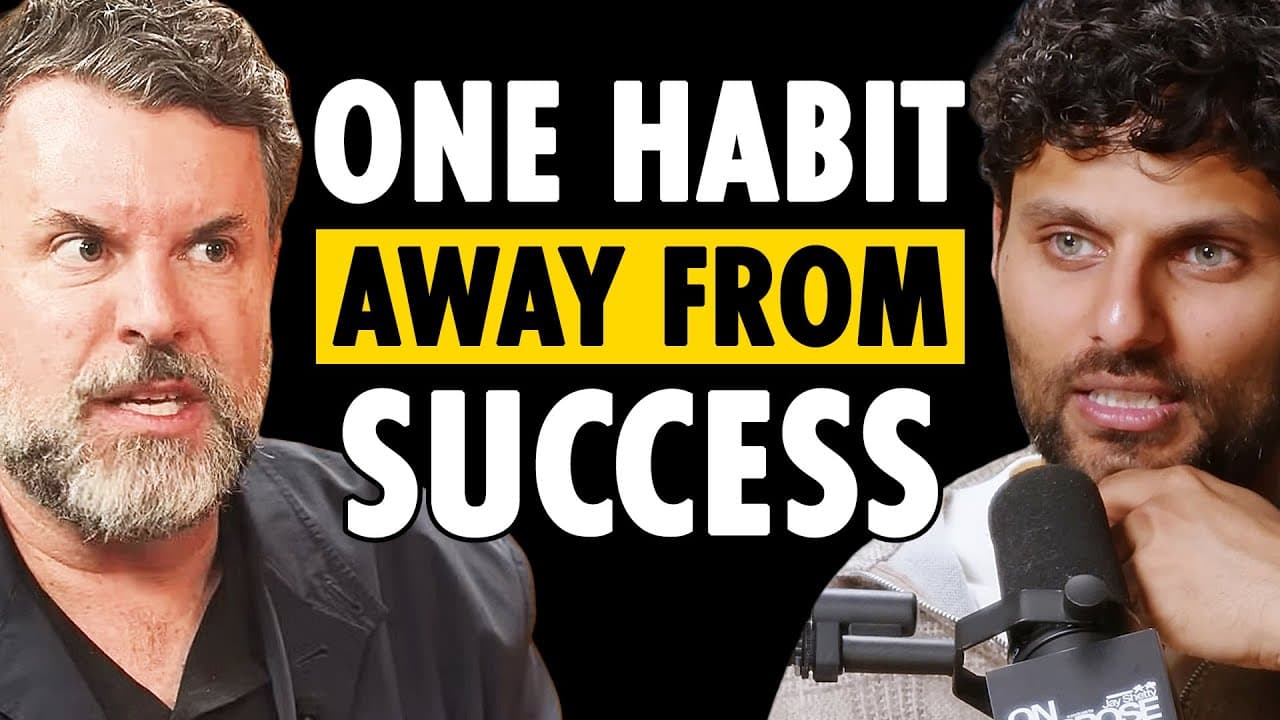
How To BREAK BAD HABITS & Get 1% Better EVERYDAY | Charles Duhigg
TL;DR
Every habit runs on a three-part loop: a cue that triggers the behavior, the routine itself, and a reward your brain latches onto. To build a habit, pair an obvious cue with a genuine reward you let yourself enjoy. Blaming or punishing yourself backfires because your brain notices the negativity and resists making the behavior easier.
Transcript
should i get out of bed should i make this decision should i eat this thing should i exercise all those questions become much easier because now our goal is well-being getting out of bed it's not about whether getting out of bed makes you happy if you don't get out of bed you're not gonna have a relationship with your wife you're not gonna earn mon... Read More
Key Insights
- Every habit is actually three things: a cue that triggers an automatic behavior, the routine that is the behavior itself, and a reward. We tend to think of only the routine as the habit, but all three parts work together.
- The basal ganglia is the part of the brain that looks for rewards and tries to turn any pattern into a habit. When it detects a reward, it works to make that behavior easier and easier to repeat.
- An obvious cue makes habits more likely to form. Studies show people who put running shoes next to their bed or plan to meet a friend at the gym every Wednesday are more likely to actually exercise.
- Rewards are what convert a repeated behavior into a real habit. A long shower, a smoothie, or marking a calendar after exercising signals the brain to make that behavior easier over time.
- Self-blame, guilt, and punishment actively sabotage habit formation. The brain pays attention to negativity, so when it notices punishment, it decides the behavior is a terrible idea and refuses to make it easier.
- Many people accidentally punish themselves for exercising. A rushed, chaotic morning after a run teaches the brain that running makes the rest of the day a nightmare, so it resists building the exercise habit.
- The military is essentially a giant habit-change machine. It overrides instincts, like the urge to run when shot at, by teaching formulaic habits broken into distinct components soldiers learn to think about.
- Shifting the goal from chasing pleasure to chasing well-being makes daily decisions easier. Getting out of bed becomes simpler when framed around relationships, earning money, and meaning rather than momentary happiness.
Install to Summarize YouTube Videos and Get Transcripts
Explore YouTube Video Summarizer or Get YouTube Transcript Extractor
Questions & Answers
Q: What are the three parts of a habit?
Every habit is made of three components. First is the cue, a trigger that starts an automatic behavior. Second is the routine, the behavior itself, which is what most people think of as the habit. Third is the reward. A part of the brain called the basal ganglia looks for those rewards and tries to bundle the cue, routine, and reward together into a chunk, making the behavior easier and easier to repeat.
Q: How does the brain decide to turn a behavior into a habit?
The basal ganglia is the part of the brain that looks for rewards and tries to make any pattern into a habit. When it detects a reward following a routine, it groups the cue, routine, and reward into a little chunk and works to make that behavior easier and easier and easier to do. This is why rewarding yourself after a behavior, combined with a clear cue, is what actually turns a repeated action into a lasting habit.
Q: Why does self-blame make it harder to build habits?
The brain pays close attention to punishments as well as rewards. When you blame yourself, feel guilty, or punish yourself around a behavior, your brain notices that negativity and concludes the behavior is a terrible idea. It then refuses to make the behavior easier, actively working against habit formation. Instead of criticizing yourself, Duhigg says you need to find and indulge in genuine rewards so your brain latches on and wants to make the behavior easier to do.
Q: How do I make exercise become a habit?
Start with an obvious cue, such as putting your running shoes next to your bed so you see them first thing in the morning, or planning to meet a friend at the gym every Wednesday. Studies show these cues make people more likely to exercise. But what truly makes it a habit is giving yourself a reward afterward, like a nice long shower, a smoothie, or marking a calendar. That reward signals your brain to make exercising easier over time.
Q: Why do people give up on exercising in the morning?
Many people accidentally punish themselves for exercising. They wake without a cue, search the closet for running shoes, feel awkward and unsure of their route, and get winded after only a few blocks. Then they rush the shower, hurry the kids to school late, and arrive at their desk sweaty and behind. The brain notices that running made the whole day a nightmare and decides exercise is a terrible idea, refusing to make the habit any easier.
Q: What does Charles Duhigg mean by the military being a habit-change machine?
While reporting in Iraq, Duhigg met an army major who explained that all militaries work by changing habits. Your instinct when being shot at is to run away, but the military teaches you the habit of shooting back. It also teaches communication habits, since staying in touch with your spouse keeps you focused and safe on patrol. Crucially, the military teaches habits formulaically, breaking each one into three components soldiers are taught to think about.
Q: Why did Charles Duhigg start studying habits?
Duhigg was a New York Times reporter, business school graduate, and company founder, yet he could not make himself go jogging despite always saying he would do it tomorrow. He also noticed himself automatically grabbing and eating his young son's chicken nuggets even when not hungry. Wondering why a smart person found healthy habits so hard to form, and inspired by learning how the military teaches habits, he decided to write a book to figure it out.
Q: Why is chasing well-being better than chasing pleasure for daily decisions?
When your goal shifts from pleasure to well-being, everyday decisions become much easier. Getting out of bed, for example, is no longer about whether it makes you happy. It is about the fact that staying in bed means you will not have a relationship with your spouse, will not earn money, will not feel safe, and your life loses meaning. Framing the choice around well-being rather than momentary pleasure makes the decision to act far simpler.
Summary
In this podcast episode, Jay Shetty interviews Charles Duhigg, journalist and New York Times bestselling author. Duhigg discusses the power of habits, productivity, and decision-making. He shares insights on how to change habits, overcome procrastination, and make better choices. He emphasizes the importance of focusing on emotional rewards, starting small, and finding ways to make habits enjoyable. The conversation also explores the impact of parenthood on habits and decision-making.
Questions & Answers
Q: How did Charles Duhigg become fascinated with productivity and habits?
Duhigg became interested in the topic when he realized that he struggled to form habits and make certain decisions that would improve his life. He wanted to understand why it was so challenging for him, even though he considered himself to be intelligent and successful. Additionally, his experience as a reporter covering the military in Iraq led him to explore how habits are taught and utilized in military training.
Q: How does guilt and self-blame affect our ability to form habits?
Duhigg explains that our tendency to blame ourselves and feel guilty for not being able to form habits actually makes it harder for us to do so. When we associate negative emotions with certain behaviors or habits, our brains are less likely to consider them as rewarding and therefore less likely to form them. Instead, he suggests finding enjoyable rewards and being kind to ourselves in the process of habit formation.
Q: How does parenthood impact habits and decision-making?
Duhigg highlights that becoming a parent requires a shift in priorities and a recognition that we can't excel in every aspect of our lives simultaneously. The key is to embrace this change and see it as opting for something new and fulfilling, rather than giving up on previous habits or accomplishments. Parenthood can also teach us the value of being present and mindful in our interactions with our children.
Q: How can we overcome procrastination and overthinking in decision-making?
Duhigg suggests breaking down decisions into smaller steps and making the first step as easy as possible. By focusing on taking that first small step, we can overcome the inertia and resistance that often lead to procrastination. Additionally, he advises rewarding ourselves for taking that first step, even if it's a small reward. This positive reinforcement can help us overcome the fear and hesitation associated with making decisions.
Q: Is procrastination always negative, or can it be positive in certain situations?
Duhigg explains that procrastination can be positive and rational in some cases. It allows us to sit with decisions and gather more information or insights before committing to a choice. Rational procrastination can prevent us from making impulsive or ill-informed decisions. However, it's important to differentiate between rational procrastination and unnecessary delay caused by fear or avoidance.
Q: How does our environment influence our decision-making?
Our environment has a significant impact on our decision-making, often in ways that we may not consciously recognize. Factors such as seating arrangements, social pressure, and external cues can influence our choices without our awareness. Duhigg references the fundamental attribution error, where we attribute our decisions to personal qualities rather than environmental influences. Being aware of these influences can help us make more deliberate and intentional choices.
Q: How can we make habits enjoyable and sustainable?
Duhigg suggests finding emotional rewards that align with our desired habits. Emotional rewards, such as feeling proud or connected, tend to have longer-lasting effects than transactional rewards, such as buying something. He also emphasizes the importance of setting small and achievable goals initially, as this builds motivation and confidence. The key is to focus on the positive aspects of each habit and to create an environment that supports our desired behaviors.
Q: How can we balance work and personal life, especially after becoming a parent?
Duhigg acknowledges that achieving a perfect balance between work and personal life is challenging, particularly for parents. He emphasizes that it's essential to accept that we can't excel in every aspect simultaneously and that it's okay to prioritize certain areas at certain times. For him personally, becoming more present and mindful with his children became a new habit and a way to make the most of those precious moments.
Q: What role does emotion play in habit formation and decision-making?
Emotion plays a significant role in both habit formation and decision-making. Rewards, particularly emotional rewards, are essential in making habits stick. Positive emotions associated with a particular behavior make it easier for our brains to recognize and form that habit. Similarly, emotional rewards and cues can influence decision-making, prompting us to choose certain options over others.
Q: How can we train ourselves to remember positive experiences and rewards?
Our brains naturally tend to remember negative experiences more vividly than positive ones due to evolutionary reasons. However, we can counteract this tendency by actively focusing on and reminding ourselves of the positive rewards associated with certain behaviors. By indulging in and savoring those rewards, we train our brains to associate positive emotions with those habits, making them more likely to stick.
Takeaways
Habit formation and decision-making are influenced by various factors, including our emotions, environment, and rewards. Overcoming procrastination and making better choices involves breaking tasks into smaller steps, finding enjoyable rewards, and recognizing the impact of our environment. Parenthood requires a shift in priorities and the acceptance that we can't excel in every area simultaneously. Positive rewards and emotional experiences contribute to sustainable habit formation. Taking the first step and rewarding ourselves along the way can help overcome procrastination. Rational procrastination can be helpful in decision-making, allowing time for reflection and information gathering. Mindfulness and being present can enhance experiences and relationships, particularly in parenting.
Summary & Key Takeaways
-
Charles Duhigg became fascinated by habits when he noticed he could not make himself go running yet automatically grabbed his son's chicken nuggets without hunger. He wondered why a seemingly smart, successful person found it so hard to do the things he wanted to do.
-
A second influence came from reporting in Iraq, where an army major explained that all militaries function as giant habit-change machines. They override dangerous instincts by teaching habits broken into three formulaic components, which convinced Duhigg there was a real science worth understanding.
-
Habits work through a loop of cue, routine, and reward, driven by the basal ganglia. Building good habits means pairing an obvious cue with a genuine reward, while self-blame and punishment backfire by teaching the brain to resist making the behavior easier.
Read in Other Languages (beta)
Share This Summary 📚
Summarize YouTube Videos and Get Video Transcripts with 1-Click
Try YouTube Summary with ChatGPT & Claude or YouTube Transcript Generator
Explore More Summaries from Success Habits 📚



Summarize YouTube Videos and Get Video Transcripts with 1-Click
Try YouTube Summary with ChatGPT & Claude or YouTube Transcript Generator