How to build an end-to-end ML project with Docker
TL;DR
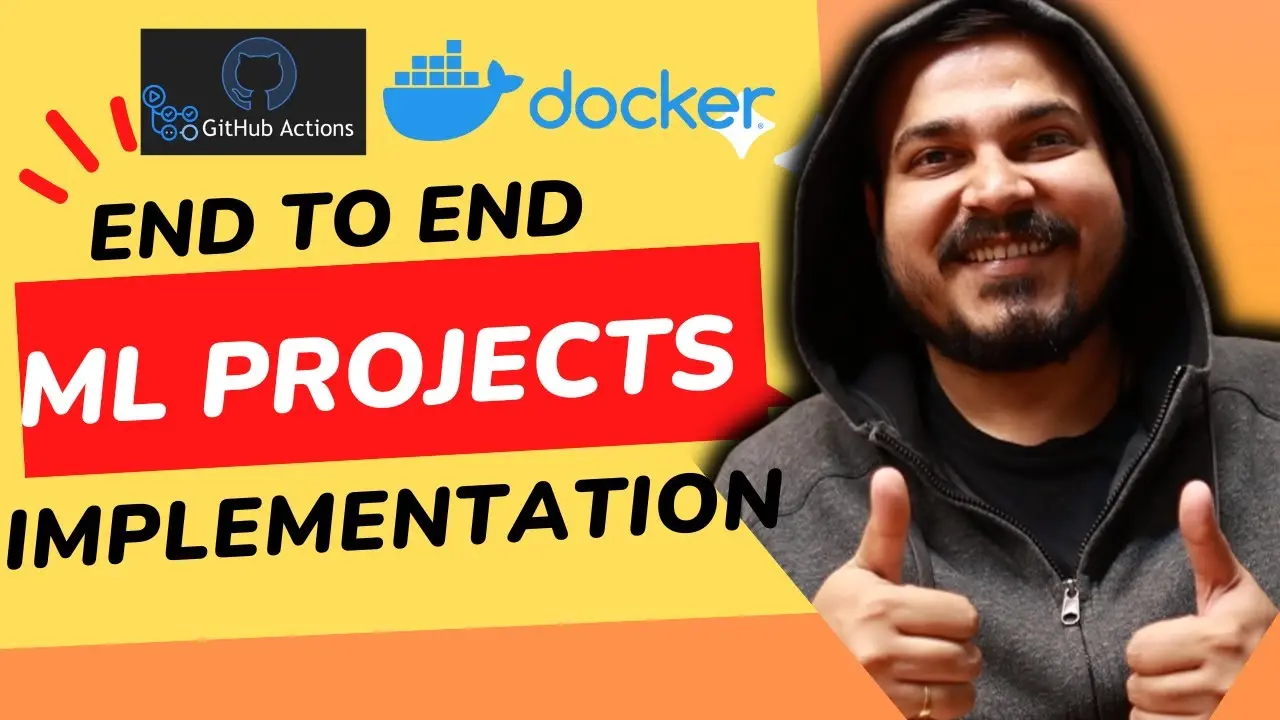
The video demonstrates starting from a Boston housing dataset, loading data, and preparing a simple end-to-end ML project. It covers basic data loading, feature handling, and setting up an end-to-end workflow that integrates Docker, GitHub Actions, and deployment steps for a full ML pipeline.
Transcript
in this video we are going to start our first practical implementation already we have covered up the theoretical part of linear regression we have understood the maths in depth intuition we have understood about gradient descent we have understood about the performance matrix that we are going to use like r square and existing r square now let's g... Read More
Key Insights
- End-to-end ML projects start with understanding the dataset and its features before modeling.
- Data preparation includes converting raw data into a proper dataframe with input features and a target price.
- Exploratory data analysis is used to understand data types and missing values before modeling.
- A DataFrame is created from the dataset, with an explicit target column named price for modeling.
- Modeling begins with a simple linear regression approach on the prepared data.
- The workflow includes training the model and evaluating performance metrics to gauge fit.
- The project is designed to be deployed using Docker and GitHub Actions for automation.
- Documentation and repository references guide where to find data sources and related code.
Install to Summarize YouTube Videos and Get Transcripts
Explore YouTube Video Summarizer or Get YouTube Transcript Extractor
Questions & Answers
Q: How can I start an end-to-end ML project with Docker from the Boston housing dataset?
To start, understand the dataset structure and identify input features and the target price. Load the data into a pandas DataFrame, assign the target values to a price column, then perform a basic exploratory data analysis to check data types and missing values. After that, implement a simple model such as linear regression and prepare the environment for Docker deployment and GitHub Actions automation.
Q: What does the video suggest about preparing the dataset for modeling?
The video emphasizes converting the dataset into a DataFrame with explicit input features and a price target. It shows adding a price column from the target values, inspecting dataframe head and info for data types, and ensuring there are no missing values before proceeding to model training. This creates a clean, consistent dataset for modeling.
Q: Why is the Boston dataset used in this walkthrough?
The Boston housing dataset is used as a simple, classic regression problem to illustrate end-to-end ML workflow concepts. It provides a clear set of features such as crime rate, pollution, rooms, and more, along with a target price, which makes it suitable for demonstrating data loading, preparation, basic modeling, and evaluation steps in a practical project.
Q: What role do Docker and GitHub Actions play in this project?
Docker is used to containerize the ML project, packaging the environment and dependencies to ensure consistent execution across platforms. GitHub Actions automates the workflow, enabling tasks like training, testing, and deployment to run automatically on code changes, thereby creating a repeatable end-to-end pipeline from data to deployment.
Q: What is the purpose of assigning a price column in the dataset?
Assigning a price column aligns with the target variable in the Boston dataset, enabling the model to learn the relationship between input features and house prices. This explicit target column makes data preparation straightforward and clarifies the modeling objective, whether for training, validation, or evaluation.
Q: What kind of model is demonstrated in this video for the initial implementation?
The initial implementation uses a simple linear regression model as a baseline to illustrate the end-to-end process. Linear regression offers an interpretable starting point to understand feature relationships with the target price and provides a baseline against which more complex models could be compared.
Q: What steps are covered after data preparation in the video?
After data preparation, the video covers training the model, evaluating performance with metrics, and preparing the project for deployment. It outlines the use of containerization with Docker and automation with GitHub Actions, followed by deployment considerations such as serving the model and integrating with web applications.
Q: Where can one find more resources related to the project?
The video description includes references to the GitHub code link and a data science blog for further guidance. Viewers are encouraged to visit the linked repository to access the implemented code, dataset details, and step-by-step instructions for reproducing the end-to-end ML project with Docker and deployment workflows.
Summary & Key Takeaways
-
This summary covers the overall workflow from dataset understanding to preparing the data and setting up a runnable end-to-end ML project. It highlights the progression from data loading, basic EDA, and feature engineering to training and deploying with Docker and GitHub Actions.
-
The content emphasizes a practical implementation of linear regression on a classic dataset, along with preparing the environment, packaging the model, and detailing deployment steps using containers and automation tools.
-
The video aims to build confidence by guiding through a simple yet complete machine learning project, including data handling, model training, evaluation, and deployment readiness.
Read in Other Languages (beta)
Share This Summary 📚
Summarize YouTube Videos and Get Video Transcripts with 1-Click
Try YouTube Summary with ChatGPT & Claude or YouTube Transcript Generator
Explore More Summaries from Krish Naik 📚





Summarize YouTube Videos and Get Video Transcripts with 1-Click
Try YouTube Summary with ChatGPT & Claude or YouTube Transcript Generator