How Do Sam Altman and Dario Amodei Disagree About OpenAI and Anthropic's AI Safety Strategies?
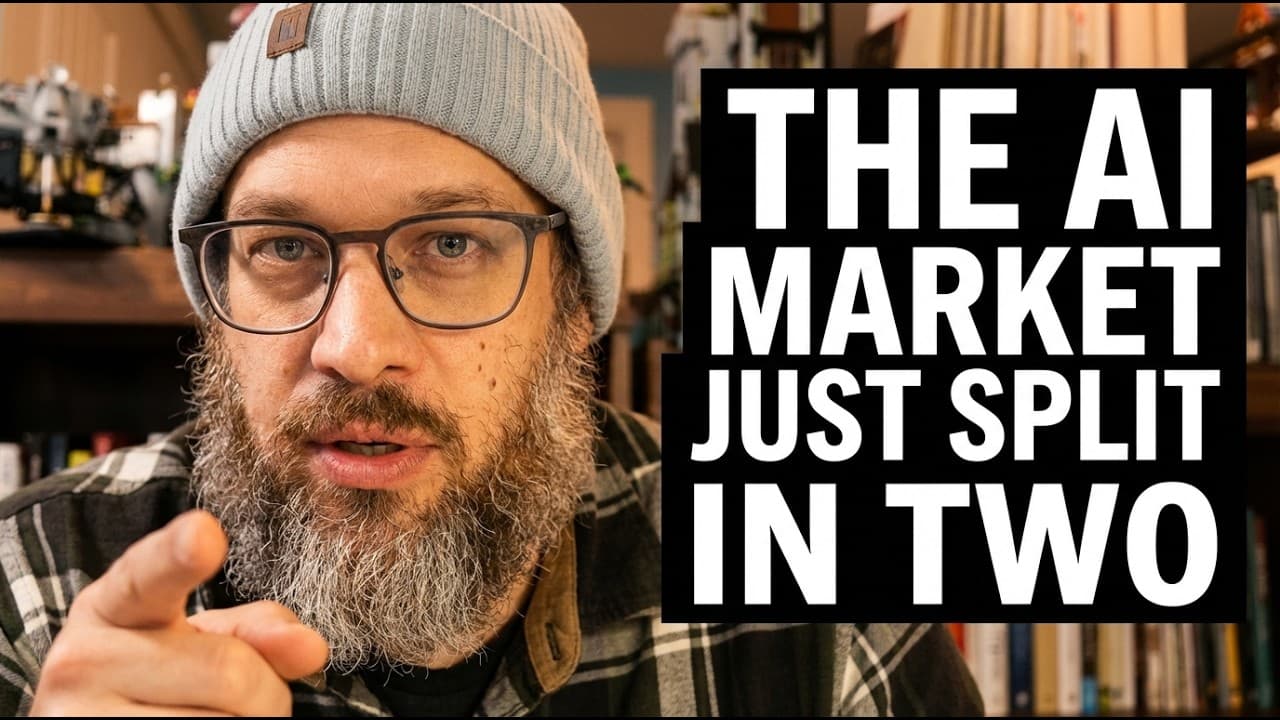
TL;DR
Sam Altman and Dario Amodei disagree about when reliable AI safety knowledge emerges: OpenAI learns through gradual deployment and user feedback, while Anthropic emphasizes understanding and demonstrating safety before release. Their contrasting entrepreneurial and scientific backgrounds shaped increasingly different strategies, products, and markets by January 2026. Read on to understand what each philosophy means for choosing between ChatGPT and Claude.
Transcript
Today we're going to look at which AI strategy is going to win in 2026. There are really two theories about how to build AI safely and at scale. Two strategies, two philosophies that have been diverging since 2021 and they've now produced completely different companies, completely different products and increasingly different markets. I'm talking a... Read More
Key Insights
- OpenAI’s safety philosophy is based on gradual deployment, extensive user feedback, and repeated improvement. Internal testing and model cards still precede release, but real-world interaction supplies evidence and failure cases that laboratory testing alone may not reveal.
- Anthropic’s safety philosophy treats understanding and affirmative safety evidence as prerequisites for deployment. Its approach rejects using the public as the primary red team and reflects a scientific preference for studying system behavior before exposing people to its risks.
- Sam Altman’s worldview was shaped by entrepreneurship and Y Combinator. His early startup failure became a lesson in smarter iteration, while YC reinforced the belief that shipping, listening to users, moving quickly, and scaling can produce knowledge unavailable through theory alone.
- Dario Amodei’s worldview was shaped by physics, biophysics, and computational neuroscience. His research into neural circuits and his interest in fundamental scientific truth encouraged an approach centered on systematic investigation, craftsmanship, and understanding mechanisms before applying them at scale.
- Amodei’s father died from a rare illness four years before a medical breakthrough made that disease nearly curable. The video connects this experience to Amodei’s continuing focus on scientific progress, human illness, and the importance of producing knowledge before solutions arrive too late.
- The disagreement between Altman and Amodei is not whether AI safety matters. It concerns how reliable safety knowledge is created: OpenAI emphasizes learning through controlled public deployment, while Anthropic emphasizes establishing safety through prior investigation and affirmative demonstrations.
- Claude and ChatGPT are portrayed as increasingly different products serving different purposes and markets. By January 2026, asking which model is universally better is compared to asking whether a hospital or television studio is better, because the appropriate choice depends on purpose.
- The most useful selection criterion for professionals is the kind of work their organization performs. Benchmarks, arena scores, and informal impressions reveal only part of the picture when the companies are building around different markets, products, safety assumptions, and theories of progress.
- "There are really two theories about how to build AI safely and at scale." (0:02)
- "One theory says you learn by deploying, ship fast, get feedback from millions of users and iterate and the public is effectively your red team for safety." (0:20)
- "The other theory says you must understand before you deploy." (0:28)
- "Both Sam Alman and Daario Amade believe safety matters." (1:00)
- "He was literally trying to understand how biological neurons process information and how brains work at the level of individual cells and their collective behavior." (3:59)
Install to Summarize YouTube Videos and Get Transcripts
Explore YouTube Video Summarizer or Get YouTube Transcript Extractor
Questions & Answers
Q: What do Sam Altman and Dario Amodei disagree about?
They disagree about how AI safety is achieved, not whether safety matters. Altman's OpenAI emphasizes learning through deployment and iteration, while Amodei's Anthropic emphasizes understanding a system and demonstrating its safety before deployment.
Q: How do OpenAI and Anthropic approach AI safety differently?
OpenAI releases systems after internal testing, learns from millions of users, and iterates when problems emerge. Anthropic treats prior understanding and affirmative safety evidence as conditions for deployment, keeping experimental risk in the lab rather than making the public its primary red team.
Q: Why does OpenAI use gradual deployment as part of AI safety?
OpenAI believes real-world use reveals evidence and failure cases that internal testing alone may miss. User reports and feedback then support repeated improvements to model behavior, safeguards, and products.
Q: Why does Anthropic prioritize understanding before deployment?
Anthropic's philosophy holds that a system should be understood and shown to be safe before broad release. It rejects the idea that the world should function as the laboratory or that the public should be the primary red team.
Q: How did Sam Altman's background shape OpenAI's strategy?
Altman learned to program at 8, studied computer science at Stanford, dropped out, and founded a social networking app that failed. He interpreted that failure as a lesson in iteration, a worldview later reinforced by Y Combinator's emphasis on shipping, feedback, speed, and scale.
Q: How did Dario Amodei's scientific background shape Anthropic?
Amodei studied physics at Caltech and Stanford, earned a PhD at Princeton, and researched the electrophysiology of neural circuits. His focus on fundamental scientific truth and understanding complex systems shaped Anthropic's emphasis on systematic investigation before broad deployment.
Q: How did Dario Amodei's father's illness affect his scientific focus?
Amodei's father died from a rare illness, and four years later a medical breakthrough made that previously fatal disease nearly curable. The experience is connected in the transcript to his later focus on scientific advancement, valuable knowledge, biophysics, computational neuroscience, and work addressing human illness.
Q: Why are Claude and ChatGPT increasingly difficult to compare?
Their paths began separating in late 2024 and continued diverging through 2025. By January 2026, they are portrayed as serving increasingly different purposes and markets, so benchmarks, arena scores, and informal testing cannot determine which system is better for every user.
Summary & Key Takeaways
-
OpenAI and Anthropic represent two distinct theories of AI development. OpenAI emphasizes shipping systems after internal testing, observing how millions of people use them, and rapidly correcting problems. Anthropic emphasizes understanding system behavior and affirmatively demonstrating safety before allowing deployment and expansion into the wider world.
-
The contrast reflects the founders’ backgrounds. Sam Altman developed an entrepreneurial worldview through startup failure and Y Combinator, where products improve through rapid releases and market feedback. Dario Amodei trained in physics, biophysics, and computational neuroscience, developing a scientific orientation centered on understanding complex systems before applying them.
-
By January 2026, the companies are portrayed as serving increasingly different markets and purposes. Consequently, comparisons based only on benchmarks, arena scores, or general impressions have become less useful. Professionals should instead evaluate their work, risk tolerance, product needs, and preferred theory of safe AI development.
Read in Other Languages (beta)
Share This Summary 📚
Summarize YouTube Videos and Get Video Transcripts with 1-Click
Try YouTube Summary with ChatGPT & Claude or YouTube Transcript Generator
Explore More Summaries from AI News & Strategy Daily | Nate B Jones 📚






Summarize YouTube Videos and Get Video Transcripts with 1-Click
Try YouTube Summary with ChatGPT & Claude or YouTube Transcript Generator