How to Build an AI-Native Organization
TL;DR
An AI-native organization combines people, agents, and shared company context so work gets faster while remaining directed by human strategy, taste, judgment, and trust. People manage agents, agents read from and write to the company, and each completed workflow enriches the context layer, helping the organization test ideas, capture customer signal, and improve over time.
Transcript
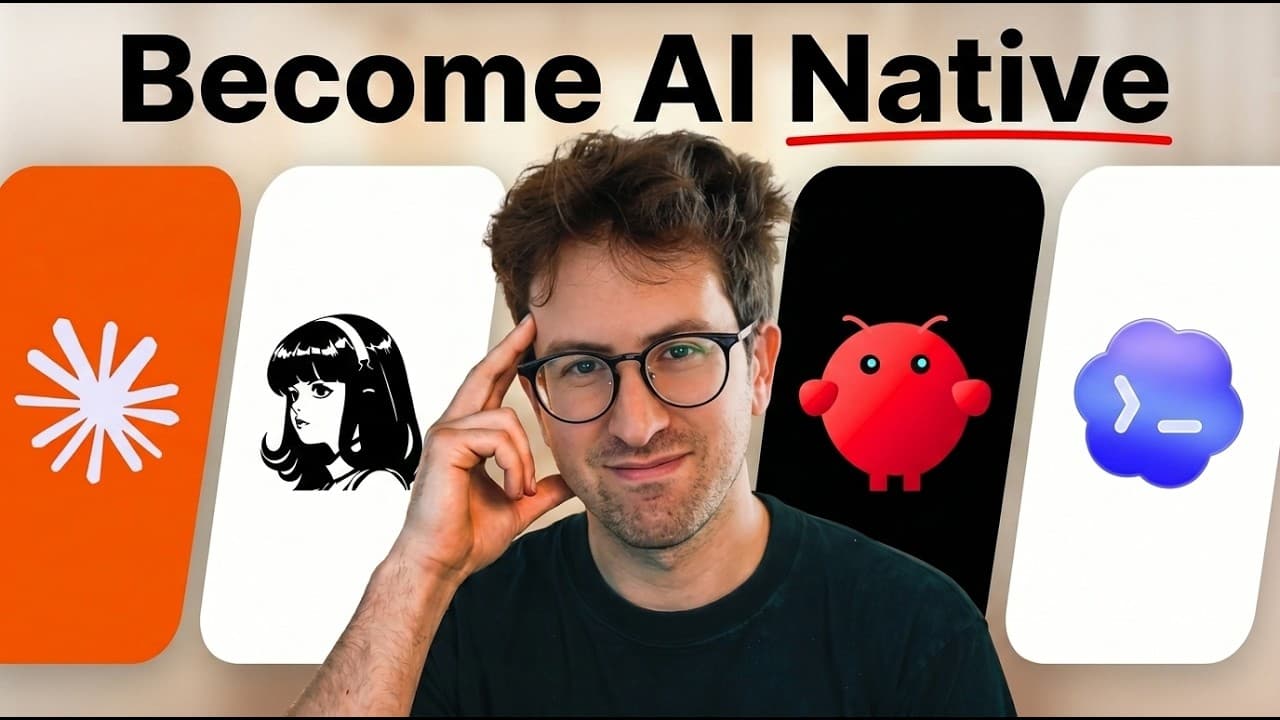
How do you become AI native? In this episode, it is an under 60inute master class for how to become AI native. This is the type of content that people charge tens of thousands of dollars for. But on this channel, we're giving away for free. And we're giving it away for free because I believe that people who understand how to become AI native are go... Read More
Key Insights
- An AI-native organization is one where people manage agents, agents read from and write to the company, and the company becomes smarter over time. These three characteristics distinguish an integrated operating system from occasional use of a conversational AI tool.
- People are the leadership layer of an AI-native system because strategy, taste, judgment, and trust remain human responsibilities. Technology alone cannot transform an organization when employees do not understand how to direct agents, evaluate their work, and use the surrounding system.
- AI eats the middle of a workflow by taking over much of the execution between planning and review. People can then concentrate on defining the right objective at the beginning and applying experienced judgment, quality control, communication, and deployment decisions at the end.
- Shared context is the foundational layer that makes a company readable to agents. When agents have clear access to relevant company knowledge, they gain the organizational visibility needed to perform useful work instead of relying on isolated prompts with incomplete information.
- Agents are models that use tools in a loop to act on behalf of people. Their value increases when they can interact with company context, complete repeatable workflows, and write useful outputs back into the organization rather than producing disconnected one-time responses.
- Evals define what good work means and provide a basis for assessing agent output. Explicit quality criteria help people review execution consistently, identify what must change, and prevent raw speed from replacing judgment or customer value as the measure of success.
- Skill chains connect repeatable capabilities into complete workflows. The proposal and prototype demonstrations show how chained work can produce polished deliverables in minutes, including an auto-generated client proposal microsite and a functional feature prototype supported by a testing suite.
- Customer signal gives speed a productive direction. Rapid prototypes and usability tests let an organization hear from the market quickly, synthesize feedback, and create a revised version within the same session, feeding new knowledge back into the system for future work.
Install to Summarize YouTube Videos and Get Transcripts
Explore YouTube Video Summarizer or Get YouTube Transcript Extractor
Questions & Answers
Q: What is an AI-native organization?
An AI-native organization is a company where people manage agents, agents can read from and write to company knowledge, and the company becomes smarter over time. Its operating system combines people, agents, and shared context. This arrangement enables faster execution, quicker access to customer signal, and repeated improvement as outputs and feedback return to the organization’s context layer.
Q: Why does using ChatGPT not make a company AI native?
Using ChatGPT alone does not make a company AI native because a standalone tool is only one part of the required system. AI-native operations require employees who can manage agents, a shared context layer agents can access, workflows that let agents take useful actions, and mechanisms for writing results back into the company so later work benefits from earlier learning.
Q: What role do people play in an AI-native company?
People lead an AI-native company through strategy, taste, judgment, and trust. They decide what work should be done, establish its direction, and review whether the result is good enough. Agents can perform much of the execution, but effective outcomes still depend on people who can frame objectives, evaluate quality, determine necessary changes, and communicate or deploy the finished work.
Q: How does AI change a traditional work process?
AI changes the work process by handling much of the execution that previously occupied the middle of a project. This frees people to focus on the two critical bookends: deciding what to do and reviewing what was produced. Human expertise therefore shifts toward direction, judgment, taste, quality control, communication, and deployment rather than disappearing from the workflow.
Q: Why is shared company context important for AI agents?
Shared company context makes organizational information readable and usable by agents. It gives agents visibility into what the company knows, allowing them to perform work that reflects the organization rather than responding from an isolated prompt. Because agents can also write results back, completed projects and customer feedback can improve the context available to future workflows.
Q: How can an AI-native organization turn speed into customer signal?
An AI-native organization turns speed into customer signal by rapidly creating functional prototypes, placing them in front of customers, collecting usability feedback, and using that feedback to produce a revised version. The demonstrated process includes a high-fidelity feature, a testing suite, live feedback synthesis, and a second version created within one session, linking execution speed directly to market learning.
Q: What are skill chains in AI-native workflows?
Skill chains are connected capabilities organized into a repeatable workflow that produces a complete business outcome. Instead of asking an AI tool for one disconnected response, a team can chain research, creation, presentation, testing, and revision activities. The proposal workflow demonstrates this idea by producing an auto-generated client proposal microsite through a coordinated system rather than a single isolated prompt.
Q: How can service businesses use the AI-native model?
Service businesses can productize AI-native systems and workflows for clients. The episode identifies this area as a source of startup ideas and demonstrates deliverables such as proposal microsites, functional prototypes, usability testing, feedback synthesis, and rapid revisions. The business value comes from packaging a repeatable combination of people, agents, context, skill chains, and evaluation into a client-focused service.
Summary & Key Takeaways
-
An AI-native organization is defined by three connected behaviors: people manage agents, agents can read from and write to company knowledge, and the organization becomes smarter over time. Simply using ChatGPT is insufficient because the real advantage comes from combining capable people, agent-driven workflows, and accessible shared context into a continuously improving system.
-
People remain responsible for the most consequential parts of work, including strategy, taste, judgment, trust, direction, and final review. Agents handle much of the execution in the middle. This shift gives professionals more time to decide what should be created, evaluate whether the result is good, and communicate or deploy the finished work effectively.
-
The operating model turns speed into useful customer signal through rapid creation, testing, and iteration. Demonstrations include a functional prototype, an auto-generated proposal microsite, and a usability test whose feedback informs a second version within one session. The same approach can support internal transformation and service businesses that productize AI-native workflows for clients.
Read in Other Languages (beta)
Share This Summary 📚
Summarize YouTube Videos and Get Video Transcripts with 1-Click
Try YouTube Summary with ChatGPT & Claude or YouTube Transcript Generator
Explore More Summaries from Greg Isenberg 📚

Summarize YouTube Videos and Get Video Transcripts with 1-Click
Try YouTube Summary with ChatGPT & Claude or YouTube Transcript Generator