How to Build Strategic Context Before Adding AI to Your Business
TL;DR
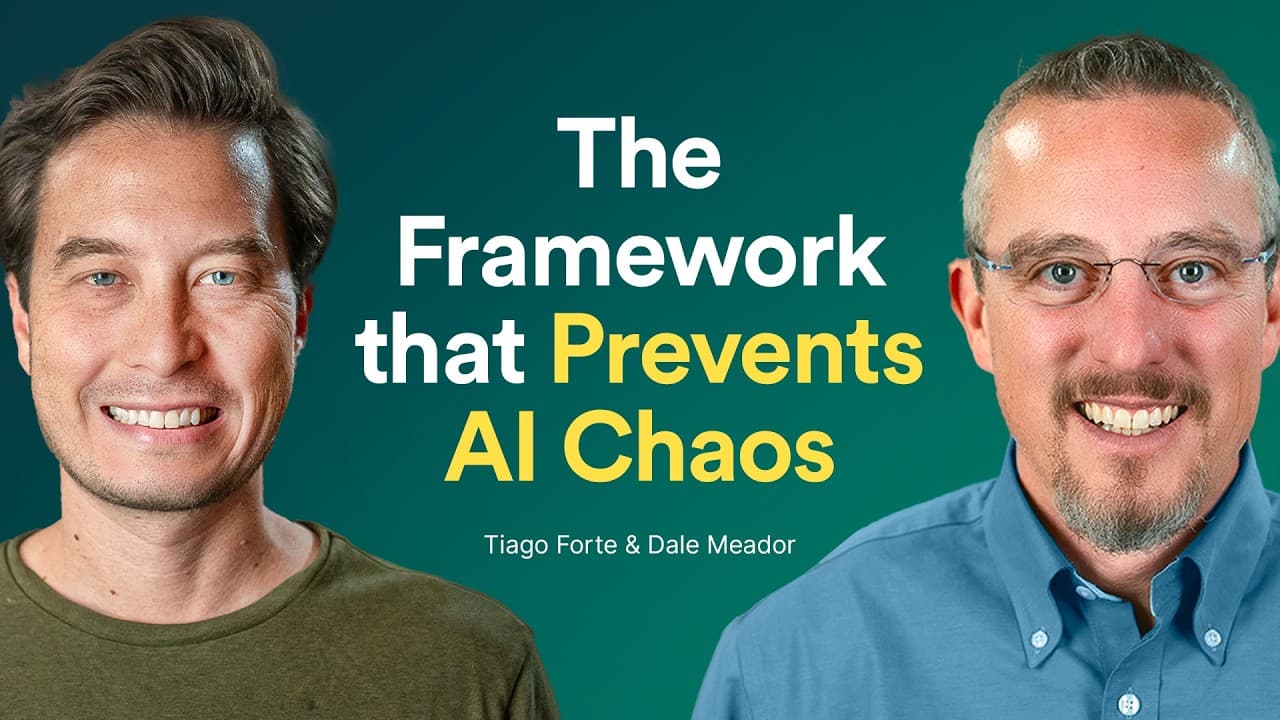
Answer six clarity questions before adding AI to any business: your year-three end date, your target fiscal measures (starting with cash), your units of delivery, and a numbers-free statement of what the company will be. This framework, credited with $200 million in business value across 17 companies, gives leaders strategic context so AI tools amplify direction instead of random experiments.
Transcript
I'm here with Dale Mador from Cadence Growth. His strategic planning framework has generated $200 million in business value across 17 different companies. Most businesses are racing to implement AI without what Dale calls strategic context. It's like strapping a jet engine to a bicycle. While your competitors are drowning in random AI experiments, ... Read More
Key Insights
- Strategic context must come before AI adoption, because implementing AI without direction is like strapping a jet engine to a bicycle, producing random experiments instead of results. Dale Meador's six-question framework has generated over $200 million in business value across 17 companies.
- The first clarity question is deceptively administrative: what is the year-end date of year three from now? Many teams cannot answer instantly, and the value lies in the team looking at each other and deciding on that specific date together before moving forward.
- The scoreboard of business is intrinsically financial, and shockingly, most organizational team members lack clarity on it. The second question asks what the fiscal measures will be as of the year-three date, starting with cash because running out of cash is like running out of oxygen.
- Working backwards from a required end-point cash balance turns strategy into a math exercise. Meador compares it to a reservoir: knowing how much water you need in three years lets you calculate how much rainfall, or activity, must happen between now and then.
- The third question identifies the units needed to reach those fiscal measures, such as units sold, clients served, billable hours, or marketing qualified leads. Choosing which unit to track biases decisions, for example clients drives new acquisition while billable hours drives expanding existing accounts.
- The fourth question, what will the company be in three years, is deliberately subjective and must contain no numbers. It is anchored in the objective figures already set, letting teams test whether their aspirations are actually supported by the numbers or require change.
- Early framework passes are exploratory, not about finding a single right answer. The fourth question works as a mini brainstorm to surface a few interesting strategic possibilities, which teams revisit in a later second pass to refine and reconcile.
- Strategy is classically defined as creating a unique, valuable, and sustainable position in the market. The subjective company statement must connect objective goals to a defensible position in the actual addressable marketplace, though Meador notes what is sustainable in the age of AI is genuinely uncertain.
Install to Summarize YouTube Videos and Get Transcripts
Explore YouTube Video Summarizer or Get YouTube Transcript Extractor
Questions & Answers
Q: What is the six clarity questions framework?
It is a strategic planning framework developed by Dale Meador of Cadence Growth over the past decade, credited with generating over $200 million in business value across 17 different companies. The six questions provide an approachable starting point that any team, from a pre-launch startup to a 20-year-old organization with a thousand employees, can work through to generate clarity about where the business is going before adding AI into the mix.
Q: Why should you define strategic context before adding AI to your business?
Most businesses race to implement AI without strategic context, which Meador compares to strapping a jet engine to a bicycle or drowning in random AI experiments. Without knowing where the business is going, AI tools amplify chaos rather than results. Establishing strategic context first gives clarity on direction, so AI can then be added intelligently as content that supports a clear plan rather than fueling disconnected, unproductive tool experiments.
Q: What is the first clarity question and why does it matter?
The first question asks: what is the year-end date of year three from now? It sounds clerical or administrative, but many teams cannot answer it instantly. The value is that the team must look at each other and decide on the specific date together. It is their decision, not the facilitator's, and once agreed they check it off and move forward with a shared, concrete starting point of clarity.
Q: Why does the fiscal measures question start with cash?
The second question asks what the fiscal measures will be as of the year-three date, and it starts with cash because cash is like oxygen. If you run out of cash, you suffocate. From cash, the framework works through revenue, gross profit, net operating profit, EBITDA, after-tax income, and possibly a few ratios. The business scoreboard is intrinsically financial, yet many team members lack clarity on it, so agreeing on these numbers is essential.
Q: How does working backwards from an end point help business planning?
Meador uses a reservoir analogy: deciding how much cash you need in the bank three years out forces a reckoning of an ending point, like knowing how much water a reservoir must hold to meet future needs. Once that end balance is set, planning becomes a math exercise to work out, in a rolling fashion, what activity or rainfall must occur between now and then. The known start and end points let you infer much of what has to happen in between.
Q: What does Dale Meador mean by units in the framework?
Units are the measures of value creation in a chain: units of product, service, delivery, and growth. For a product company they might be units sold or moved; for a services company, number of clients or billable hours. They can also be functional units like leads, marketing qualified leads, or sales qualified leads at the top of the funnel. The third question asks which units are needed to reach the target fiscal measures, driving clarity on products, services, and the marketing funnel.
Q: How does choosing a unit of measurement affect business decisions?
The unit you choose biases your strategy. If a services company decides its unit is number of clients, that automatically pushes toward acquiring brand-new clients. If instead the unit is billable hours, it biases toward increasing hours from the existing client base. Meador stresses this is a conversation the team needs to have deliberately, because a simple question about units drives significant clarity about where growth should come from and what actions to prioritize.
Q: Why must the fourth question be answered without numbers?
The fourth question, what will the company be in three years, is deliberately subjective, right-brained, and creative, requiring a statement with no numbers in it. By definition it is a statement of being, yet it stays anchored in the objective figures already set. Answering it lets teams test whether their aspirations are supported by the numbers, revealing where a figure must change. It defines a unique, valuable, and sustainable market position, connecting objective goals to a defensible strategic stance.
Summary & Key Takeaways
-
Dale Meador of Cadence Growth shares a six-question strategic planning framework that has created over $200 million in business value across 17 companies. The core premise is that businesses rush into AI without strategic context, like strapping a jet engine to a bicycle, so leaders must first gain clarity on direction.
-
The first three questions establish objective anchors. Question one fixes the year-end date three years out. Question two defines the target fiscal measures as of that date, beginning with cash because running out of cash suffocates a business. Question three identifies the units of product, service, or delivery required to reach those numbers.
-
The fourth question shifts to the subjective: what will the company be in three years, stated without any numbers. Anchored in the prior figures, it tests whether aspirations match the math and defines a defensible market position. The advice is being turned into a free custom GPT so users can experience working with an expert through AI.
Read in Other Languages (beta)
Share This Summary 📚
Summarize YouTube Videos and Get Video Transcripts with 1-Click
Try YouTube Summary with ChatGPT & Claude or YouTube Transcript Generator
Explore More Summaries from Tiago Forte 📚



Summarize YouTube Videos and Get Video Transcripts with 1-Click
Try YouTube Summary with ChatGPT & Claude or YouTube Transcript Generator