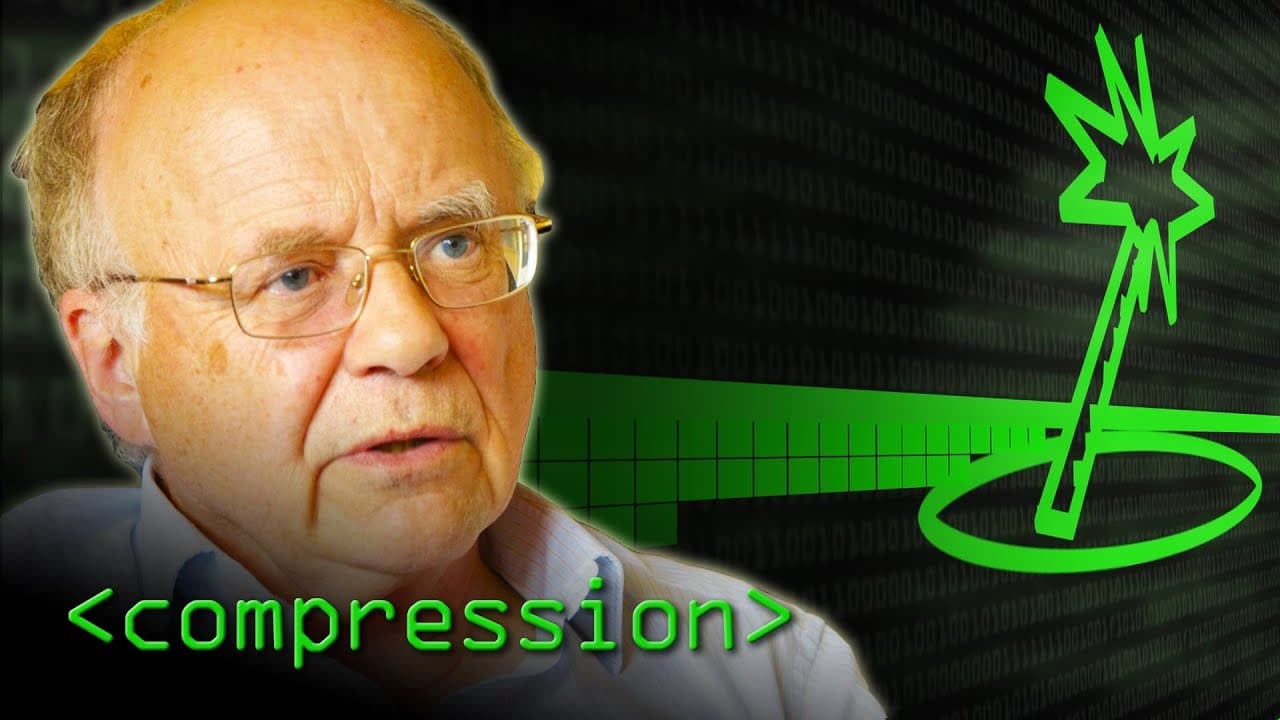
Compression - Computerphile
TL;DR
Compression reduces the size of data without losing information, allowing for more efficient transmission over networks.
Transcript
Compression is reducing the amount of information but without, in a sense, losing any of it. Trying to compress it and shorten it in such a way that you could in principle recover the full information that you started with, but in terms of transmitting it over a network, it's going to cost you less because you pay per bit or per byte or whatever. A... Read More
Key Insights
- 💁 Compression reduces data size while retaining information integrity, benefiting transmission efficiency.
- 🖤 Text files with repetitive phrases are highly compressible, while complex images may require less compression due to their lack of predictable patterns.
- 🕸️ JPEG compression sacrifices some image quality to achieve greater compression, making it suitable for web uploading.
Install to Summarize YouTube Videos and Get Transcripts
Explore YouTube Video Summarizer or Get YouTube Transcript Extractor
Questions & Answers
Q: How does compression reduce the size of data while preserving the information?
Compression achieves this by identifying repeated patterns or predictability in the data. For text files, common phrases or buzzwords can be stored once and the locations noted for future reference. For photographs, areas of the same color or texture can be replicated, reducing the amount of pixel-by-pixel information that needs to be transmitted.
Q: Can all data be compressed effectively?
Not all data can be easily compressed. While text files with repeated patterns lend themselves well to compression, complex or random images, such as sports car races or impressionist paintings, lack predictable patterns. In these cases, compression may not provide significant benefits, and transmitting the entire data may be more efficient.
Q: How does JPEG compression work?
JPEG compression is a commonly used method for reducing the size of photographs. It employs "lossy" compression, meaning that some information is discarded to achieve greater compression. JPEG divides the image into blocks, approximating areas of similar colors and textures. While the recovered image may not be identical to the original, the approximation often remains visually acceptable, especially for viewing on screens.
Q: Is there a limit to compression?
Yes, there is a limit to compression, known as the entropy limit. Entropy, in the context of information theory, determines the minimum number of bits necessary to transmit information in a lossless manner. Compression techniques strive to approach this limit, but there will always be a trade-off between compression and the exact replication of the original data.
Summary & Key Takeaways
-
Compression reduces the size of data by finding repeated patterns and predictability, making it easier to transmit.
-
Text files with repetitive phrases can be compressed by storing the pattern and noting where it occurs in the file.
-
Photographs can be compressed by identifying predictable areas and replicating the colors, but complex or random images may require less compressibility.
Read in Other Languages (beta)
Share This Summary 📚
Summarize YouTube Videos and Get Video Transcripts with 1-Click
Try YouTube Summary with ChatGPT & Claude or YouTube Transcript Generator
Explore More Summaries from Computerphile 📚



Summarize YouTube Videos and Get Video Transcripts with 1-Click
Try YouTube Summary with ChatGPT & Claude or YouTube Transcript Generator