What is a Python tuple and how to use it?
TL;DR
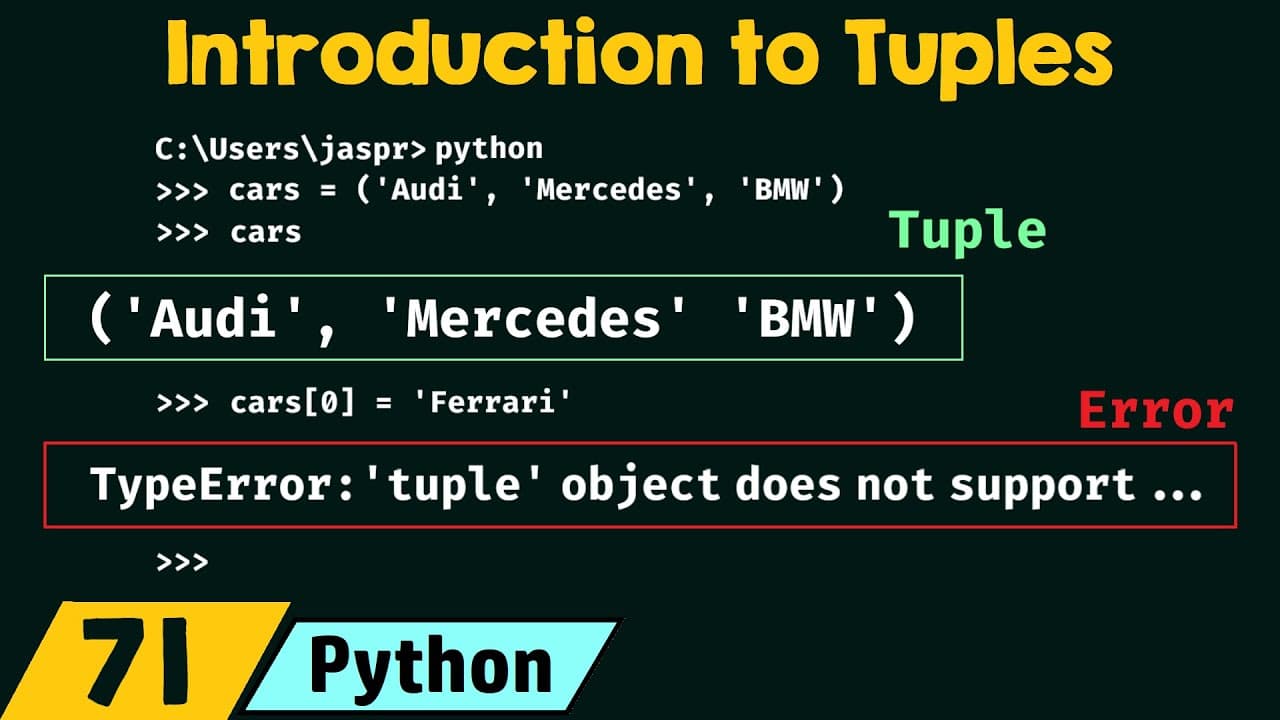
A tuple is a collection of items that is indexed, ordered, and immutable. It is created with parentheses and items accessed by their index. A single item must include a trailing comma to be recognized as a tuple. The length can be found with len and you can also construct using the tuple() constructor.
Transcript
foreign onwards we will understand tuples in details this lecture is the introduction lecture to tuples so without any further delay let's get started the topics of this presentation are introduction to tuples Tuple with one item length of a tuple and the Tuple Constructor let's understand these topics one by one let's start with the first topic th... Read More
Key Insights
- Tuples are indexed, ordered, and immutable collections.
- Tuples are created with parentheses, unlike lists which use brackets.
- Items are accessed by index and can be duplicated within a tuple.
- A single item tuple must have a trailing comma to be recognized.
- Tuples cannot be updated in place; item assignment raises an error.
- The length of a tuple is obtained using the len function.
- The tuple constructor offers an alternative creation method.
- Creating a one item tuple requires a comma after the item.
Install to Summarize YouTube Videos and Get Transcripts
Explore YouTube Video Summarizer or Get YouTube Transcript Extractor
Questions & Answers
Q: How do you create a Python tuple and why are parentheses used?
A Python tuple is created by listing items inside parentheses, which marks the tuple as an ordered, indexed collection. The parentheses differentiate a tuple from other data structures like lists, and they establish the boundary for the items. Using the tuple syntax helps Python recognize the data as immutable, ordered, and indexable.
Q: What makes a tuple immutable and how is that shown in practice?
A tuple is immutable because once created, you cannot change its items. This is shown when attempting to assign a new value to an existing index, which raises an error saying that the object does not support item assignment. Immutability means the contents cannot be altered, including adding or removing elements.
Q: How do you define a single element tuple correctly?
To define a single element tuple, include the item followed by a trailing comma inside parentheses. Without the comma, Python does not recognize it as a tuple and treats it as a plain value. The comma is essential to convey the tuple structure for one element.
Q: How can you determine the number of items in a tuple?
The number of items in a tuple is determined using the built-in len function. Pass the tuple as an argument to len, and it returns the total count of elements. This works regardless of the specific types of items contained in the tuple.
Q: Can a tuple contain duplicate items, and what does this illustrate about tuples?
Yes, a tuple can contain duplicate items. This illustrates that unlike dictionaries, tuples allow repeated values and do not require unique elements. Duplicates are permitted, and the tuple maintains the same order and indexing for each occurrence.
Q: What is the tuple constructor and how does it relate to creating tuples?
The tuple constructor offers an alternative way to create a tuple by calling tuple with an iterable containing the desired items. This provides a different syntax route to achieve the same result as listing items within parentheses, and it reinforces that tuples are a distinct, immutable collection.
Q: How is the order of items in a tuple important, and can it change over time?
The order of items in a tuple is fixed once created, meaning it remains identical throughout its lifetime. Since tuples are immutable, you cannot rearrange, insert, or delete elements to change the order. This stability in ordering is a defining characteristic of tuples.
Q: What is the difference between a tuple and a list based on the introduction video content?
The key difference highlighted is immutability: a tuple is indexed, ordered, and immutable, while a list is not restricted by immutability and can be changed after creation. Tuples use parentheses, lists use square brackets, and only tuples guarantee that their contents cannot be modified after creation.
Summary & Key Takeaways
-
A tuple is a collection of items that is indexed, ordered, and immutable, and it is different from a list mainly by immutability. You create it with parentheses and separate items by commas. Accessing elements uses their index, starting at zero.
-
Tuples can contain duplicates, and attempting to change an element by assignment will raise an error, demonstrating immutability. The order of items remains fixed, and you can verify membership and length with built-in operations.
-
The video also covers special cases like creating a single item tuple by including a trailing comma after the item, and how the len function helps determine the number of elements in a tuple.
Read in Other Languages (beta)
Share This Summary 📚
Summarize YouTube Videos and Get Video Transcripts with 1-Click
Try YouTube Summary with ChatGPT & Claude or YouTube Transcript Generator
Explore More Summaries from Neso Academy 📚





Summarize YouTube Videos and Get Video Transcripts with 1-Click
Try YouTube Summary with ChatGPT & Claude or YouTube Transcript Generator