How Will AI Turn Companies Into Feedback Loops?
TL;DR
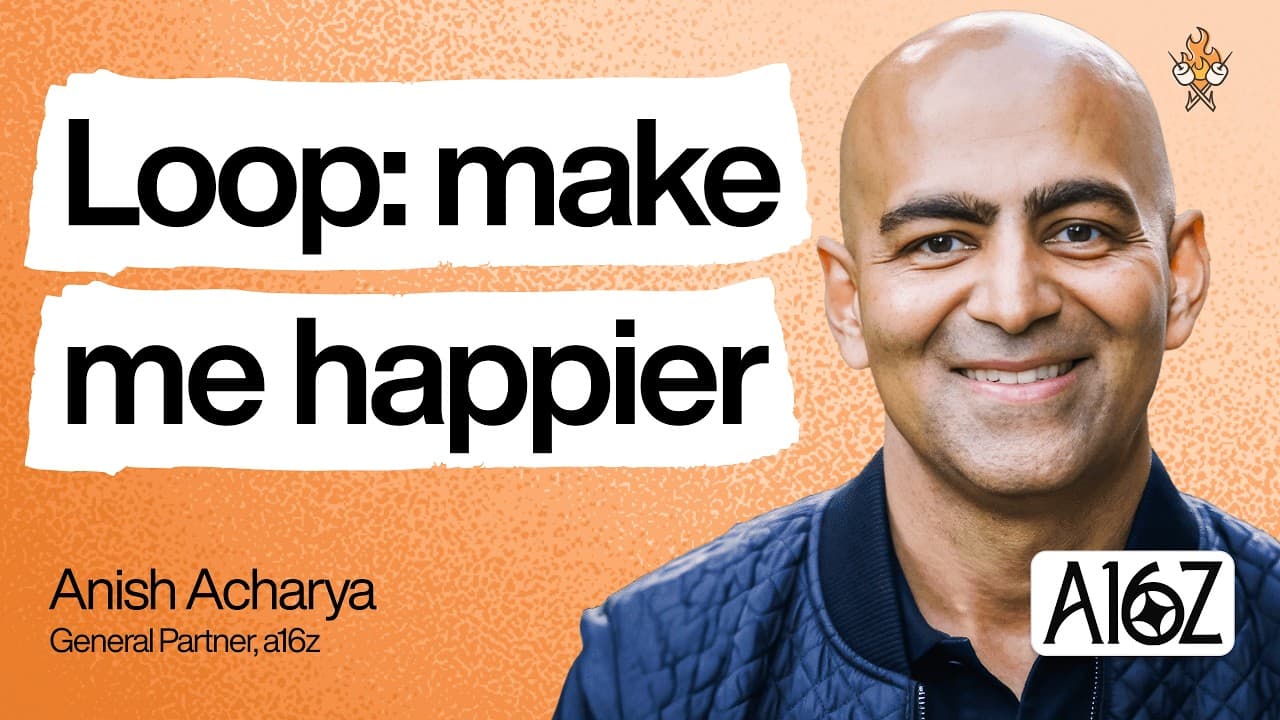
AI is likely to reorganize companies around automated loops that improve work, while humans supply the intuition needed to move beyond each loop’s plateau. Acharya argues that fears of a permanent AI underclass are overstated because competition remains distributed, economic diffusion is slow, many problems are not limited by intelligence, and employees often want to gain leverage from new tools.
Transcript
There's a lot of fear and worry about the future with AI. I want to talk about this idea that if you fall behind, you're going to become part of this >> permanent underclass. [music] >> It's a funny dark fantasy that we seem to have as Silicon Valley collectively. Like things have never been better by almost every measure. >> This is a technology t... Read More
Key Insights
- AI competition is distributed across many participants rather than concentrated in a single obvious winner. Foundation model labs, open-weight alternatives, and multiple coding products are all finding traction, challenging the assumption that the current technology cycle must produce one dominant company.
- The permanent-underclass narrative is not supported by the examples Acharya presents. Radiologists and programmers have repeatedly been described as vulnerable to automation, yet he says job postings remain strong, while opportunities and powerful technologies are more broadly available than the prevailing fear suggests.
- Current AI progress is described as autocatalytic rather than genuinely recursive self-improvement. New technology can improve the process used to create later technology, but Acharya argues that this is different from a self-contained recursive cycle capable of giving one slightly advanced participant an unstoppable lead.
- Economic diffusion is slower than progress inside AI laboratories. Even when model capabilities advance rapidly, those advances take time to reshape ordinary lives, companies, and local communities, which makes a sudden economy-wide transformation less plausible than technical milestone announcements might imply.
- Many practical problems are not primarily constrained by intelligence. Acharya argues that placing a data center full of highly educated experts inside delivery or pizza businesses would not automatically produce exponential dominance because operations, supply chains, and other real-world constraints still matter.
- AI loops can optimize work until they reach a local maximum, but they cannot reliably choose the next hill to climb. Human intuition remains the critical ingredient for recognizing a new direction, repositioning the organization, and establishing the starting point for another improvement loop.
- AI can increase ambition as well as productivity by unbundling skill from desire. When technology helps people execute work they previously lacked the specialized ability to perform, individuals and companies can pursue larger goals, making ideas that once seemed excessively ambitious more credible.
- Consumer AI’s central opportunity is to improve emotional experience, not simply efficiency. Products can focus on helping people feel more connected and loved, make progress, or have fun, making the core challenge one of product design rather than model capability alone.
Install to Summarize YouTube Videos and Get Transcripts
Explore YouTube Video Summarizer or Get YouTube Transcript Extractor
Questions & Answers
Q: Should workers fear becoming part of a permanent AI underclass?
Workers should not treat a permanent AI underclass as an inevitable outcome. Acharya argues that opportunities and advanced technologies are broadly distributed, many competing AI products are succeeding, and occupations repeatedly predicted to disappear still show strong job postings. He also believes common portrayals underestimate ordinary employees, many of whom actively want to improve their abilities and gain leverage from new tools.
Q: Why might AI markets support many successful companies?
AI markets may support many successful companies because competition exists throughout the stack. Acharya points to foundation model laboratories, open-weight alternatives, different variations within those groups, and several coding products that are all working. This differs from the previous mobile era, where network effects often produced highly centralized markets and businesses designed around a single dominant network.
Q: What is the difference between recursive self-improvement and autocatalytic AI progress?
Recursive self-improvement suggests that an AI system repeatedly improves itself in a way that could create a runaway advantage for an early leader. Acharya says the process occurring today is better described as autocatalytic: developers use new technology to improve their development process. That can accelerate progress, but it is not the fully recursive mechanism assumed in fast-takeoff scenarios.
Q: Why does Acharya expect AI adoption to resemble a slow takeoff?
Acharya expects a slower takeoff because dramatic technical milestones are still observed, caught, and evaluated by people, while economic change spreads much more gradually. He notes that model progress is moving quickly, but everyday life in the small town where he grew up had not changed very much. Slow economic diffusion can therefore constrain how rapidly technical advances transform society.
Q: Why are some business problems not solved by greater intelligence?
Some business problems are limited by factors other than intelligence, including operational and real-world constraints. Acharya illustrates this by asking whether a data center full of people with advanced expertise would allow FedEx or Domino’s Pizza to dominate supply chains or pizza exponentially. His answer is no, suggesting that smarter reasoning alone cannot remove every practical bottleneck affecting a company.
Q: How will companies operate as a series of AI loops?
Companies may create a cascading collection of loops, beginning with tools that support one person and expanding to systems capable of running large portions of the organization. Each loop can repeatedly perform and improve a process, helping the business climb toward a local maximum. Human participants remain necessary to recognize when optimization has plateaued and select the next direction.
Q: Why will human intuition remain important in AI-driven companies?
Human intuition remains important because an optimization loop can improve performance within its current direction but may plateau at a local maximum. The loop does not necessarily know which different opportunity deserves pursuit. A person must help the company move to the base of the next hill by identifying a promising direction that existing automated processes cannot discover through incremental optimization alone.
Q: What should consumer AI products help people achieve?
Consumer AI products should address basic human desires such as feeling connected, feeling loved, making progress, and having fun. Acharya questions the assumption that consumers mainly want greater productivity or saved time, arguing that many people prefer meaningful ways to spend time. He frames the opportunity as a product design challenge rather than primarily a limitation of models or technical capabilities.
Summary & Key Takeaways
-
Acharya rejects the fear that people who fail to master every new AI tool will become a permanent underclass. He points to broadly distributed opportunities, competition across the AI stack, continued demand for occupations previously expected to disappear, and the difference between genuine recursive self-improvement and technology-assisted improvements to existing development processes.
-
Company building may increasingly involve automated loops operating at several levels, from an individual employee’s workflow to large parts of an organization. These loops can repeatedly optimize a process and help it reach a local maximum. Human judgment remains essential because intuition is needed to identify a different direction and begin climbing the next hill.
-
AI amplifies human agency by separating the desire to accomplish something from some of the skills previously required to do it. That can increase both productivity and ambition. However, compelling consumer products should address basic emotional needs, including connection, love, progress, and fun, because many people would rather spend time meaningfully than merely save it.
Read in Other Languages (beta)
Share This Summary 📚
Summarize YouTube Videos and Get Video Transcripts with 1-Click
Try YouTube Summary with ChatGPT & Claude or YouTube Transcript Generator
Explore More Summaries from Lenny's Podcast 📚





Summarize YouTube Videos and Get Video Transcripts with 1-Click
Try YouTube Summary with ChatGPT & Claude or YouTube Transcript Generator