Why Is U.S. Airport Security So Slow and Costly?
TL;DR
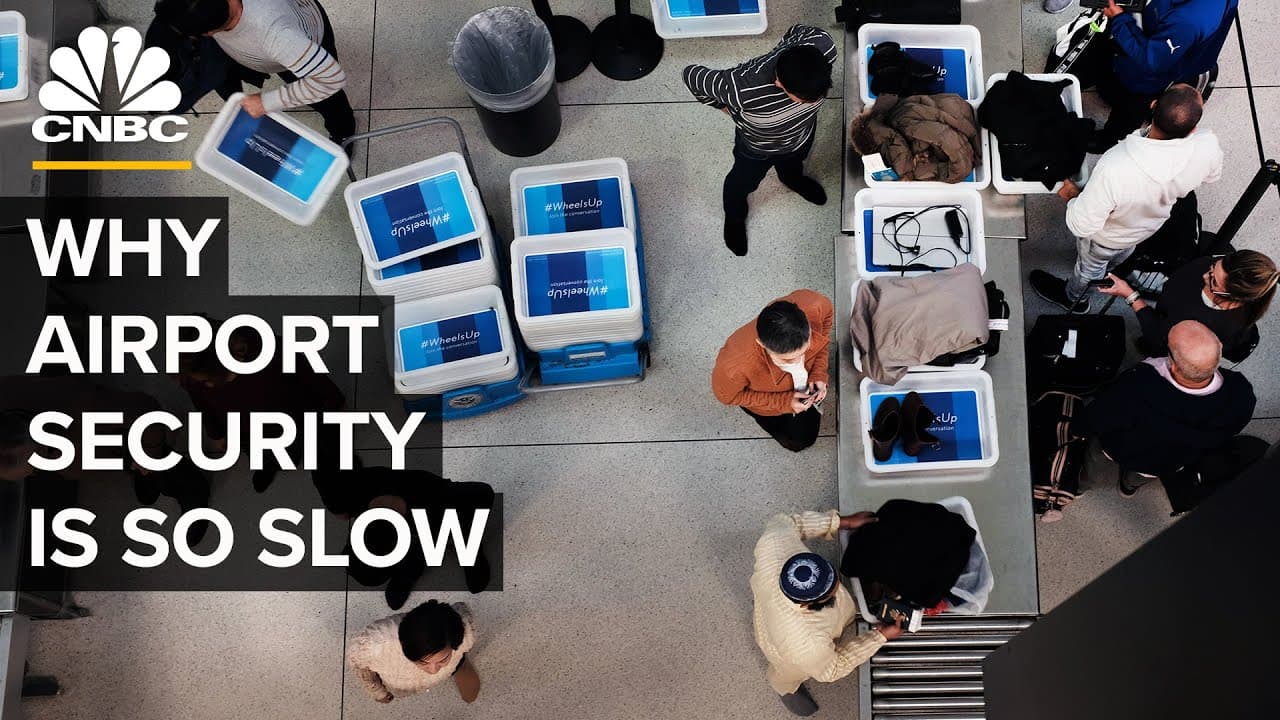
U.S. airport security has been slow to evolve since the TSA was created after 9/11, leaving travelers to remove shoes, laptops, liquids, and belts while wait times reach 45 to 60 minutes at busy airports. The TSA and airlines are now testing facial recognition, CT scanners, and shoe-screening tech to speed lines and improve safety.
Transcript
There once was a time when getting through airport security was quick and easy. Before 9/11, you used to be able to go through airport screening to meet friends or family coming in, there was no checking of ID or anything. X-ray machines were still by and large black and white images. The FAA performance standards for screeners were almost non-exis... Read More
Key Insights
- The TSA was created in November 2001 after 19 hijackers used mace and knives on 9/11, when President George Bush signed the Aviation and Transportation Security Act into law, establishing federal screening standards and taking airport security far more seriously.
- Airport security today is largely reactive: passengers remove shoes because of a shoe bomber, and liquids are pulled out because of attempts to make explosives from liquids, meaning each rule fills a gap that was previously exploited.
- TSA Pre-Check, introduced in 2013, costs $85 for five years and requires fingerprints and a background check, but lets vetted passengers keep shoes, laptops, and electronics in place, with 95% waiting less than five minutes.
- The TSA screens more than 2 million passengers, 5.5 million carry-on items, and 1.4 million checked items daily, and employs over 60,000 people including air marshals, dog teams, explosive specialists, and passenger screeners.
- A 2015 internal Homeland Security red team investigation found TSA agents failed to identify weapons and explosives 95% of the time, leading critics to call the agency 'security theater,' though officials said the vulnerabilities were addressed.
- The airport security market was worth $10.78 billion in 2019 and is expected to exceed $11 billion by the end of 2027, with Smiths Detection, Analogic, and Raytheon among the major companies working in the space.
- Delta, JetBlue, and American Airlines are testing facial recognition for boarding and TSA checkpoints, letting Delta SkyMiles Pre-Check customers drop bags, clear security, and board without showing an ID or boarding pass.
- Liberty Defense received $500,000 from the TSA to develop the Hexwave, a walk-through screener detecting metal, nonmetallic items, liquids, plastics, ghost guns, and drugs, plus a shoe screener integrated into existing body scanners.
Install to Summarize YouTube Videos and Get Transcripts
Explore YouTube Video Summarizer or Get YouTube Transcript Extractor
Questions & Answers
Q: Why do you have to take off your shoes at airport security?
Passengers remove their shoes because of a shoe bomber, whose attempt led the TSA to add shoe inspection to screening. The video explains that a large part of U.S. airport security is reactive: when someone exploits a gap, like hiding a threat in footwear, the TSA adds a corresponding rule. This is the same reason liquids are pulled out from bags, stemming from attempts to make explosives out of liquids.
Q: When and why was the TSA created?
The TSA was created in November 2001, in the aftermath of the September 11 attacks when 19 hijackers used mace and knives to take control of several aircraft. President George Bush signed the Aviation and Transportation Security Act into law, which established the TSA and created federal standards. The focus was to take airport security screening far more seriously, replacing the pre-9/11 system that had almost nonexistent FAA screener standards.
Q: What is TSA Pre-Check and how much does it cost?
TSA Pre-Check, introduced in 2013, is a program that lets vetted passengers bypass some standard screening. It costs $85 for five years, and you agree to share fingerprints and let the TSA run a background check. In exchange, you use a fast-track lane and don't have to remove shoes, laptops, or other electronics. The TSA says 95% of Pre-Check passengers wait less than five minutes.
Q: How many passengers does the TSA screen each day?
In the U.S., the TSA screens more than 2 million passengers, 5.5 million carry-on items, and 1.4 million checked items daily. To handle this volume it employs over 60,000 people, including federal air marshals, dog teams, explosive specialists, and passenger screeners. At Denver International Airport, one of the world's busiest, traveling on a Monday around 10am means average wait times of typically 45 to 60 minutes.
Q: How effective is TSA screening at catching weapons?
A 2015 internal investigation by Homeland Security red teams revealed that TSA agents failed to identify weapons and explosives 95% of the time, leading some to call the TSA simply 'security theater.' U.S. officials said these vulnerabilities were addressed. The video also notes there is work behind the scenes, and that the FBI may know of threats deterred early that have never been made public.
Q: What is facial recognition being used for at airports?
Delta, JetBlue, and American Airlines are among U.S. carriers testing facial recognition for boarding and TSA checkpoints. Delta partnered with the TSA so that SkyMiles customers with TSA Pre-Check can use facial recognition to drop bags, go through security, and board the plane without taking out their ID or boarding pass. Research cited shows 81% of U.S. airline passengers are willing to share personal data with airlines they fly regularly.
Q: What is the Hexwave and what can it detect?
The Hexwave is a walk-through screener developed by Liberty Defense, which received $500,000 from the TSA. It looks like a walk-through metal detector but has capabilities similar to a body scanner, able to detect any anomaly including metal, nonmetallic items, liquids, plastics, ghost guns, and drugs. The technology was developed by Pacific Northwest National Laboratory and funded by DHS, with roughly a three-year program expected before it reaches airports.
Q: How is TSA screening technology expected to change in the future?
The TSA is working with companies to design better screeners so passengers don't have to remove anything from bags and can leave shoes on, integrating detection into existing body scanners for full capability from the shoes on. Analogic and Smiths Detection have won contracts for CT scanners that scan in 3D and identify explosives without removing liquids or electronics. Liberty Defense is also developing a shoe screener using foot reflection to detect threats.
Summary & Key Takeaways
-
Before 9/11, airport security was quick and casual, with no ID checks, no screening lines, black-and-white X-ray machines, and almost nonexistent FAA standards for screeners. Passengers could even walk through screening to meet arriving friends or family at the gate without any identity verification.
-
After the 9/11 attacks, the TSA was created under the Department of Homeland Security, operating on a Congress-set budget of just over $8 billion in 2019, partly funded by a September 11 Security fee that raised $4.2 billion from airline passengers that year.
-
To reduce bottlenecks, the TSA and airlines are deploying automated screening lanes, biometric facial recognition, credential authentication technology rolled out in 2020, and next-generation CT and walk-through scanners so travelers eventually keep shoes on and leave liquids and electronics in bags.
Read in Other Languages (beta)
Share This Summary 📚
Summarize YouTube Videos and Get Video Transcripts with 1-Click
Try YouTube Summary with ChatGPT & Claude or YouTube Transcript Generator
Explore More Summaries from CNBC 📚






Summarize YouTube Videos and Get Video Transcripts with 1-Click
Try YouTube Summary with ChatGPT & Claude or YouTube Transcript Generator