Why Good Decisions Can Still Lead to Bad Outcomes
TL;DR
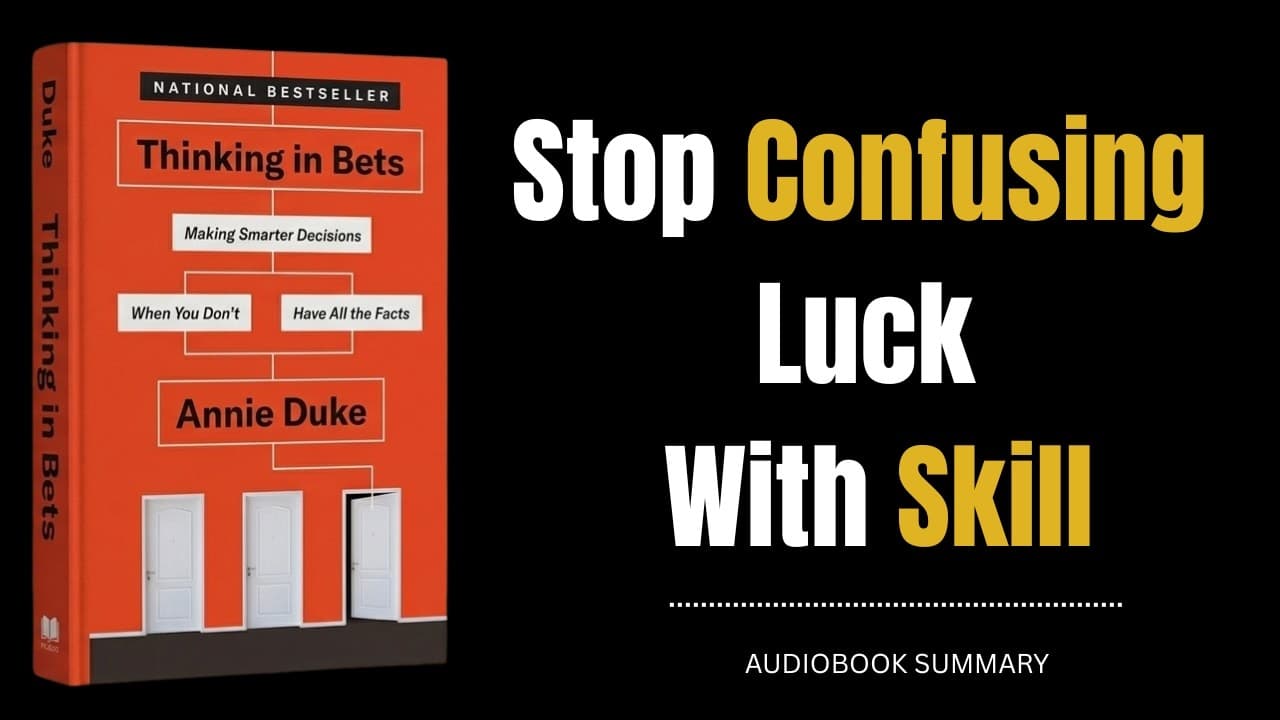
Decision quality and outcome quality are separate things: luck can rescue a careless choice and ruin a careful one, so judging a decision only by its result teaches you the wrong lessons. Annie Duke calls that habit resulting. The fix is to treat every choice as a bet made under uncertainty, judge the process rather than the result, and hold beliefs as estimates you update.
Transcript
Every day we make decisions without knowing exactly how things will turn out. We choose where to invest our money, which career to pursue, whether to start a business, whom to trust, when to take a risk, and when to walk away. We try to gather information, compare options, and make the smartest choice available to us. Yet, even after doing everythi... Read More
Key Insights
- Resulting is the habit of judging a decision solely by how it turned out. It is attractive because outcomes are visible and easy to understand, while the reasoning behind a choice involves uncertainty, hidden information, and probabilities that are hard to measure.
- Good decisions do not always lead to good outcomes and bad decisions do not always lead to bad outcomes. A favorable result does not prove a decision was intelligent, and an unfavorable result does not prove it was foolish, because chance sits between process and result.
- Life resembles poker rather than chess. Chess has almost complete information, every piece is visible, and chance plays almost no role once play begins, so a loss can usually be traced to mistakes made during the match.
- Poker players act without seeing opponents' cards, estimating what opponents hold, calculating likelihoods, deciding how much risk to accept, and updating as new cards appear. The statistically correct move can still lose, and a terrible move can still win.
- A bet, in Duke's broader sense, is any decision made under uncertainty. Accepting a job, starting a company, going back to school, saving instead of spending, and even choosing how to spend one hour are all bets on which option is more likely to help.
- The goal of better decision-making is not to guarantee success, because no method can remove uncertainty from life. The goal is to improve the quality of choices so that over time the likelihood of favorable outcomes increases.
- Beliefs should be treated as estimates rather than fixed facts. That means asking how confident you are, what evidence supports the position, what evidence might challenge it, and what new information would cause you to change your mind.
- Groups improve judgment only when they challenge ideas honestly. A strong decision group does not simply agree; it asks difficult questions, points out missing information, and helps separate fact from personal narratives.
Install to Summarize YouTube Videos and Get Transcripts
Explore YouTube Video Summarizer or Get YouTube Transcript Extractor
Questions & Answers
Q: What does 'resulting' mean in Thinking in Bets?
Resulting is Annie Duke's term for the habit of judging a decision only by its outcome. It is attractive because outcomes are visible and easy to understand: we know whether an investment made money, whether a business succeeded, whether a relationship lasted, or whether a plan worked. The reasoning behind the decision is far harder to evaluate, since it involves uncertainty, hidden information, imperfect predictions, and probabilities that are difficult to measure. So the mind builds a simple story where success means the decision was good and failure means it was bad, even though luck can rescue a poor decision and bad luck can damage a good one.
Q: Why does Annie Duke compare life to poker instead of chess?
Chess is a game with almost complete information. Both players see the entire board, every piece is visible, the rules are fixed, nothing is hidden, and once the game begins chance plays almost no role, so a loss can usually be traced back to mistakes made during the match. Poker works differently: players cannot see their opponents' cards and must decide using partial information, studying betting patterns, calculating probabilities, observing behavior, and drawing on experience, yet never knowing everything with certainty. Ordinary life is much closer to poker, because investors, business owners, employers, and career changers all act without being able to know how things will turn out.
Q: How can a good decision lead to a bad outcome?
Because chance sits between the decision and the result. A poker player can make the statistically correct move and still lose the hand when the final card favors an opponent. In the same way, an investor can study a company's finances, leadership, competition, debt, and future prospects, make a decision based on thoughtful analysis, and then lose value when an unexpected crisis causes the market to fall. The original decision is not automatically bad. The process was strong and the outcome was unfavorable, and a single outcome does not tell us everything about the process that produced it.
Q: What counts as a bet in Annie Duke's framework?
A bet is any decision made under uncertainty, not just casino wagers, sports, or gambling. When we choose one option instead of another, we place confidence in a particular view of the future and bet that one action is more likely to help us than the alternatives. Accepting a job is a bet that the opportunity beats the choices we reject. Starting a company is a bet that customers will value what we offer. Going back to school is a bet that the benefits justify the time and cost. Saving instead of spending is a bet that future security outweighs immediate consumption, and even deciding how to spend one hour is a bet.
Q: How should you evaluate a decision if not by its result?
Evaluate the process rather than the emotional meaning of the outcome. That means asking what you knew at the time, what alternatives were available, how likely each outcome seemed, and whether your reasoning was disciplined. Gathering useful information, estimating probabilities, considering alternative explanations, and accepting that even a strong decision may produce an unfavorable result are all part of the standard. Since outcomes cannot be guaranteed, the best available strategy is to improve the way choices are made, which raises the likelihood of favorable results over time even though it can never promise them in any single case.
Q: Why do people resist changing their beliefs, and what should replace that?
People often protect their beliefs rather than test them. We search for information that confirms what we already think, ignore evidence that makes us uncomfortable, interpret disagreement as a personal attack, and become more interested in proving we are right than in discovering what is true. Duke argues for a different attitude: treat beliefs as estimates rather than fixed facts, and ask how confident you are, what evidence supports your position, what evidence might challenge it, and what new information would change your mind. Changing your mind should be seen as progress, not failure, because inaccurate beliefs build choices on a weak foundation.
Q: How do groups improve decision-making quality?
Our own thinking is affected by bias, emotion, and self-interest, so we need environments where ideas can be challenged honestly. A strong decision group does not simply agree with us. It asks difficult questions, points out missing information, and helps separate fact from personal narratives. This is especially valuable in business, investing, leadership, and personal finance, where important decisions often involve pressure, fear, hope, and overconfidence. Learning from other people is one of the practical ways to counter the distortions that arise when a single person evaluates their own reasoning in isolation.
Q: Why do people stick with failing plans and investments?
Emotion and identity get tangled up with the decision. We may become attached to a project because we have already spent money on it. We may refuse to sell an investment because accepting a loss feels painful. We may continue following a failing plan because admitting a mistake threatens our identity. Thinking in bets offers a healthier framework by shifting attention from the emotional meaning of an outcome to the quality of the process: what was known at the time, which alternatives existed, how likely each outcome seemed, and whether the reasoning was disciplined enough to justify the choice.
Q: Does thinking in bets mean becoming cold and mechanical about decisions?
No. Duke is explicit that thinking in bets does not mean becoming cold, mechanical, or obsessed with numbers. It means recognizing that our beliefs are rarely completely certain. We can be confident without pretending to know everything, make strong choices while admitting we might be wrong, and say an outcome is likely without claiming it is guaranteed. This way of thinking encourages intellectual humility rather than detachment. The aim is honest calibration about what we know, not the removal of judgment, values, or conviction from the decisions we make.
Q: What is the goal of better decision-making under uncertainty?
The goal is not to guarantee success, because no method can remove uncertainty from life. It is to improve the quality of our choices so that over time we increase the likelihood of favorable outcomes. Uncertainty is not something we can defeat, it is something we must learn to manage. We cannot control every event, predict every change, or remove luck from our lives, but we can become more honest about what we know, more careful about how we decide, and more willing to learn from both success and failure. Life is a series of bets made with limited information.
Summary & Key Takeaways
-
Annie Duke's central argument is that we live in a world shaped by uncertainty, incomplete information, chance, and forces outside our control, so decisions should not be judged only by what happened afterward. A careful choice can fail through bad luck and a careless one can succeed through good luck, which makes outcome-only judgment a poor teacher.
-
Duke draws the lesson from professional poker, a serious decision-making environment where players act on partial information. A statistically correct move can lose a hand and a terrible move can win it. Players who judge themselves by single hands repeat strategies that happened to work and abandon strong strategies that failed in the short term.
-
The same distortion appears in investing. One investor studies finances, leadership, competition, debt, and prospects, then loses money in an unexpected market fall. Another invests on a random online post with no research and profits. Focusing only on results praises recklessness and punishes careful thinking, damaging our ability to learn over time.
-
Thinking in bets means recognizing that beliefs are rarely completely certain, and that a bet is any decision made under uncertainty. It encourages intellectual humility: being confident without pretending to know everything, making strong choices while admitting you might be wrong, and treating a change of mind as progress rather than failure.
-
People often protect beliefs instead of testing them, seeking confirming information, ignoring uncomfortable evidence, and reading disagreement as personal attack. Because our own thinking carries bias, emotion, and self-interest, we need groups and environments where ideas are challenged honestly and missing information is pointed out.
-
Emotional attachment distorts important decisions: we cling to projects we have spent money on, refuse to sell investments because accepting a loss hurts, and continue failing plans because admitting a mistake threatens our identity. The framework redirects attention to what we knew at the time, what alternatives existed, and whether the reasoning was disciplined.
-
The deeper message is that uncertainty cannot be defeated, only managed. We cannot control every event, predict every change, or remove luck. We can be more honest about what we know, more careful about how we decide, and more willing to learn from both success and failure.
Read in Other Languages (beta)
Share This Summary 📚
Summarize YouTube Videos and Get Video Transcripts with 1-Click
Try YouTube Summary with ChatGPT & Claude or YouTube Transcript Generator
Explore More Summaries from Capitura Audiobooks 📚
Summarize YouTube Videos and Get Video Transcripts with 1-Click
Try YouTube Summary with ChatGPT & Claude or YouTube Transcript Generator