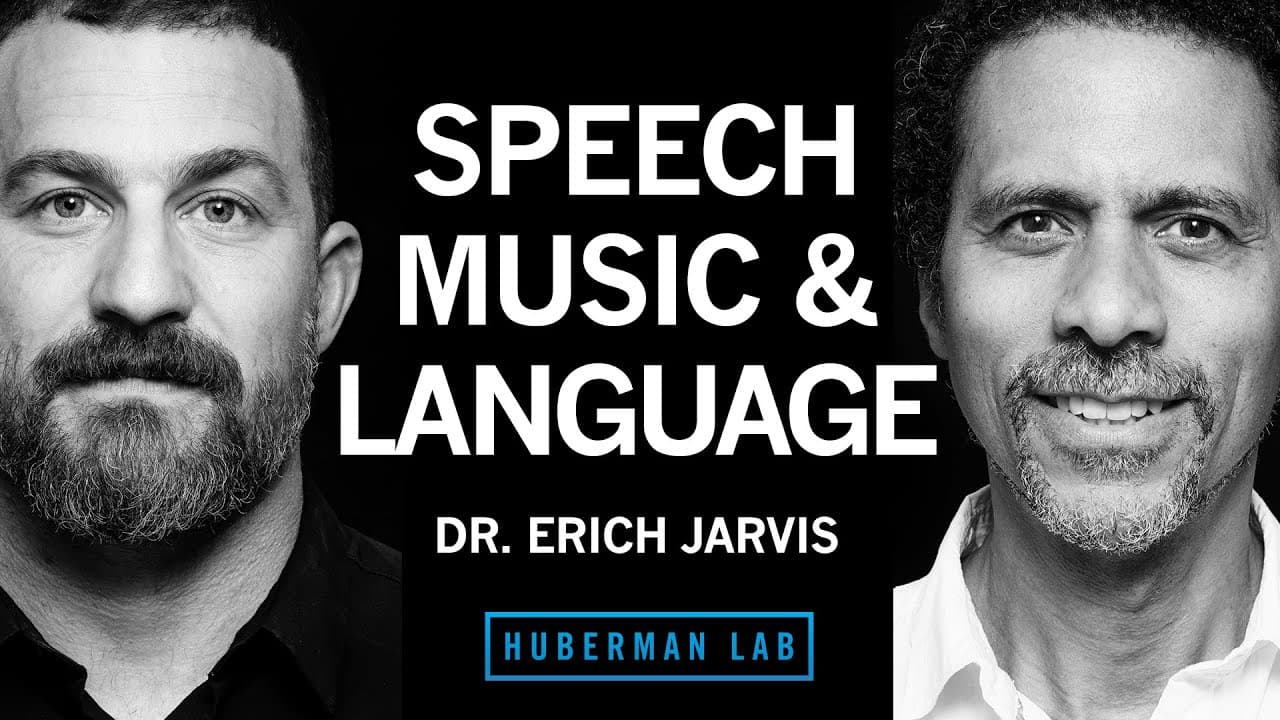
What Is the Neuroscience Behind Speech and Language?
TL;DR
The neuroscience of speech and language reveals that humans and vocal learning species like parrots and songbirds have similar brain circuits that enable vocal mimicry and complex communication. These circuits control sound production, auditory perception, and are influenced by genetic factors. Critical periods during early development enhance our ability to learn languages effortlessly, as the brain's plasticity allows for better phonetic and vocabulary acquisition.
Transcript
- Welcome to the Huberman Lab Podcast, where we discuss science and science-based tools for everyday life. [lively music] I'm Andrew Huberman, and I'm a professor of neurobiology and ophthalmology at Stanford School of Medicine. Today, my guest is Dr. Erich Jarvis. Dr. Jarvis is a professor at the Rockefeller University in New York City and his lab... Read More
Key Insights
- 🔔 Vocal learning is a rare ability found in humans, parrots, and songbirds, enabling the imitation and production of complex sounds and language.
- 🧠 The brain circuits involved in vocal learning are similar between humans, parrots, and songbirds, suggesting a shared evolutionary origin.
- 🧠 Dance and vocal learning share common brain circuits, allowing for coordinated movement and emotional expression.
- ▶️ Critical periods in early life play a role in language learning, facilitating the acquisition of new languages during these sensitive developmental stages.
Install to Summarize YouTube Videos and Get Transcripts
Explore YouTube Video Summarizer or Get YouTube Transcript Extractor
Questions & Answers
Q: How do humans generate speech when reading silently?
Dr. Jarvis explains that when reading silently, humans generate low-level motor activity in their throat, essentially speaking the words they are reading without sound. However, this motor activity is not perceptible to the reader.
Q: Do animals other than humans have language or forms of communication similar to language?
Certain species of birds, such as parrots and songbirds, have the ability to imitate sounds, including human speech. While their communication may not be as complex as human language, it demonstrates a form of vocal learning and communication through sounds.
Q: How do critical periods affect language learning?
Critical periods are specific periods in early life when learning certain skills, such as language, is most efficient. During these periods, the brain is highly plastic and receptive to acquiring new knowledge. Learning additional languages later in life may be more difficult as the brain becomes less plastic, but prior language learning can facilitate the acquisition of new languages.
Q: Does dancing involve coordination between the brain and the body?
Yes, dancing involves the synchronization of body movements and the processing of rhythmic beats of music. The brain circuits involved in speech and language are also utilized in dance, allowing for the coordination of movement and emotional expression. Dancing serves as an effective form of non-verbal communication and bonding.
Key Insights:
- Vocal learning is a rare ability found in humans, parrots, and songbirds, enabling the imitation and production of complex sounds and language.
- The brain circuits involved in vocal learning are similar between humans, parrots, and songbirds, suggesting a shared evolutionary origin.
- Dance and vocal learning share common brain circuits, allowing for coordinated movement and emotional expression.
- Critical periods in early life play a role in language learning, facilitating the acquisition of new languages during these sensitive developmental stages.
- Effective communication and semantic communication both involve the brain circuits for language, but effective communication focuses more on emotion and bonding.
Summary & Key Takeaways
-
Vocal learning is a rare ability found in humans, parrots, and songbirds, allowing them to imitate sounds and communicate through complex language.
-
The brain circuits involved in vocal learning are similar in humans and vocal learning species, indicating a common evolutionary origin.
-
These brain circuits are responsible for connections, calcium buffering, and neuroplasticity, facilitating the production and understanding of language sounds.
-
Dancing, like vocal learning, involves coordination between sound and movement, and it is believed to have evolved from the same brain circuits.
Read in Other Languages (beta)
Share This Summary 📚
Summarize YouTube Videos and Get Video Transcripts with 1-Click
Try YouTube Summary with ChatGPT & Claude or YouTube Transcript Generator
Explore More Summaries from Andrew Huberman 📚

Summarize YouTube Videos and Get Video Transcripts with 1-Click
Try YouTube Summary with ChatGPT & Claude or YouTube Transcript Generator