Sacha Arnoud, Director of Engineering, Waymo - MIT Self-Driving Cars
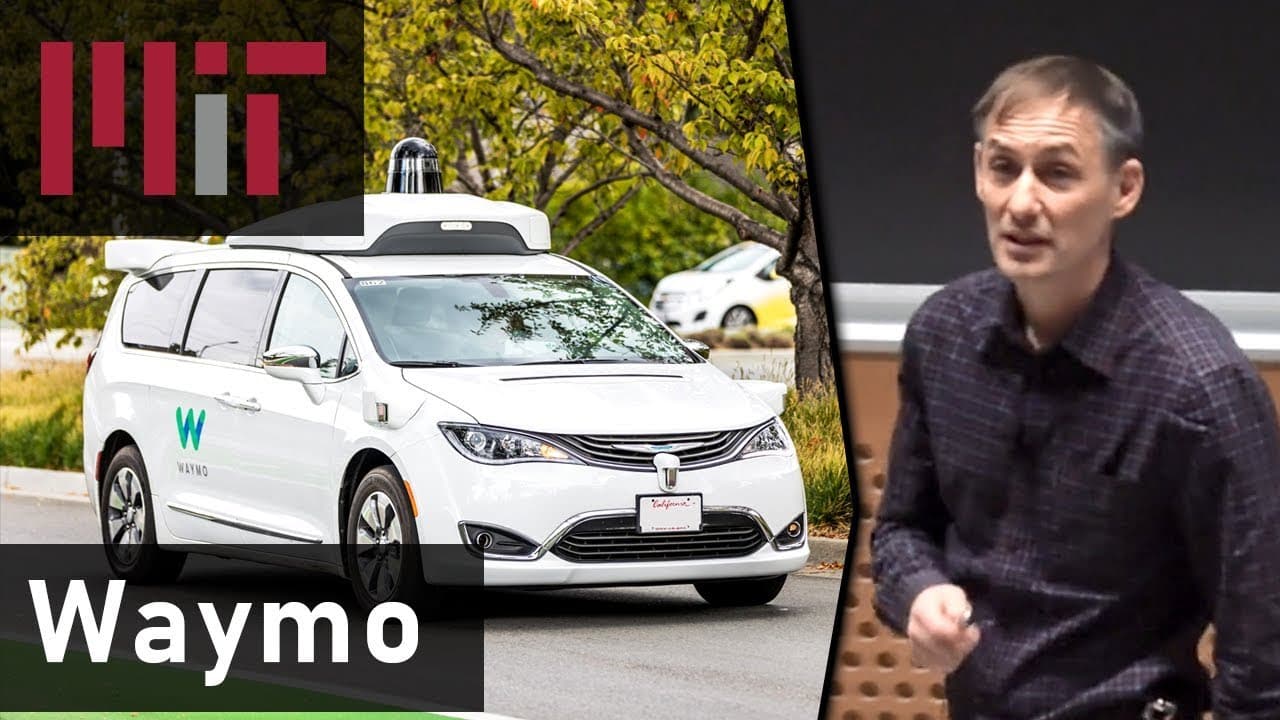
TL;DR
Waymo employs deep learning to enhance the perception and understanding of self-driving cars, allowing for safer navigation in complex environments. By analyzing over four million miles of driving data, they ensure the technology can recognize and predict behaviors of pedestrians and vehicles. Extensive testing and simulation are key to developing a robust, efficient self-driving system.
Transcript
today we have the director of engineering head of perception at way mo a company that's recently driven over four million miles autonomously and in so doing inspired the world in what artificial intelligence and good engineering can do so please give a warm welcome to Sasha our new [Applause] thanks a lot Lex for the introduction well it's it's a p... Read More
Key Insights
- 🤳 Waymo's self-driving technology relies on deep learning techniques to enhance perception and understanding of the surrounding environment.
- ✊ Labeling efforts, computation power, and extensive testing and simulation are crucial for building a successful self-driving system.
- 😒 Waymo uses a combination of real-world testing and simulation to refine their self-driving technology and handle a wide range of scenarios and challenges.
Install to Summarize YouTube Videos and Get Transcripts
Explore YouTube Video Summarizer or Get YouTube Transcript Extractor
Questions & Answers
Q: How does Waymo collect and label the data necessary for training their deep learning models?
Waymo collects a massive amount of data from their self-driving cars and uses a combination of supervised and unsupervised techniques to label the data. They also utilize active learning and iterative training to improve the accuracy of the labels.
Q: How does simulation play a role in the testing and validation of Waymo's self-driving technology?
Simulation is an essential component of Waymo's testing process. They have a simulated environment that allows them to replay and augment real-world driving data to test their self-driving system in various scenarios and ensure its robustness and safety.
Q: How does Waymo handle perception failures and unpredictable scenarios in their self-driving system?
Waymo uses the data from perception failures during testing to improve their models. By incorporating the mistakes and challenges encountered in real-world scenarios into their simulation and testing process, they can refine their perception system and ensure better performance in challenging situations.
Q: How does Waymo decide on the architecture for their self-driving system, considering the variety of sensors and algorithms available?
Waymo's architecture is carefully designed through a combination of research, collaboration with Google teams, and extensive testing. They aim to choose the best building blocks and continually explore and refine their system to ensure safety and efficiency.
Summary
In this video, the director of engineering and head of perception at Waymo shares insights into the self-driving car industry, the history of machine learning and deep learning, and the technical aspects of building a self-driving car system. He discusses the challenges of perception in autonomous vehicles and how deep learning techniques are used to analyze sensor data and understand the surrounding environment.
Questions & Answers
Q: What are the three main objectives of the presentation?
The three main objectives of the presentation are to provide background on the self-driving space, share technical details on the techniques used in self-driving cars, and give insights into the process of building an industrial project for self-driving cars.
Q: Why is self-driving technology important?
Self-driving technology has the potential to greatly improve safety, accessibility to mobility, and efficiency in transportation. It can reduce human errors that lead to accidents, make transportation more affordable and accessible to all, and optimize traffic flow and urban design.
Q: How did the self-driving project at Waymo start?
The self-driving project at Waymo started under the umbrella of a Google project called Chauffeur in 2009. The initial objective was to assemble off-the-shelf sensors and test if self-driving was even possible. The team successfully completed 10 loops of driving in challenging conditions, which led to the decision to pursue self-driving technology.
Q: What was a major milestone for Waymo in 2017?
In 2017, Waymo became its own company, which was a major milestone and a testament to the robustness of the technology. This allowed Waymo to move from a prototype phase to a productization phase.
Q: What are the main motivations for self-driving technology?
The main motivations for self-driving technology are safety, accessibility to mobility, and efficiency. Self-driving cars have the potential to reduce human errors that lead to accidents, make transportation more affordable and accessible to all, and optimize traffic flow and urban design.
Q: How does perception work in self-driving cars?
Perception in self-driving cars involves building an understanding of the surrounding world using sensor data. This includes mapping the environment, localizing the car within the map, and using sensors like cameras and lidar to detect and classify objects and understand their behaviors.
Q: What are the challenges in perception for self-driving cars?
Some of the challenges in perception for self-driving cars include filtering sensor data to remove noise and irrelevant information, dealing with reflections and other sensor limitations, segmenting objects in the scene, understanding complex semantics like emergency vehicles and pedestrians, and predicting the behavior of objects in the scene.
Q: How does deep learning impact perception in self-driving cars?
Deep learning techniques, like convolutional neural networks, are used in perception tasks to extract features from sensor data and understand the scene. Deep learning enables efficient processing and analysis of dense and sparse sensor data, and can be used to detect and classify objects, segment scenes, and learn semantic embeddings for efficient and accurate processing.
Q: How do deep learning techniques handle objects with different shapes and poses?
Deep learning techniques, like the sliding window approach and single-shot multi-box convolutional networks, can be used to handle objects with different shapes and poses. These techniques involve training deep neural networks to detect and segment objects, while taking into account priors and shape information of the objects.
Q: How do deep learning techniques handle complex semantic understanding, like emergency vehicles?
Deep learning techniques, in combination with embeddings, can be used to handle complex semantic understanding, like emergency vehicles. By training deep neural networks to learn vector representations of objects, semantic information can be encoded in these embeddings. This enables efficient and accurate processing of objects with specific semantics, such as emergency vehicles.
Takeaways
Deep learning techniques play a vital role in perception tasks for self-driving cars. They enable efficient processing and analysis of sensor data, extraction of features, object detection and segmentation, and semantic understanding. Deep learning allows self-driving cars to understand and respond to their surrounding environment, making autonomous driving safer and more efficient. The development of self-driving technology requires extensive testing and refinement, as well as collaboration across different domains. Building a self-driving car system involves not just algorithms and deep learning models, but also industrial project management and real-world implementation.
Summary & Key Takeaways
-
Waymo has driven over four million miles autonomously, aiming to make self-driving cars safe, accessible, and efficient.
-
Deep learning has played a crucial role in the development of their self-driving technology, enhancing perception and understanding of the surrounding environment.
-
Labeling efforts, computation power, and extensive testing and simulation are key factors in the process of building a robust machine learning system for self-driving cars.
Read in Other Languages (beta)
Share This Summary 📚
Summarize YouTube Videos and Get Video Transcripts with 1-Click
Try YouTube Summary with ChatGPT & Claude or YouTube Transcript Generator
Explore More Summaries from Lex Fridman 📚






Summarize YouTube Videos and Get Video Transcripts with 1-Click
Try YouTube Summary with ChatGPT & Claude or YouTube Transcript Generator