Apple Watch Series 10 Review: Accurate Heart Rate
TL;DR
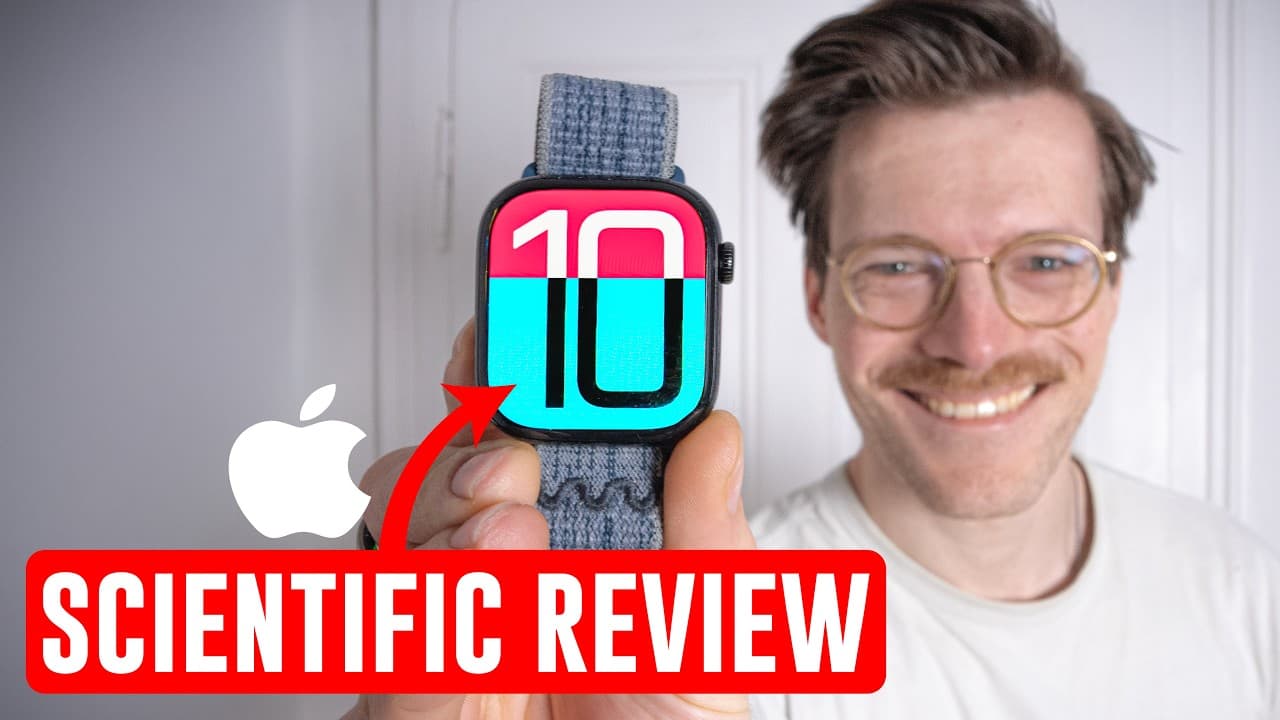
Apple Watch Series 10 produced highly accurate heart-rate measurements for outdoor running and cycling, closely matching a Polar H10 ECG chest strap. Weightlifting accuracy was also strong for the reviewer’s colleague, although a few outliers reduced correlation and the reviewer cautions that wrist tension, exercise style, and individual physiology can affect performance.
Transcript
the Apple Watch series 10 is the Apple watch most people will likely get if they plan to get an Apple watch right now but is it the best Apple watch to get in 2025 well in terms of features and usability it's one of the most solid and well integrated devices out there but if you want to track your workouts and your health is the Apple watch the way... Read More
Key Insights
- Apple Watch Series 10 is an incremental update that adds a slightly larger screen and slightly thinner design, rather than the substantially new appearance some people anticipated for the tenth watch in the series.
- The 46 mm and 42 mm versions have no indicated performance difference in the testing discussed, although only the 46 mm model was used in the final test because the reviewer expected it to be the more common choice.
- Outdoor running heart-rate tracking is exceptionally accurate for the tested colleague, with three runs producing nearly perfect agreement against the Polar H10 ECG chest strap and a rounded correlation value of 1.0.
- Outdoor cycling heart-rate tracking is highly accurate across 22 rides, achieving a correlation of 0.99 against the reference device, although occasional brief signal losses and incompletely captured abrupt heart-rate changes appeared in individual rides.
- Apple Watch Series 10 and Pixel Watch 3 are the strongest performers among the devices compared for the colleague’s running and cycling, while Pixel Watch 2, Whoop Strap, and Galaxy Fit 3 showed weaker results in the presented comparisons.
- Weightlifting heart-rate tracking is strong for the tested colleague, with a correlation of 0.94 and successful detection of most peaks, although a small number of distant outliers had a substantial effect on the correlation score.
- Wrist-based heart-rate accuracy can differ between people because physiology, exercise technique, and muscular tension may affect optical measurements, which could explain why weightlifting results were better for the colleague than for the reviewer.
- Apple Watch heart-rate tracking may omit data when it cannot obtain a reliable lifting measurement, according to the reviewer’s prior experience, instead of filling the session with heart-rate values that appear incorrect.
Install to Summarize YouTube Videos and Get Transcripts
Explore YouTube Video Summarizer or Get YouTube Transcript Extractor
Questions & Answers
Q: How accurate is Apple Watch Series 10 for running?
Apple Watch Series 10 was nearly perfect for the three outdoor runs completed by the reviewer’s colleague. Its heart-rate readings closely followed the Polar H10 ECG chest strap, including during an interval run, and the combined correlation rounded to 1.0. Only a few measurements departed noticeably from the agreement line, and the reviewer considered the performance more than sufficient.
Q: How accurate is Apple Watch Series 10 for cycling?
Across 22 outdoor bike rides, Apple Watch Series 10 achieved a heart-rate correlation of 0.99 against the Polar H10 reference. Most rides showed very close agreement, but the watch occasionally lost its signal briefly or failed to reproduce the full abruptness of a heart-rate change. The reviewer still judged the overall cycling performance to be very good.
Q: Does Apple Watch Series 10 track weightlifting accurately?
Weightlifting tracking was surprisingly strong for the reviewer’s colleague. The watch achieved a correlation of 0.94 against the chest strap and followed most of the heart-rate peaks across several sessions. A few measurements were far from the agreement line, and one peak was missed, but the individual workout plots generally showed results the reviewer considered good enough.
Q: Why can Apple Watch heart-rate accuracy vary by wearer?
The review suggests that individual physiology, exercise technique, or both may influence wrist-based heart-rate measurements. During weightlifting, muscular tension around the reviewer’s wrist has previously prevented Apple Watches from detecting peak heart rates. His colleague experienced far fewer problems, so the difference could reflect how each person exercises, their physical characteristics, or improved Series 10 performance.
Q: What reference device was used to test Apple Watch Series 10?
The tests used a Polar H10 ECG chest strap as the reference for heart-rate measurements. The reviewer describes chest straps as generally the most reliable approach to heart-rate measurement and notes that the Polar H10 has been used and validated in multiple scientific studies. Apple Watch readings were matched against simultaneous Polar H10 readings to calculate agreement and correlation.
Q: Is Apple Watch Series 10 a major design upgrade?
Apple Watch Series 10 is characterized as an incremental upgrade rather than a major redesign. Despite anticipation surrounding the tenth watch in the series, the changes highlighted are a slightly larger screen and a slightly thinner body. The reviewer appreciates those improvements but says they would not, by themselves, provide enough reason for him to upgrade from an earlier model.
Q: How does Apple Watch Series 10 compare with other trackers?
In the comparisons based on the colleague’s data, Apple Watch Series 10 and Pixel Watch 3 were the strongest performers for running and outdoor cycling. Pixel Watch 2 performed worse than Pixel Watch 3, while the newer Whoop heart-rate algorithm improved upon its older version but remained less accurate than the Apple Watch. Galaxy Fit 3 ranked last in the cycling comparison shown.
Q: Why does Apple Watch sometimes omit heart-rate readings during lifting?
The reviewer reports that intense wrist and arm tension during a lifting set can prevent an Apple Watch from reliably detecting his heart rate, particularly at the peaks. When the watch recognizes that it cannot obtain a dependable reading, it may stop reporting heart rate temporarily. The reviewer views missing data as different from devices that continue displaying an apparently incorrect measurement.
Summary & Key Takeaways
-
Apple Watch Series 10 is presented as a polished, well-integrated smartwatch, but its physical changes are incremental. Compared with previous versions, the principal design differences discussed are a slightly larger screen and a slightly thinner body. The review therefore focuses on workout and health tracking rather than appearance or general usability.
-
Testing compared the 46 mm Apple Watch Series 10 with a Polar H10 ECG chest strap, which served as the heart-rate reference. Three outdoor runs produced nearly perfect agreement and a rounded correlation of 1.0. Twenty-two outdoor bike rides achieved a correlation of 0.99, with only brief signal losses and missed abrupt changes.
-
Weightlifting results varied by wearer. The reviewer’s colleague achieved a correlation of 0.94, and the watch followed most heart-rate peaks across several sessions. The reviewer notes that Apple Watches have previously struggled on his own wrist during lifting, often withholding readings when muscular tension prevents reliable detection rather than reporting an apparently incorrect value.
Read in Other Languages (beta)
Share This Summary 📚
Summarize YouTube Videos and Get Video Transcripts with 1-Click
Try YouTube Summary with ChatGPT & Claude or YouTube Transcript Generator
Explore More Summaries from The Quantified Scientist 📚
Summarize YouTube Videos and Get Video Transcripts with 1-Click
Try YouTube Summary with ChatGPT & Claude or YouTube Transcript Generator