How Will Advanced AI Reshape Work and Careers?

TL;DR
Current AI can already perform far more knowledge work than most people realize, creating a large gap between technical capability and practical adoption. The speaker argues that stronger models, wider application, coding-focused research, and increasing autonomy could rapidly reshape careers, while workers can prepare by understanding AI’s uneven skills and learning to apply it effectively.
Transcript
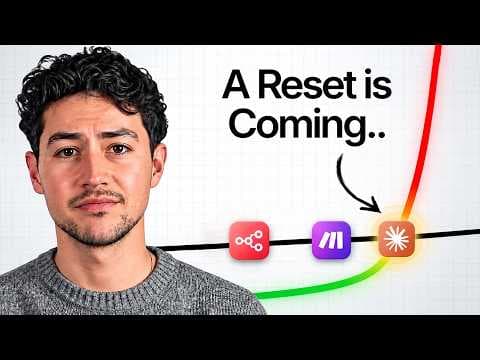
OpenAI published an article just last month all about the future of work and what AI developments mean for the economy and I think a lot of people have missed it. So in this video I wanted to talk a little bit about that. Then I also wanted to show you guys three major concepts that you can use in order to insulate yourself against oncoming changes... Read More
Key Insights
- AI capability overhang is the gap between what current systems can accomplish and what people understand or apply. The speaker argues that most users still associate AI with chatbots, search, homework, and limited coding, despite its potential to perform a much broader range of knowledge work.
- Current AI can perform conversations, sales calls, email writing, spreadsheet analysis, coding, and tax-related tasks, according to the speaker. This breadth supports the claim that the primary near-term constraint is not only model intelligence, but also society’s limited ability to deploy existing capabilities effectively.
- AI adoption could continue for 20 or 30 years even if model development stopped, according to the speaker’s estimate. The reasoning is that practical applications lag behind theoretical capability, leaving many use cases, workflows, and economic efficiencies undiscovered even with the technology already available.
- AI progress is driven by two simultaneous forces: models are becoming more intelligent, and people are becoming better at applying them. The speaker expects these forces to reinforce one another, accelerating both technical progress and the conversion of model capabilities into economically useful systems.
- AI performance is spiky because it exceeds human ability in some domains while falling below it in others. The speaker argues that critics often focus on weak edge cases, even though frontier reasoning models already display exceptionally strong performance in selected mathematical and intellectual tasks.
- AI weaknesses are expected to diminish as the overall capability boundary expands. The speaker predicts that even the lowest-performing portions of future systems may eventually exceed human performance, while their strongest areas could complete in seconds work that would require enormous amounts of collective human effort.
- Coding is the central capability receiving investment from frontier AI laboratories, according to the speaker. The strategic purpose is to build systems that can program and research new approaches well enough to contribute to the creation of more intelligent successor models.
- The Turing test illustrates how a major AI milestone can pass without immediately changing daily life. Computers can now converse and address difficult problems through natural language, yet the speaker notes that society mainly received new products because practical adoption did not advance as quickly as the underlying capability.
Install to Summarize YouTube Videos and Get Transcripts
Explore YouTube Video Summarizer or Get YouTube Transcript Extractor
Questions & Answers
Q: What is the AI capability overhang?
The AI capability overhang is the gap between what existing AI systems can actually do and what people believe they can do or know how to apply. The speaker says most people still think primarily about chatbots, search, homework, and coding assistance, while current systems can also support conversations, sales calls, email writing, spreadsheet analysis, and tax-related work.
Q: Why could AI transform work even if development stopped?
AI could continue transforming work because society has not yet applied the full capabilities of existing models. The speaker estimates that, even if development stopped tomorrow, people could spend another 20 or 30 years discovering use cases and using AI to economize parts of the market. Practical implementation currently trails the power of the underlying models.
Q: Why does the speaker expect AI-driven change to accelerate?
The speaker expects acceleration because two developments are occurring at the same time. Model intelligence is improving, supported by rapidly increasing investment, while individuals and organizations are also learning how to apply that intelligence more effectively. Progress in both capability and adoption means stronger tools can reach more tasks as people discover better ways to use them.
Q: What does spiky AI performance mean?
Spiky performance means that AI ability is uneven across different tasks. A model may remain worse than humans in some domains while vastly outperforming them in others. The speaker uses expanding, irregular capability shapes to explain this pattern and argues that attention to isolated failures can produce a misleading picture of the system’s overall intellectual reach.
Q: Why are isolated AI mistakes a weak measure of capability?
Isolated mistakes reveal genuine weaknesses, but they do not represent every area of model performance. The speaker cites examples such as counting letters in the word strawberry, generating too many fingers, or producing images with a recognizable sheen. Focusing only on these cases ignores domains where frontier models already outperform the vast majority of people.
Q: Why are AI laboratories concentrating on coding?
AI laboratories are concentrating on coding because the next generation of model intelligence depends heavily on the ability to program more complex systems and research new coding approaches. According to the speaker, improving this capability may allow AI to contribute to building smarter successor models, increasing the pace of research and development rather than optimizing every application separately today.
Q: How does coding-focused AI research affect future progress?
Coding-focused research is intended to create a feedback loop in which a capable model helps develop an even more capable model. The speaker presents this as a way to steepen the historical pace of technological progress. Instead of allocating equal effort to counseling, art, protein folding, math, and other fields, laboratories prioritize the capability that may accelerate future research itself.
Q: Why did passing the Turing test not immediately change society?
The popular version of the Turing test asks whether someone using a text interface can distinguish a machine from a human. The speaker says computers can now converse and think about difficult problems in natural language, yet daily life largely continued as before. The capability arrived faster than broad deployment, producing useful products without an immediate societal transformation.
Summary & Key Takeaways
-
The speaker describes an AI capability overhang: current systems can handle conversations, sales calls, emails, spreadsheet analysis, coding problems, and tax-related work, but most people still treat them mainly as chatbots or search tools. Even without further model development, practical adoption could continue transforming the knowledge economy for decades.
-
AI performance is described as spiky because models outperform humans dramatically in some areas while retaining serious weaknesses in others. The speaker expects these weak areas to shrink as models improve. Judging AI only by conspicuous mistakes, such as spelling-count errors or flawed images, can therefore obscure its strongest existing capabilities.
-
Frontier laboratories are portrayed as concentrating heavily on coding because better programming and research abilities can help create more capable future models. The discussion connects this feedback loop with the Turing test, arguing that machines crossed a long-anticipated conversational milestone without immediately transforming daily life because capability and widespread application develop at different speeds.
Read in Other Languages (beta)
Share This Summary 📚
Summarize YouTube Videos and Get Video Transcripts with 1-Click
Try YouTube Summary with ChatGPT & Claude or YouTube Transcript Generator
Explore More Summaries from Nick Saraev 📚




Summarize YouTube Videos and Get Video Transcripts with 1-Click
Try YouTube Summary with ChatGPT & Claude or YouTube Transcript Generator