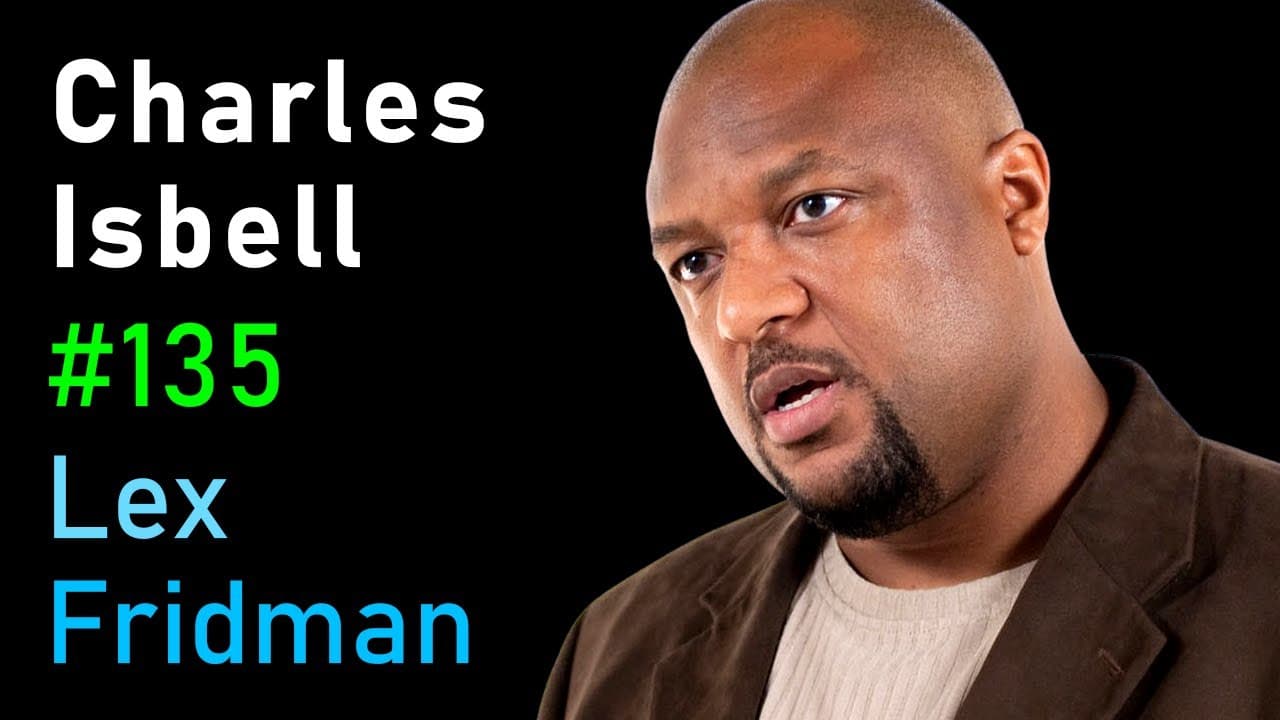
Charles Isbell on Interactive AI and Race
TL;DR
Computing is broader than any single tool or discipline, and interactive AI should be understood through its continuing relationship with people. Charles Isbell connects machine learning, education, culture, and race, arguing that empathy and communication can help people move beyond social bubbles while thoughtful institutions can better support learning, research, and inclusion.
Transcript
The following is a conversation with Charles Isbell, Dean of the College of Computing at Georgia Tech, a researcher and educator in the field of artificial intelligence, and someone who deeply thinks about what exactly is the field of computing and how do we teach it. He also has a fascinatingly varied set of interests, including music, books, movi... Read More
Key Insights
- Computing is presented as a broad field whose identity affects how universities teach it, organize faculty, and communicate its purpose. The conversation treats defining computing as an institutional and educational question, not merely a matter of selecting particular technologies or technical methods.
- Interactive AI is framed around the continuing relationship between intelligent systems and people. The topic shifts attention from isolated model performance toward interaction, adaptation, and the ways a system's behavior develops in contact with human users and changing circumstances.
- Lifelong machine learning is discussed as part of understanding systems that continue learning over time. Its inclusion alongside interactive AI emphasizes that intelligence is not necessarily a fixed capability produced once, but can involve ongoing experience, feedback, and adjustment.
- Human behavior can be highly predictable when observations capture the right period and context. Isbell's home experiment recorded infrared activity, and his two-day intuition concerned whether a carefully chosen sample could reveal much of a person's repeated routine.
- Social bubbles limit exposure to unfamiliar perspectives, while empathy and communication can help people engage across disagreement. The conversation links this challenge to online interaction and asks how exchanges can contain more understanding during periods of racial and political tension.
- Faculty hiring and university rankings shape academic computing by influencing who joins institutions and how those institutions evaluate success. The discussion places these administrative subjects beside teaching and research, showing that the organization of universities affects the field's development.
- Narrative and conversation are central to Isbell's appreciation of movies. He values rapid dialogue in His Girl Friday and admires Crouching Tiger, Hidden Dragon and John Wick for introducing rich worlds without stopping to explain every rule.
- Race in America is explored through personal stories, racial tensions, and a comparison involving Martin Luther King Jr. and Malcolm X. The discussion emphasizes human experience and empathy, then broadens into questions about civilization, death, and the passage of time.
Install to Summarize YouTube Videos and Get Transcripts
Explore YouTube Video Summarizer or Get YouTube Transcript Extractor
Questions & Answers
Q: What is interactive AI according to Charles Isbell?
Interactive AI is treated as intelligence understood through continuing interaction between a system and people, rather than as a completely isolated technical artifact. The discussion connects it with lifelong machine learning, suggesting attention to how systems learn, adapt, and respond over time. This perspective places human behavior, feedback, communication, and changing circumstances within the study of artificial intelligence.
Q: How does lifelong machine learning relate to interactive AI?
Lifelong machine learning concerns systems that continue learning across experience rather than remaining fixed after an initial period of development. In the conversation, it appears alongside interactive AI because interaction supplies new situations and feedback over time. Together, the ideas encourage researchers to examine adaptation, accumulated experience, and the ongoing relationship between intelligent systems and the people around them.
Q: Why does Charles Isbell think people are predictable?
Isbell's intuition comes from an experiment involving infrared activity recorded throughout his home. He suggests that the right two days of observations may capture a large share of a person's behavior because routines produce repeated patterns. The qualification matters: he does not claim that any arbitrary two days are sufficient, but specifically says they must be the right two days.
Q: How can people break out of social bubbles?
Breaking out of social bubbles requires contact with perspectives that are normally filtered out, together with communication grounded in empathy. The conversation connects this problem to disagreement and online exchanges, where people can lose sight of another person's humanity. More loving and empathetic communication can create room to understand opposing views without requiring people to erase their own convictions.
Q: How does Charles Isbell define the field of computing?
Isbell treats the definition of computing as a deep educational and institutional question rather than reducing it to a single technology. The conversation connects computing with artificial intelligence, teaching, faculty hiring, and the organization of a college. This broad framing suggests that how a university defines computing affects what students learn, which researchers it hires, and how the field develops.
Q: What role do faculty hiring and rankings play in computing education?
Faculty hiring determines which areas of expertise, teaching approaches, and research interests become represented within a computing institution. University rankings provide another form of evaluation that can influence how institutions understand and present their success. By discussing both topics, Isbell highlights that computing education is shaped not only by curricula, but also by organizational decisions and external measures.
Q: What storytelling qualities does Charles Isbell value in movies?
Isbell values narrative, conversation, and worlds that audiences can understand without extensive explanation. He praises His Girl Friday for its rapid conversational energy and treats Crouching Tiger, Hidden Dragon and John Wick as similar because both introduce viewers midway into richly structured worlds. Their rules are not formally explained, yet careful storytelling allows viewers to infer how those worlds operate.
Q: How does the conversation approach race in America?
The conversation approaches race through personal experience, a story involving police, racial tensions, empathy, and a comparison involving Martin Luther King Jr. and Malcolm X. Rather than isolating race as an abstract topic, it connects social conflict with communication and human understanding. The broader aim is to consider how people might respond to disagreement and tension with greater empathy.
Summary & Key Takeaways
-
Charles Isbell discusses an experiment that recorded infrared activity in his home and his intuition that the right two days of observations could capture much of a person's routine. The discussion uses predictability as a starting point for examining behavior, social bubbles, communication, and the ways people understand one another.
-
The conversation examines interactive AI, lifelong machine learning, computing education, faculty hiring, and university rankings. Isbell approaches computing as a broad field while connecting research questions to institutional choices. The discussion also considers the role of science communicators and how universities organize, evaluate, and explain technical work.
-
Isbell connects race in America with personal experience, racial tension, empathy, and competing approaches associated with Martin Luther King Jr. and Malcolm X. Music, especially hip hop and funk, provides additional cultural context. The closing discussion turns toward civilization's future, mortality, and the experience of time passing.
Read in Other Languages (beta)
Share This Summary 📚
Summarize YouTube Videos and Get Video Transcripts with 1-Click
Try YouTube Summary with ChatGPT & Claude or YouTube Transcript Generator
Explore More Summaries from Lex Fridman 📚





Summarize YouTube Videos and Get Video Transcripts with 1-Click
Try YouTube Summary with ChatGPT & Claude or YouTube Transcript Generator