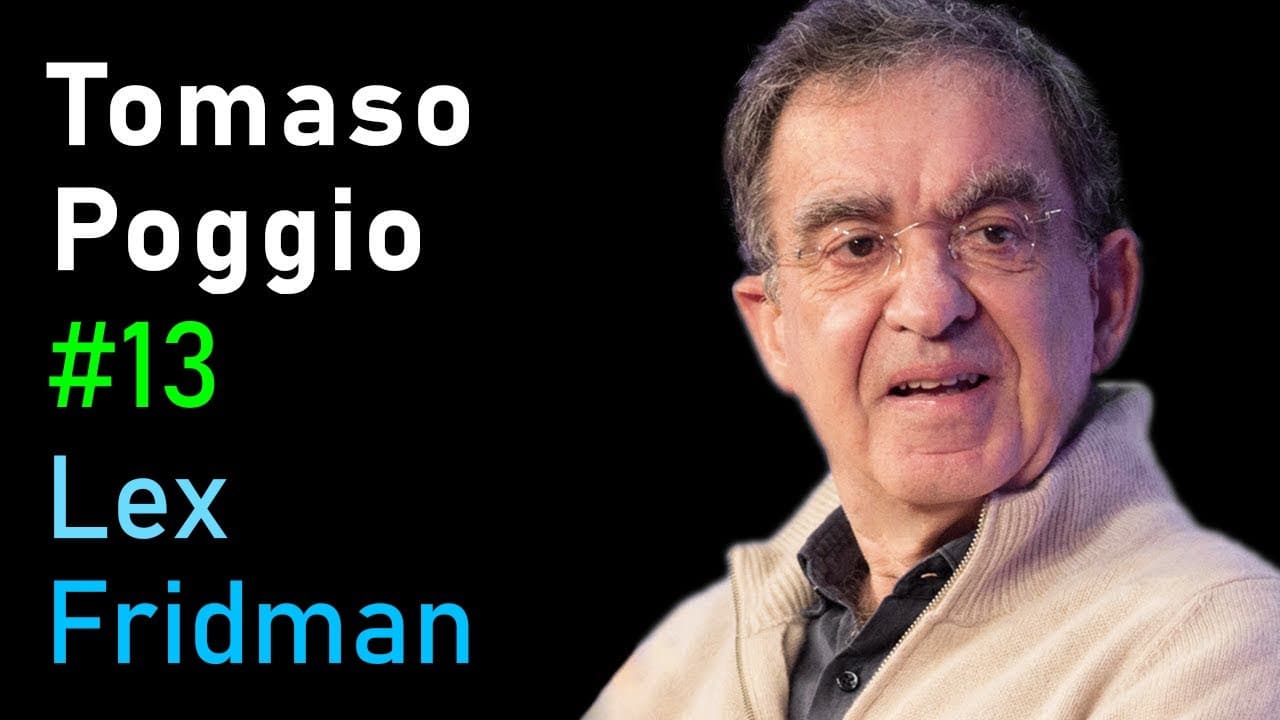
Tomaso Poggio: Brains, Minds, and Machines | Lex Fridman Podcast #13
TL;DR
Intelligence is a complex interplay of visualization and understanding, as explored by Tommaso Poggio. He emphasizes the importance of learning from unconventional thinkers like Einstein and discusses how breakthroughs in AI rely on understanding the biological nature of the brain. The challenges of unsupervised learning and the quest for insights into consciousness further illustrate the quest to enhance our own cognitive abilities.
Transcript
the following is a conversation with Tommaso poggio he's the professor at MIT and as a director of the Center for brains minds and machines sited over 100,000 times his work has had a profound impact on our understanding of the nature of intelligence in both biological and artificial neural networks he has been an advisor to many highly impactful r... Read More
Key Insights
- 🤔 Einstein's ability to simplify complex concepts and his unconventional thinking made a significant contribution to physics and our understanding of the world.
- 🤔 All individuals have the potential for breakthroughs and unconventional thinking, but the willingness to think differently sets them apart.
- 🗺️ While time travel is unlikely, the engineering of intelligence systems that surpass human intelligence is feasible and could greatly enhance our problem-solving abilities.
- 🧠 Understanding the biological nature of the brain is crucial for the development of intelligent systems, although artificial neural networks are simplified versions of their biological counterparts.
- 👨🔬 The challenge of unsupervised learning and reducing the reliance on labeled data is an ongoing area of research in the field of artificial intelligence.
- 🙂 The connection between consciousness and intelligence is still not fully understood, but studying the neuroscience of ethics and consciousness has the potential to shed light on these complex topics.
- 💦 The path to success in science and engineering careers involves curiosity, having fun, working with other intelligent and curious individuals, and maintaining an enthusiasm for the process of discovery.
- 🛰️ The next breakthrough in the field of artificial intelligence may be inspired by neuroscience, although the specific area of breakthrough is uncertain.
- 🛟 The relationship between intelligence and happiness, as well as the meaning of life, is complex, and there is no clear consensus on the topic.
Install to Summarize YouTube Videos and Get Transcripts
Explore YouTube Video Summarizer or Get YouTube Transcript Extractor
Questions & Answers
Q: What fascinated Tommaso Poggio about Einstein's genius and his discovery of the theory of relativity?
Poggio was captivated by Einstein's ability to simplify complex concepts and his deep understanding of the relationship between time, space, and speed.
Q: Can anyone have breakthroughs and think differently like Einstein, or was there something special about his intelligence?
Poggio believes that everyone has the potential for breakthroughs and unconventional thinking, but Einstein's anti-conformist mindset and willingness to think differently set him apart from his peers.
Q: Is time travel possible, and what are Poggio's thoughts on engineering intelligence systems that can achieve such leaps?
Poggio believes that time travel is unlikely, but engineering intelligence systems that surpass human intelligence is possible and could greatly enhance our ability to think and solve problems.
Q: What does Poggio find fascinating about the problem of understanding the nature of intelligence?
Poggio is intrigued by the idea that intelligence is the greatest problem in science and that unlocking the secrets of the human brain and improving it could greatly impact our understanding of the world and our place in it.
Q: Can artificial neural networks achieve the same level of intelligence without understanding the biological nature of the human brain?
Poggio believes that understanding the biological nature of the brain is crucial for building intelligent systems and that artificial neural networks, while powerful, are still simplified versions of the complexity found in the brain.
Q: What differences does Poggio find most interesting between artificial and biological neural networks?
While artificial neural networks are simplified versions of biological neural networks, Poggio finds similarities in their hierarchical architecture and believes that adding complexity to artificial networks could improve their performance.
Q: What aspect of artificial neural networks does Poggio think needs improvement?
Poggio believes that artificial neural networks currently rely heavily on labeled examples and that finding ways to reduce the need for large amounts of labeled data is an important challenge to address.
Q: What is Poggio's take on the concerns about the existential threat of AI?
Poggio believes that while it is important to be cautious and address safety concerns, it will take a long time before AI poses a significant threat, and he emphasizes the need to prioritize other urgent challenges like nuclear weapons.
Key Insights:
- Einstein's ability to simplify complex concepts and his unconventional thinking made a significant contribution to physics and our understanding of the world.
- All individuals have the potential for breakthroughs and unconventional thinking, but the willingness to think differently sets them apart.
- While time travel is unlikely, the engineering of intelligence systems that surpass human intelligence is feasible and could greatly enhance our problem-solving abilities.
- Understanding the biological nature of the brain is crucial for the development of intelligent systems, although artificial neural networks are simplified versions of their biological counterparts.
- The challenge of unsupervised learning and reducing the reliance on labeled data is an ongoing area of research in the field of artificial intelligence.
- The connection between consciousness and intelligence is still not fully understood, but studying the neuroscience of ethics and consciousness has the potential to shed light on these complex topics.
- The path to success in science and engineering careers involves curiosity, having fun, working with other intelligent and curious individuals, and maintaining an enthusiasm for the process of discovery.
- The next breakthrough in the field of artificial intelligence may be inspired by neuroscience, although the specific area of breakthrough is uncertain.
- The relationship between intelligence and happiness, as well as the meaning of life, is complex, and there is no clear consensus on the topic.
- Understanding the biological nature of intelligence and consciousness may have implications for the future development of AI systems.
Summary
In this conversation with Tommaso Poggio, a professor at MIT and director of the Center for Brains, Minds, and Machines, various topics related to artificial intelligence and the nature of intelligence are discussed. Poggio shares insights about the genius of Einstein, the possibility of time travel, the problem of intelligence, the role of the human brain, the differences between biological and artificial neural networks, the challenges of deep learning, and the potential of unsupervised learning.
Questions & Answers
Q: What aspect of Einstein's genius do you think was essential for discovering the theory of relativity?
Einstein's ability to simplify complex concepts and imagine Gedanken experiments was crucial in unraveling the complexities of space, time, and speed.
Q: Is the ability to imagine and visualize something that all human beings possess?
While not everyone may possess the same level of imagination and visualization skills, it is believed that all individuals have the capacity to learn and have breakthroughs similar to Einstein.
Q: Can time travel be possible?
While traveling forward in time may be possible under certain conditions, such as freezing ourselves or traveling close to the speed of light, traveling back in time is highly unlikely.
Q: Do you still believe in the engineering of intelligence that can accomplish feats like time travel?
Poggio believes that while certain problems may be unsolvable, it is very much possible to create machines that can think as well or better than humans, improving our cognitive capabilities.
Q: Why is the problem of intelligence captivating to you?
Poggio finds the problem of intelligence interesting because it not only encompasses scientific questions but also delves into the very nature of our brains and our ability to understand and improve upon it.
Q: Can we build intelligent systems without understanding how the human brain creates intelligence?
While it is possible to create intelligent systems without a complete understanding of the biological aspects of the brain, Poggio believes that a deeper understanding of the brain's functional nature can greatly enhance the development of strong AI systems.
Q: What differences between biological and artificial neural networks intrigue you the most?
Poggio initially found artificial networks to be too simplistic compared to the complexity of the brain, but he now sees them as closer in architecture to the brain than previous models used in computer science, such as mathematical logics.
Q: What improvements would you like to see in artificial neural networks over time?
Poggio emphasizes the need to address the limitation of deep learning techniques that require vast amounts of labeled data. He believes that finding ways to learn from smaller sets of labeled examples, similar to how children learn, would be a valuable improvement.
Q: How does the brain learn and understand the world through sensory information?
While much is known about the details of the brain's structure, there is still a lot to learn about how the brain learns and understands sensory information. Exploring questions about the modular nature of the brain and the interaction between different regions is ongoing.
Q: Is there a distinct hierarchy or structure within the brain that contributes to intelligence?
The brain consists of specific modules that contribute to different cognitive functions, such as vision, language, and motor control. Although there is still much to learn, it is believed that these modules work collaboratively to create intelligence.
Q: How does compositionality play a role in deep neural networks?
Deep neural networks are more powerful than shallow networks in approximating functions with a compositional structure. If the underlying function is composed of smaller functions, such as computing information from local groups of pixels in vision tasks, deep networks are more effective.
Q: What are your thoughts on the challenges and potential of unsupervised learning with generative adversarial networks (GANs)?
While GANs have shown promise in generating realistic images and estimating probability densities, Poggio sees their potential as distinct from supervised methods. He believes they may have applications in computer graphics and unsupervised learning problems, but their significance for intelligence may be limited.
Q: How can we address the challenges of supervised learning that requires a large number of labeled examples?
Poggio suggests two approaches. The first is to focus on improving the selection of examples to optimize learning. The second is to explore the idea of weak priors, where basic machinery from evolution, like motion detection, can bootstrap learning in babies and reduce the need for an extensive dataset.
Q: How does stochastic gradient descent work in artificial neural networks?
Stochastic gradient descent is a simple optimization technique used in neural networks. It explores the space of solutions by iteratively adjusting the network's parameters based on labeled data. While its success is not fully understood, over-parameterization and the presence of multiple minima in the loss function space are key factors.
Q: What is the universality theorem in neural networks, and how does it relate to approximation?
The universality theorem states that a neural network with only a single hidden layer can approximate any computable function to a desired degree. Poggio finds this theorem similar to the bias-complexity trade-off theorem, where increasing the number of parameters allows the approximation of continuous functions. The theorem's existence was not surprising to him.
Takeaways
Tommaso Poggio discusses various aspects of intelligence, neural networks, and deep learning. He highlights the power of the human mind to imagine and simplify complex concepts, the challenges and potential of artificial neural networks, the differences and similarities between biological and artificial neural networks, and the importance of understanding the brain's functional nature. Poggio also emphasizes the need for improvements in deep learning techniques, the exploration of unsupervised learning methods, and the quest for better ways to teach AI systems.
Summary & Key Takeaways
-
Tommaso Poggio discusses his childhood fascination with physics, specifically the theory of relativity, and how Einstein's ability to simplify complex concepts fascinated him.
-
He explores the power of the mind and its ability to imagine and visualize, emphasizing that anyone can have breakthroughs and learn from Einstein's unconventional thinking.
-
Poggio also shares his thoughts on the possibility of time travel, the engineering of intelligence systems, the importance of understanding the biological nature of the brain, and the challenges of deep learning and unsupervised learning.
-
He touches on the significance of consciousness and its connection to intelligence, the role of ethics and morals in AI, and the future breakthroughs in neuroscience.
Read in Other Languages (beta)
Share This Summary 📚
Summarize YouTube Videos and Get Video Transcripts with 1-Click
Try YouTube Summary with ChatGPT & Claude or YouTube Transcript Generator
Explore More Summaries from Lex Fridman Podcast 📚




Summarize YouTube Videos and Get Video Transcripts with 1-Click
Try YouTube Summary with ChatGPT & Claude or YouTube Transcript Generator