What Is Maslow's Hierarchy of Needs and Why It Matters
TL;DR
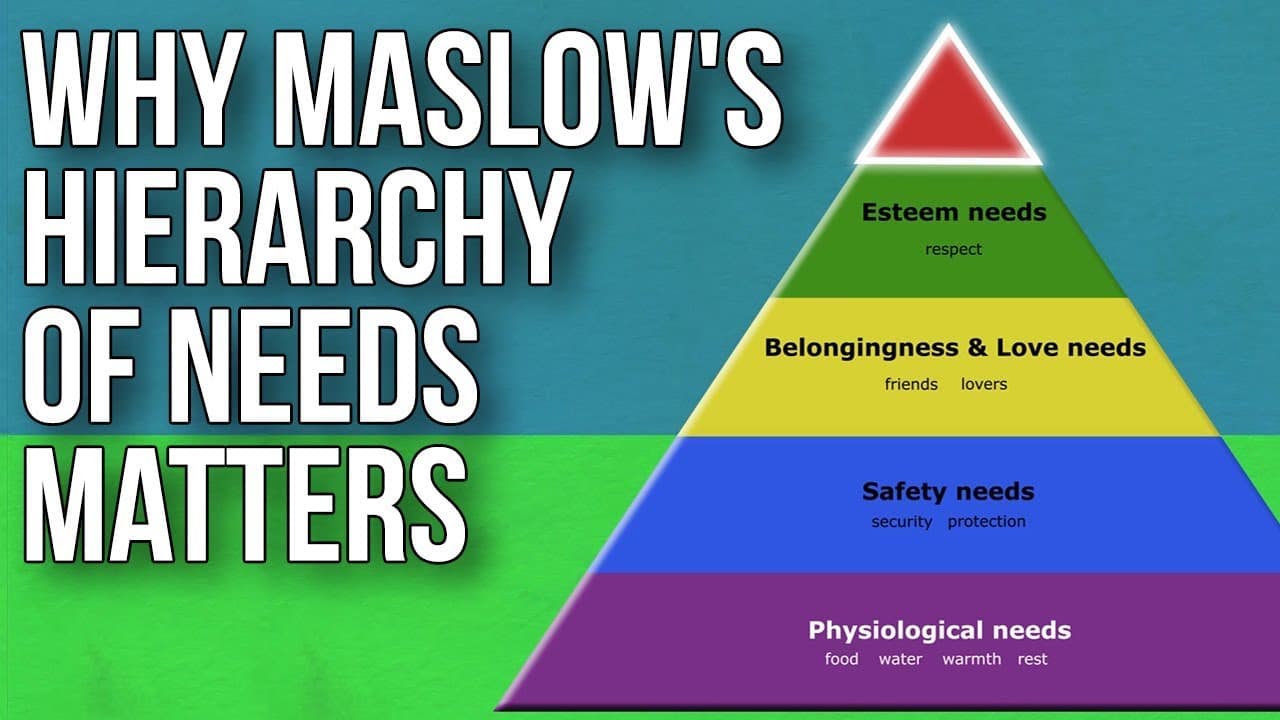
Maslow's hierarchy identifies five levels of needs starting with physiological and safety, then belonging and esteem, culminating in self actualization. The model explains how people prioritize different needs as conditions change, and why balancing material security with personal growth is essential for a whole life. The video argues that business and personal life benefit from acknowledging both bases and summits of human motivation.
Transcript
One of the most legendary ideas in the history of psychology is located in an unassuming triangle divided into five sections referred to universally simply as ‘Maslow’s Pyramid of Needs’.This profoundly influential pyramid first saw the world in an academic journal in the United States in 1943, where it was crudely drawn in black and white and surr... Read More
Key Insights
- Maslow’s pyramid outlines five need levels, progressing from physiological to self actualization. The model helps explain why people seek both security and meaning in life.
- The base of the pyramid covers essential survival needs while higher levels address belonging, esteem, and the drive to realize one’s full potential.
- The concept encourages a balance between material security and spiritual or psychological growth, not prioritizing one over the other.
- Maslow believed business could benefit from addressing higher needs in addition to basic ones, leading to more enlightened capitalism.
- Self actualization represents living according to one’s true potential and authentic identity, not just achieving material success.
- The hierarchy suggests that neglecting lower needs can hamper the pursuit of higher goals, while overemphasizing material wealth can undermine deeper fulfillment.
- The film presents Maslow as a humane critic of both relentless materialism and extreme asceticism, advocating integration of all life dimensions.
- Using the hierarchy as a reflective tool, individuals can reassess priorities and adjust actions toward a more balanced life.
- More videos from this channel:
- More from this channel: The School of Life
Install to Summarize YouTube Videos and Get Transcripts
Explore YouTube Video Summarizer or Get YouTube Transcript Extractor
Questions & Answers
Q: What is Maslow's hierarchy of needs and what are the five levels?
Maslow's hierarchy of needs is a framework for understanding human motivation arranged as a pyramid with five levels. The levels start with physiological needs such as food and shelter, followed by safety needs, then belongingness and love, then esteem, and finally self actualization at the top. The idea is that people are motivated to satisfy lower-level needs before pursuing higher ones, though in real life these needs can overlap or recur depending on circumstances. The model serves as a guide for evaluating priorities in both personal development and organizational design.
Q: Why does Maslow emphasize balance between material and spiritual needs?
Maslow argues that a fulfilling life requires attention to both material and spiritual dimensions. A life focused only on money or status may neglect belonging, self esteem, and the sense of purpose that comes from self actualization. Conversely, pursuing spirituality without material security can create instability. The balance helps people live in harmony with their inner drives and external responsibilities, promoting well rounded growth and well being.
Q: How did the video describe the impact of Maslow on business and culture?
The video notes that Maslow was ambivalent about business, admiring material resources while critiquing how corporate activity often prioritized basic needs over higher ones. It suggests enlightened capitalism could emerge if companies address not just nourishment and safety but also belonging, esteem, and meaning. This perspective invites organizations to support holistic employee development and customer well being.
Q: What is the role of self actualization in Maslow's theory?
Self actualization is the peak level of Maslow's hierarchy, defined as living according to one’s full potential and becoming who one truly is. It represents the pursuit of personal growth, authenticity, and meaningful achievement beyond basic survival or social acceptance. The video frames this as a guiding aim that informs decisions and life direction, not merely a luxury goal.
Q: How can individuals use Maslow's pyramid to reflect on their lives?
Individuals can use the pyramid as a lens to assess where their attention and resources are allocated. By identifying which level dominates their current focus, a person can realign priorities to ensure lower level needs are met while still pursuing higher aspirations. The idea is to create balance so neither the base nor the summit is neglected, enabling a more integrated sense of purpose.
Q: What critique does the video offer about ignoring certain needs?
The video critiques both extremes: ignoring spiritual or psychological needs in favor of material gain, and ignoring material safety in pursuit of lofty ideals. It argues that neglecting either side can lead to imbalance, insecurity, or unsustainable progress. The takeaway is to acknowledge the full spectrum of human needs to maintain stability while fostering growth.
Q: How does the film describe the educational value of Maslow's pyramid?
The film describes Maslow's pyramid as a powerful, simple visual cue that helps people reflect on life direction. It presents the hierarchy as a practical tool for evaluating priorities and deciding what to focus on next. By illustrating the interdependence of different needs, it encourages thoughtful planning and healthier decision making.
Q: What is the overall message The School of Life conveys about Maslow?
The overall message is that Maslow offered a clear map of human needs that remains relevant for personal development and societal thinking. It invites viewers to avoid binary thinking about money or spirituality and to strive for a balanced life. By considering both base and summit needs, individuals and businesses can pursue more meaningful, sustainable outcomes.
Summary & Key Takeaways
-
Maslow’s hierarchy condenses human needs into five levels, from basic to higher aspirations, and presents a framework for assessing life priorities. The film argues that recognizing these layers helps individuals and organizations address both survival and growth. It also highlights the role of self actualization in living according to one’s potential.
-
The structure of the pyramid visually represents how foundational needs support higher ones, suggesting that neglecting basic needs undermines progress toward fulfilling personal meaning. It also critiques extremes that focus solely on material or spiritual aims, urging a balanced approach.
-
The School of Life frames Maslow as both a pragmatic and aspirational thinker who sought a more enlightened capitalism. The takeaway is to reflect on one’s own life and consider how to align daily actions with broader psychological and existential goals.
Read in Other Languages (beta)
Share This Summary 📚
Summarize YouTube Videos and Get Video Transcripts with 1-Click
Try YouTube Summary with ChatGPT & Claude or YouTube Transcript Generator