What Is Romanticism and Its Key Moments?
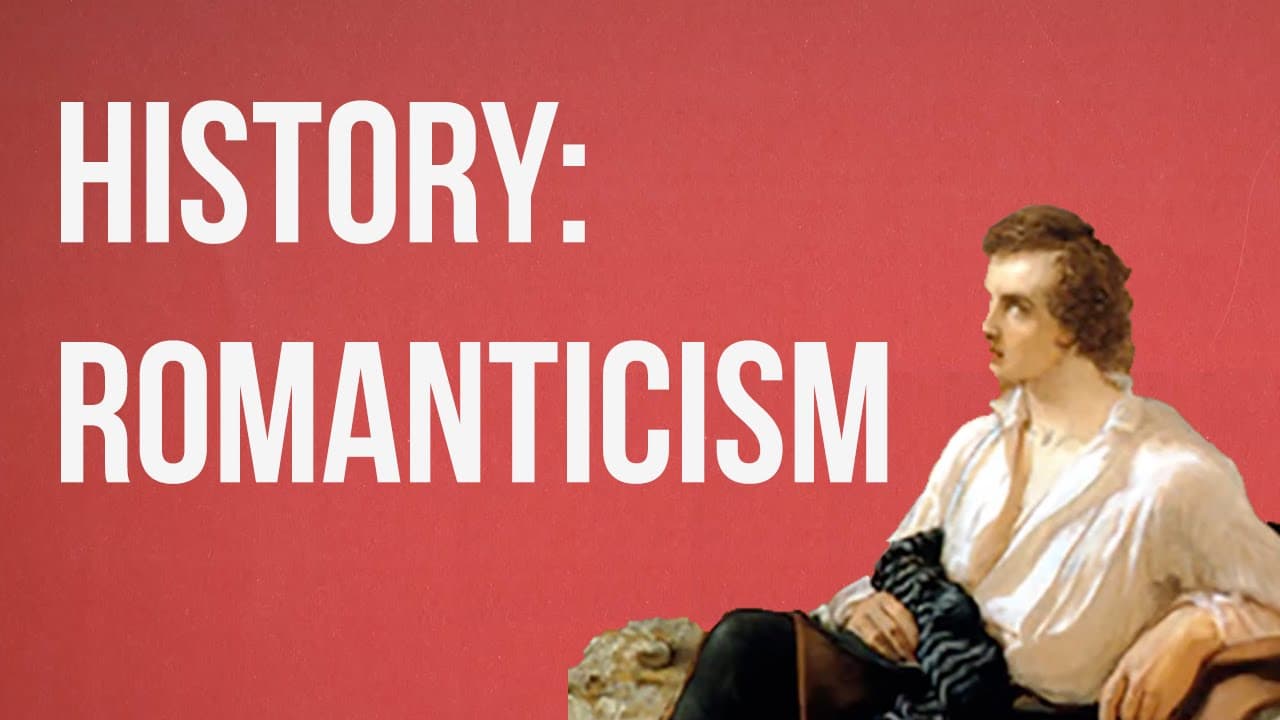
TL;DR
Romanticism is a shift in ideas and sensibilities that reacts against the modern world, emphasizing nature, emotion, and imagination. It marks a move away from industrialization and rationalism toward the value of feeling, beauty, and the individual artist, with famous episodes across Europe and America that shaped art, literature, and culture.
Transcript
Romanticism is one of the most important historical events of all time. Unlike a lot of what gets called history, romanticism isn't a war or a piece of technology or a political event. It refers to the birth of a new set of ideas. It is about a mindset and a way of feeling. Romanticism began in Western Europe in the mid-18 century, in the work of a... Read More
Key Insights
- Romanticism is a birth of a new set of ideas, a mindset and feeling that spreads beyond war or technology.
- It emerges as a reaction to modern features like industrialization, urbanization, secularization and consumerism.
- Rousseau’s Emile elevates natural childhood and criticizes oppressive adult world views.
- Chatterton’s life and poetry symbolize the doomed artist rejected by a pragmatic society.
- Werther represents the romantic hero driven by heart over conventional career and money.
- Goya’s The Sleep of Reason Brings out Monsters highlights the value placed on the irrational in romance.
- Wordsworth champions nature and laments mechanization, preferring a simple life over a railway expansion.
- Baudelaire’s flâneur embodies a romantic wanderer who observes modern city life with playfulness and detachment.
- More videos from this channel:
- More from this channel: The School of Life
Install to Summarize YouTube Videos and Get Transcripts
Explore YouTube Video Summarizer or Get YouTube Transcript Extractor
Questions & Answers
Q: What is Romanticism as a historical mood and movement?
Romanticism is described as a birth of a new set of ideas, a mindset and a way of feeling that began in Western Europe in the mid 18th century and spread worldwide. It marks a shift from rational and bureaucratic modernity toward valuing emotion, nature, imagination and the individual artist. It changes how people view love, nature, work and society.
Q: Why did Romanticism arise as a reaction to modern life?
Romanticism arose because the world was becoming more rational, scientific and technologically based, yet many people felt this progress stripped away spontaneity and warmth. It emphasized feeling over tradition and celebrated natural innocence, beauty, and the magic of the untrained mind as a counterforce to industrial and urban life.
Q: What role does Rousseau play in Romantic ideas?
Rousseau is central as the author of Emile, which praises natural goodness and the wisdom of children while criticizing oppressive adult society. His ideas elevate the child, spontaneity and innocence as sources of creativity and genius, challenging the rational, planned and bureaucratic world of his time.
Q: Who epitomizes the doomed romantic artist and why is he significant?
Thomas Chatterton embodies the doomed romantic artist who seeks beauty and wisdom but dies young due to lack of recognition and parental pressure to pursue law. His story creates a proto romantic archetype of the sensitive, talented outsider rejected by a harsh society, influencing later poets and artists.
Q: How does Goethe influence Romanticism through Werther?
Goethe popularizes a romantic love story in The Sorrows of Young Werther, where passion and impracticality triumph over social constraints. Werther’s feelings and pursuit of art over bourgeois life shape readers to sympathize with the heart’s impulses, elevating dramatic emotion as a legitimate basis for life choices.
Q: What is the Romantic view on reason and science, as seen in Goya’s work?
Goya’s The Sleep of Reason Brings out Monsters signals the Romantic suspicion of excessive rationality. Romantics value the limits of reason, the irrational, and the dangers of overconfidence in science, invoking sympathy for madness and a critique of Enlightenment rationality.
Q: How does Wordsworth connect Romanticism with nature?
Wordsworth champions the natural world and simple living, writing poetry about daffodils, trees and rivers. He opposes mechanization like railway expansion and seeks to preserve a heartfelt, nature-centered experience against industrial progress, embodying the Romantic ideal of siding with nature over urban modernity.
Q: What themes does Baudelaire introduce with the flâneur, and why are they significant?
Baudelaire’s flâneur represents a casual, observant wanderer who thrives in the modern city. This figure embodies romantic playfulness, detachment from strict practicality, and a cultivated sense of narratives within everyday street life, illustrating how modern urban life can be a source of artistic inspiration rather than mere productivity.
Q: How do Gauguin and other artists shape Romantic sensibilities in distant lands?
Gauguin travels to Tahiti seeking escape from artificial modern life, portraying native subjects as natural and unspoiled to critique civilization itself. This reflects the Romantic attraction to the exotic, the untrained, and the naive, reinforcing the movement's claim that true beauty often lies outside industrial society.
Q: What is the overall impact of Romanticism on modern sensibilities?
Romanticism permanently changes how people view love, nature, art and the self, privileging emotion, grandeur of nature and individual genius over strict social rules. Its influence extends across literature, painting and social attitudes, shaping a lasting tension between modernization and the longing for authenticity, mystery, and meaning.
Summary & Key Takeaways
-
Romanticism is a historical movement that redefines how people feel about nature, love, and creativity, arising in mid 18th century Western Europe and spreading worldwide.
-
Key moments include Rousseau on education, Chatterton and Werther as symbols of the doomed artist, Goethe on romantic love, Goya and Wordsworth on reason and nature, and Baudelaire and Gauguin shaping modern sensibilities.
-
The movement champions the irrational, the childlike, and the exotic while questioning industrial progress, with a lasting impact on how modernity is perceived and critiqued.
Read in Other Languages (beta)
Share This Summary 📚
Summarize YouTube Videos and Get Video Transcripts with 1-Click
Try YouTube Summary with ChatGPT & Claude or YouTube Transcript Generator