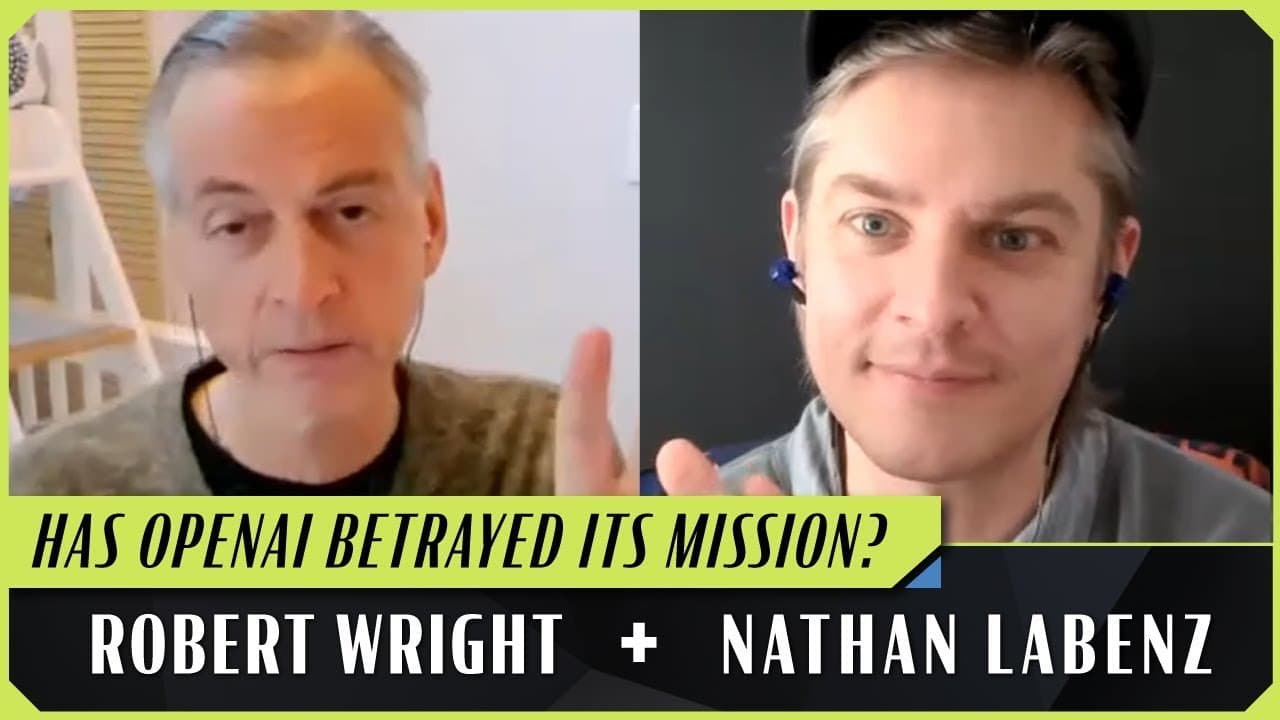
What Is the Open-Source AI Question? Part 2 with Robert Wright & Nathan Labenz
TL;DR
AI could transform society by enabling prompt-generated virtual worlds, AI-assisted contract resolution, and increasingly sophisticated systems whose behavior may become harder to align. Nathan Labenz argues that today’s language models are not inherently power-seeking, but misalignment risks may grow with their capabilities; in an open-source world, layered safety measures may offer the best defense. Read on for the discussion’s concrete examples and cautions.
Transcript
hello and welcome to the cognitive Revolution where we interview Visionary researchers entrepreneurs and Builders working on the frontier of artificial intelligence each week we'll explore their revolutionary ideas and together we'll build a picture of how AI technology will transform work life and Society in the coming years I'm Nathan lens joined... Read More
Key Insights
- AI's transformative potential spans various fields, including VR and mechanistic interpretability.
- Current AI alignment techniques are insufficient to ensure safe control of advanced systems.
- Open-source AI increases the challenge of maintaining control and safety due to diverse actors.
- Emergent behavior in AI models can lead to unexpected and potentially risky outcomes.
- Mechanistic interpretability seeks to understand AI's internal processes but remains complex.
- AI's development requires international collaboration to ensure intelligent governance.
- Defense in depth, employing multiple safety measures, may be necessary for managing AI risks.
- The current generation of AI models offers significant utility but requires careful handling.
Install to Summarize YouTube Videos and Get Transcripts
Explore YouTube Video Summarizer or Get YouTube Transcript Extractor
Questions & Answers
Q: What is discussed in The Open Source AI Question – Part 2 with Robert Wright and Nathan Labenz?
Robert Wright and Nathan Labenz discuss AI-powered virtual reality, advanced-AI risk warnings associated with Eliezer Yudkowsky, mechanistic interpretability, and the state of AI alignment research. They also consider whether increasingly sophisticated models could develop misaligned behavior and why open-source AI may require defense in depth.
Q: Are today’s language models inherently power-seeking?
Nathan Labenz argues that today’s language models are not inherently power-seeking. He cautions, however, that the risk of misaligned behavior may increase as these systems become more sophisticated.
Q: What does defense in depth mean for open-source AI safety?
Defense in depth means layering many safety measures rather than depending on a single safeguard. Labenz presents this approach as possibly the best hope for managing risk in a world of open-source AI.
Q: What is mechanistic interpretability?
Mechanistic interpretability is described as an emerging field that seeks to open the black box of neural networks. The discussion treats it as part of the broader effort to understand advanced AI systems and address alignment risks.
Q: How could AI change virtual reality?
AI could let users prompt systems to create virtual environments, moving toward interactive, three-dimensional dreams. Labenz says low-resolution versions already exist through video and 3D models, while reaching the resolution supported by Apple Vision Pro would require substantial compute.
Q: What impressed Nathan Labenz about the Apple Vision Pro demo?
Labenz describes a virtual birthday scene with a cake, a candle, and a child sitting in a mother’s lap. He says its presence, image sharpness, and stability while moving through the space felt qualitatively different from his experience with Oculus 2.
Q: Why might creating high-resolution AI virtual worlds require significant computing power?
Existing models can already generate video and three-dimensional environments at lower resolution. Labenz says refining generated environments to the resolution supported by Apple Vision Pro will take substantial compute, and he expects many chips to be used for ongoing generation.
Q: How could AI improve smart contracts?
Labenz argues that traditional smart contracts struggle because contracts are difficult to specify completely and often need a resolution process beyond their written terms. Adding an AI model could enable AI arbitration or AI-powered smart-contract resolution on a blockchain.
Summary & Key Takeaways
-
AI's impact on society is profound, with potential benefits in fields like VR and challenges in areas like mechanistic interpretability. The conversation highlights the importance of AI alignment research, though current techniques fall short of ensuring safe control over advanced systems. Open-source AI presents additional risks, necessitating a multi-layered defense strategy and international cooperation.
-
Emergent behavior in AI models can lead to unexpected outcomes, underscoring the need for improved understanding and control. Mechanistic interpretability aims to decipher AI's internal workings, but this remains a complex task. The discussion emphasizes that AI's development must be accompanied by thoughtful governance and safety measures to harness its benefits while mitigating risks.
-
The current generation of AI models offers substantial utility, yet their potential for unexpected behavior requires careful management. Open-source AI's diverse landscape poses challenges in maintaining safety, making defense in depth a critical strategy. International collaboration and improved alignment techniques are essential for navigating AI's rapid advancements and ensuring its positive impact on society.
Read in Other Languages (beta)
Share This Summary 📚
Summarize YouTube Videos and Get Video Transcripts with 1-Click
Try YouTube Summary with ChatGPT & Claude or YouTube Transcript Generator
Explore More Summaries from Cognitive Revolution "How AI Changes Everything" 📚



Summarize YouTube Videos and Get Video Transcripts with 1-Click
Try YouTube Summary with ChatGPT & Claude or YouTube Transcript Generator