Can We Use Atoms for Computing and 3D Printing?
TL;DR
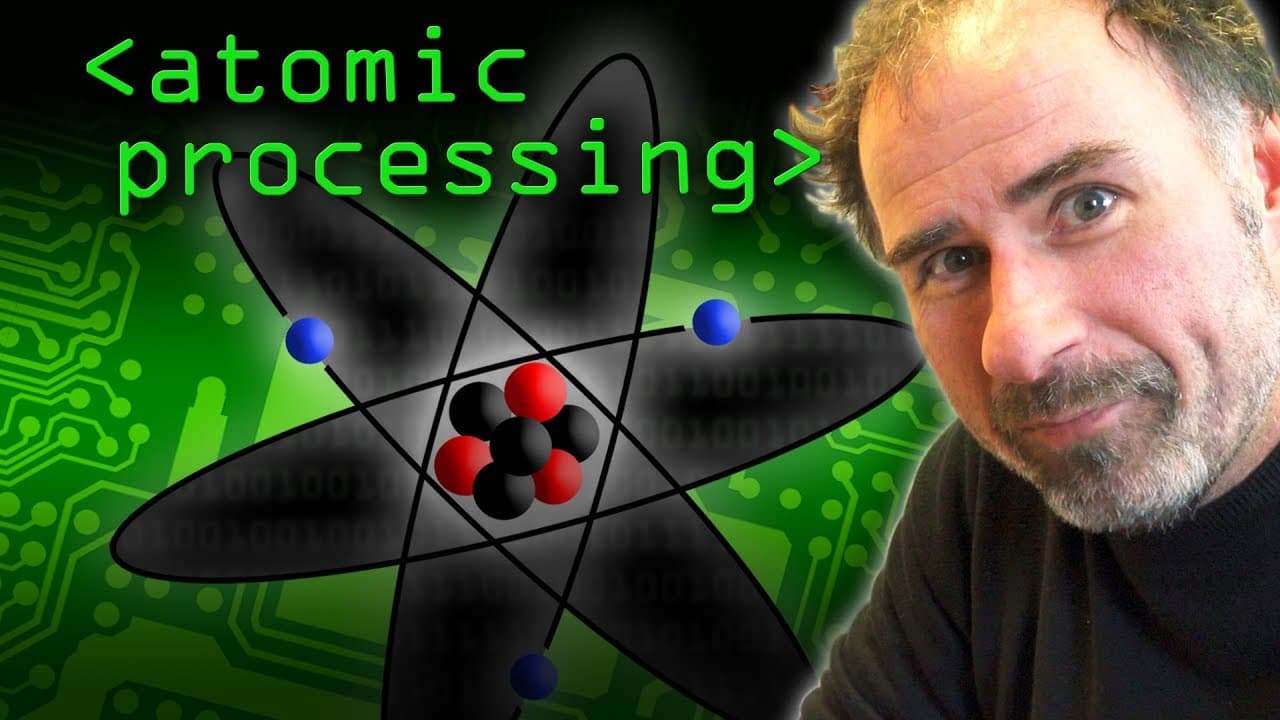
Computing with individual atoms could revolutionise technology, as proposed by K. Eric Drexler. Researchers are making strides in manipulating atoms, enabling atomic-scale information processing and the development of single-atom transistors, paving the way for future advancements in this field.
Transcript
as we've done in a couple of other videos sean we're going to talk about those links between physics and computing and again we're back to the ultimate limits of computation and the book i have in front of me is a book that has caused a massive amount of consternation over the last few decades it's by a guy called k eric drexler now the reason it's... Read More
Key Insights
- 🫀 K. Eric Drexler's vision of using individual atoms for computing and 3D printing is still far from realization, but researchers have made progress in manipulating and building structures atom by atom.
- 🔬 Scanning probe microscopes have played a crucial role in observing and manipulating atoms and molecules, allowing for the development of logic gates and atomically precise structures.
- 🫀 The ability to connect and repair dangling bond features is a significant advancement in controlling and manipulating individual atoms, pushing towards atomic-scale computing.
- 😘 Low temperatures are necessary to prevent thermal motion and maintain the stability of engineered structures, making extreme conditions a requirement for current experiments.
- 🫀 Single-atom transistors are a remarkable achievement in atomic-scale information processing, demonstrating the potential for processing matter at the atomic limit.
- 🫀 The ultimate goal is to push atomic-scale computing and manipulation further, potentially ushering in a new era of technology that operates at the atomic level.
- 💪 Challenges, such as surface physics and chemistry, and the need for strong covalent bonds, must be overcome to realize the full potential of atom manipulation and computing.
Install to Summarize YouTube Videos and Get Transcripts
Explore YouTube Video Summarizer or Get YouTube Transcript Extractor
Questions & Answers
Q: Can we use individual atoms for computing and 3D printing?
K. Eric Drexler's vision explores the possibility of using atoms as the smallest building blocks for computing and 3D printing, similar to the concept of replicators in Star Trek. While we are not currently at that level, researchers have been able to manipulate atoms and molecules, demonstrating progress in this direction.
Q: How have researchers manipulated atoms and molecules?
Researchers have used scanning probe microscopes to manipulate and observe individual atoms and molecules. By using sharp probes and bringing them close to a surface, they can manipulate and rearrange atoms and molecules. This has led to the development of logic gates and even the creation of structures like the IBM logo using atoms.
Q: Why do researchers need low temperatures for these experiments?
At higher temperatures, thermal motion causes molecules to diffuse and move across surfaces, destabilizing the engineered structures. To prevent this, researchers work at extremely low temperatures, often just four degrees above absolute zero. This allows for more control over the manipulation and arrangement of atoms and molecules.
Q: What is the significance of single-atom transistors?
Single-atom transistors are a breakthrough in atomic-scale information processing. By manipulating silicon surfaces and introducing a single atom as a dopant, researchers can create a transistor that operates at the atomic level. This opens up possibilities for more advanced logic gates and atomic-scale computing.
Summary & Key Takeaways
-
K. Eric Drexler's book discusses the possibility of using individual atoms for computing and 3D printing, envisioning a future with replicator-like technology.
-
Researchers have successfully manipulated atoms and molecules, demonstrating the potential of atomic-scale information processing and building structures atom by atom.
-
The development of single-atom transistors and the ability to connect and repair dangling bond features show progress towards computing and manipulating matter at the atomic limit.
Read in Other Languages (beta)
Share This Summary 📚
Summarize YouTube Videos and Get Video Transcripts with 1-Click
Try YouTube Summary with ChatGPT & Claude or YouTube Transcript Generator
Explore More Summaries from Computerphile 📚



Summarize YouTube Videos and Get Video Transcripts with 1-Click
Try YouTube Summary with ChatGPT & Claude or YouTube Transcript Generator