How to Answer Every IELTS Reading Question: The Only Strategy You Need in 2026
TL;DR
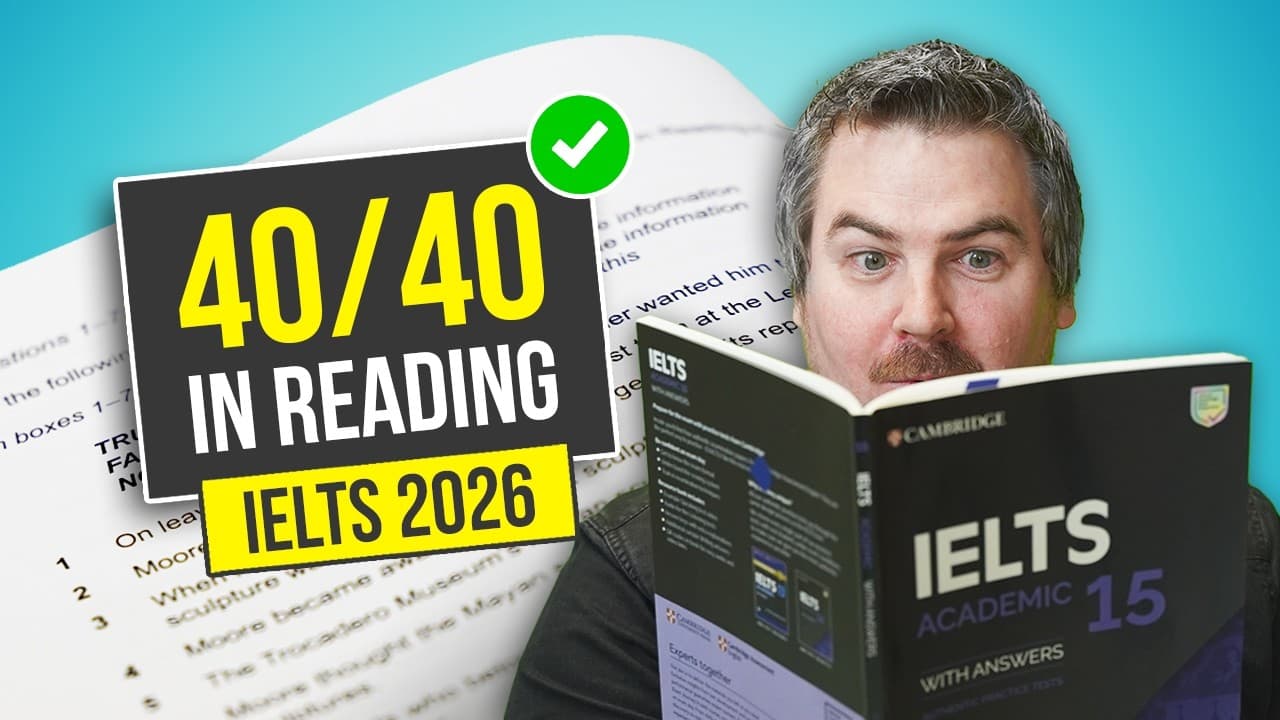
Answer IELTS Reading questions efficiently by finding where the relevant information appears before deciding what the answer is. For all 12 possible question types, read the instructions and question first, predict likely content or word forms, scan for keywords and synonyms, and then study only the matching section closely. Read on for specific methods covering sentence completion, summaries, multiple choice, short answers, and diagram labeling.
Transcript
you've just found the Ultimate Guide to a reading this gives you step-by-step strategies for all 12 of the questions that you might get on test day these are the exact same strategies that thousands of my students have used to get band nine on their I reading test and at the end I'll also give you two free practice tests and step-by-step walkthroug... Read More
Key Insights
- The "where before what" principle is the foundation of the recommended approach. Students should scan for the relevant location before deciding on an answer, then read only that section carefully instead of examining the entire passage in equal detail.
- Sentence completion requires strict compliance with the stated word limit. Answers must come from the passage, and a single incorrect letter makes the response wrong, so careful spelling is essential after the correct location and wording have been identified.
- Prediction prepares the reader to recognize relevant information. Before searching the passage, students should anticipate the likely content, vocabulary, synonyms, or grammatical form, even though an initial prediction may ultimately prove incorrect.
- Summary completion depends on both meaning and grammar. Students should read the summary first, predict whether each gap needs a noun, verb, or adjective, locate the matching passage section, and confirm that the selected wording makes grammatical and logical sense.
- Multiple-choice accuracy depends on understanding subtle differences among the options. Students should read the question and choices carefully, skim for the passage's general meaning, locate the relevant section, and compare each option directly with the information found there.
- Elimination is useful when a multiple-choice answer remains unclear. Identifying options that are definitely wrong can reduce the decision to two possibilities, allowing the student to focus on their main difference and check that distinction against the passage.
- Short-answer questions require precise comprehension of the question itself. Students should underline keywords, especially nouns and noun phrases such as people, places, objects, or things, consider possible synonyms, and use those clues to scan for the answer's location.
- Diagram labeling tests interpretation rather than prior knowledge of the depicted subject. Students should avoid panicking when the image is unfamiliar, inspect the diagram to understand its structure, highlight useful keywords, and follow any limits on words or numbers exactly.
Install to Summarize YouTube Videos and Get Transcripts
Explore YouTube Video Summarizer or Get YouTube Transcript Extractor
Questions & Answers
Q: How should I approach IELTS Reading questions efficiently?
Use the “where before what” principle: locate the relevant part of the passage before deciding on the answer. Read the question and instructions first, predict likely content or wording, scan for keywords or synonyms, and then examine only the matching section carefully. Finally, check requirements such as spelling, grammar, and word limits.
Q: How do I answer IELTS sentence completion questions?
Read the instructions and incomplete sentences before reading the passage, paying particular attention to the word limit. Predict the likely content and possible synonyms, scan for the answer’s location, and then read that section closely. Copy the answer from the text and check every letter because one incorrect letter makes the whole answer wrong.
Q: Why should I predict answers before scanning the passage?
Prediction primes your brain to recognize the relevant information when it appears. Consider the likely content, vocabulary, synonyms, or type of word before scanning. The prediction can still focus your search even when it is not exactly correct.
Q: How do I solve IELTS summary completion questions?
Read the instructions and summary first, then predict both the missing content and whether each gap requires a noun, verb, or adjective. Scan for the relevant location while watching for synonyms, and read that section carefully. Insert the selected words only after confirming that the completed summary makes grammatical and logical sense.
Q: How do I answer IELTS multiple-choice reading questions?
Read the question and every option carefully, focusing on the slight differences in meaning between the choices. Skim the passage for its general meaning, locate the relevant section, and compare its information directly with each option. If the answer remains unclear, eliminate choices that are definitely wrong.
Q: What should I do when two IELTS multiple-choice options seem correct?
Identify the main difference in meaning between the two remaining options. Return to the relevant passage section and check which distinction the text supports. Carefully reread the question before making the final choice.
Q: How do I answer IELTS short-answer reading questions?
Read each question first and make sure you understand precisely what it asks. Underline useful keywords, especially nouns and noun phrases referring to people, places, objects, or things, and consider possible synonyms. Scan for the matching location, read that section carefully, and recheck the question before writing the answer.
Q: How should I handle an unfamiliar IELTS diagram-labeling question?
Do not assume that you need prior knowledge of the diagram’s subject. Read the instructions and any limits on words or numbers, inspect the diagram until its structure is clear, and highlight useful keywords. Use those clues to locate the relevant information in the passage systematically.
Summary & Key Takeaways
-
The central strategy is "where before what." Students first study the question, predict the likely answer, and scan for its location using keywords and synonyms. Only after locating the relevant section should they read closely and choose an answer. This focused process is intended to save time and improve accuracy.
-
Sentence and summary completion both require careful attention to word limits, spelling, predictions, and synonyms. Summary completion adds a stronger grammatical check because the missing item may need to be a noun, verb, or adjective. After inserting an answer, students should confirm that the completed sentence or summary makes sense.
-
Multiple-choice, short-answer, and diagram-labeling tasks require distinct adjustments. Multiple-choice questions demand comparison of small differences between options and elimination of clearly wrong choices. Short-answer questions require precise understanding of what is being asked. Diagram tasks require calmly interpreting unfamiliar visual information without relying on prior subject knowledge.
Read in Other Languages (beta)
Share This Summary 📚
Summarize YouTube Videos and Get Video Transcripts with 1-Click
Try YouTube Summary with ChatGPT & Claude or YouTube Transcript Generator
Explore More Summaries from IELTS Advantage 📚


Summarize YouTube Videos and Get Video Transcripts with 1-Click
Try YouTube Summary with ChatGPT & Claude or YouTube Transcript Generator