What Is Deep Work and How Can It Boost Your Productivity?
TL;DR
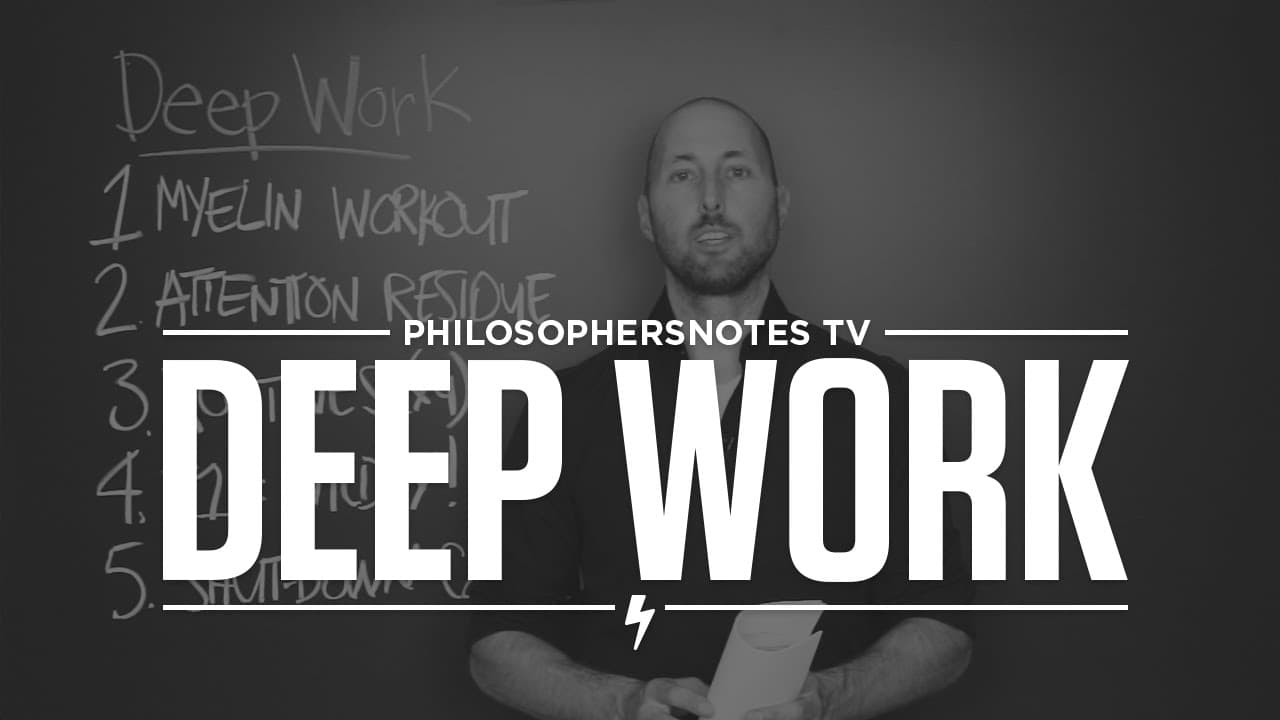
Deep work is the practice of focusing intensely on cognitively demanding tasks without distraction, making it increasingly rare and valuable in today's fast-paced environment. To enhance productivity through deep work, it's essential to build myelin via deliberate practice, minimize multitasking to avoid attention residue, and establish routine structures that allow for sustained focus.
Transcript
hi this is Brian welcome back to philosophers notes TV today another great book deep work by Cal Newport deep work subtitle rules for focused success in a distracted world Cal also wrote the great books so good they can't ignore you which we profiled in one of these episodes and I interviewed him early last week and at the end of my interview ask a... Read More
Key Insights
- 🌟 Deep work is becoming increasingly rare and valuable in our distracted world, and is essential for producing high-quality work.
- 🧠 Cultivating deep work requires training our brains and building myelin through deliberate practice and intense focus.
- 💡 Multitasking and constantly switching tasks leads to attention residue and diminishes performance. ⏰ Creating time blocks and routines is crucial for cultivating deep work and minimizing distractions.
- 🔥 Passion and enthusiasm for a goal can help crowd out distractions and increase productivity.
- 🌙 Implementing a shutdown complete ritual at the end of the day helps create boundaries and allows for rest and recovery.
- 🔄 Different types of routines, such as the monastic, bimodal, rhythmic, and journalistic approaches, can be effective for cultivating deep work.
- 📚 The Optimal Living membership program offers access to 250 Philosophers Notes on a variety of self-improvement books, as well as classes and micro classes on various topics.
- 🎙️ More videos with Cal Newport:
Install to Summarize YouTube Videos and Get Transcripts
Explore YouTube Video Summarizer or Get YouTube Transcript Extractor
Questions & Answers
Q: What is the difference between shallow work and deep work?
Shallow work refers to tasks that are easily done and require limited cognitive effort, such as answering emails and browsing social media. Deep work, on the other hand, involves intense focus and concentration on a mentally demanding task, leading to higher-quality and more valuable work.
Q: How does deep work benefit productivity and success?
Deep work allows individuals to achieve a state of flow, where they are fully immersed and highly productive. By eliminating distractions and focusing on a single task, people can produce high-quality work in a shorter amount of time, leading to increased productivity and success.
Q: What strategies can be used to cultivate deep work?
Cal Newport suggests creating routines and rituals, such as dedicating specific time blocks for deep work, establishing a conducive environment, minimizing distractions, and setting clear goals. Additionally, finding the approach that suits one's style, such as the monastic, bimodal, rhythmic, or journalistic approach, can help establish a consistent deep work practice.
Q: What is the concept of "attention residue" and how does it impact performance?
Attention residue refers to the lingering effects of switching tasks and divided attention, even when one is fully focused on a new task. Research has shown that attention residue can diminish performance and productivity. To minimize these effects, it is important to create time blocks for deep work and avoid switching tasks too frequently.
Q: What are the four different approaches to creating routines for deep work mentioned in the book?
The four approaches are the monastic approach (complete detachment and focus akin to a monk), the bimodal approach (combining intense deep work periods with regular work/life commitments), the rhythmic approach (creating a daily rhythm or streak of deep work), and the journalistic approach (scheduling deep work opportunistically as time allows).
Q: How does shutting down and creating boundaries for work contribute to productivity?
Setting clear boundaries and establishing a shutdown routine, like Cal Newport's "shutdown complete," helps individuals separate work from personal life and allows for better recovery and rejuvenation. By consciously ending the workday, people can prevent work from leaking into all aspects of their lives and maintain a healthy work-life balance, leading to increased productivity.
Q: Why is it important to have a goal or passion to crowd out distractions during deep work?
Having a clear goal or passion helps individuals stay motivated and enthusiastic about their work. When deeply engaged in meaningful work, distractions become less appealing, making it easier to resist them. Passion and purpose act as powerful motivators that can crowd out distractions and enhance the quality and focus of deep work.
Q: How does deep work contribute to personal growth and achievement?
Deep work allows individuals to improve their skillset, build expertise, and achieve mastery in their chosen fields. By dedicating focused and distraction-free time to engage in deep work, individuals can produce higher-quality work, reach their goals more efficiently, and accelerate their personal and professional growth.
Summary & Key Takeaways
-
Most people spend the majority of their time engaged in shallow work, constantly responding to distractions like emails and social media notifications.
-
Deep work, which requires intense focus and lack of distraction, is becoming increasingly rare and valuable in today's society.
-
To cultivate deep work, it is important to give your neurons a workout and build "myelin" through deliberate practice, similar to training at the gym.
Questions:
-
What is the difference between shallow work and deep work?
-
How does deep work benefit productivity and success?
-
What strategies can be used to cultivate deep work?
-
What is the concept of "attention residue" and how does it impact performance?
-
What are the four different approaches to creating routines for deep work mentioned in the book?
-
How does shutting down and creating boundaries for work contribute to productivity?
-
Why is it important to have a goal or passion to crowd out distractions during deep work?
-
How does deep work contribute to personal growth and achievement?
Answer:
Q: What is the difference between shallow work and deep work?
Shallow work refers to tasks that are easily done and require limited cognitive effort, such as answering emails and browsing social media. Deep work, on the other hand, involves intense focus and concentration on a mentally demanding task, leading to higher-quality and more valuable work.
Read in Other Languages (beta)
Share This Summary 📚
Summarize YouTube Videos and Get Video Transcripts with 1-Click
Try YouTube Summary with ChatGPT & Claude or YouTube Transcript Generator
Explore More Summaries from Brian Johnson 📚



Summarize YouTube Videos and Get Video Transcripts with 1-Click
Try YouTube Summary with ChatGPT & Claude or YouTube Transcript Generator