How to Learn Coding Through Five Practical Steps
TL;DR
Build strong programming fundamentals, then move quickly into small projects instead of endlessly consuming tutorials. Treat failure as necessary practice, document unsuccessful approaches, take restorative breaks, and seek informed help after making a serious attempt. This combination turns abstract concepts into usable skills while reducing analysis paralysis, ineffective debugging, and burnout.
Transcript
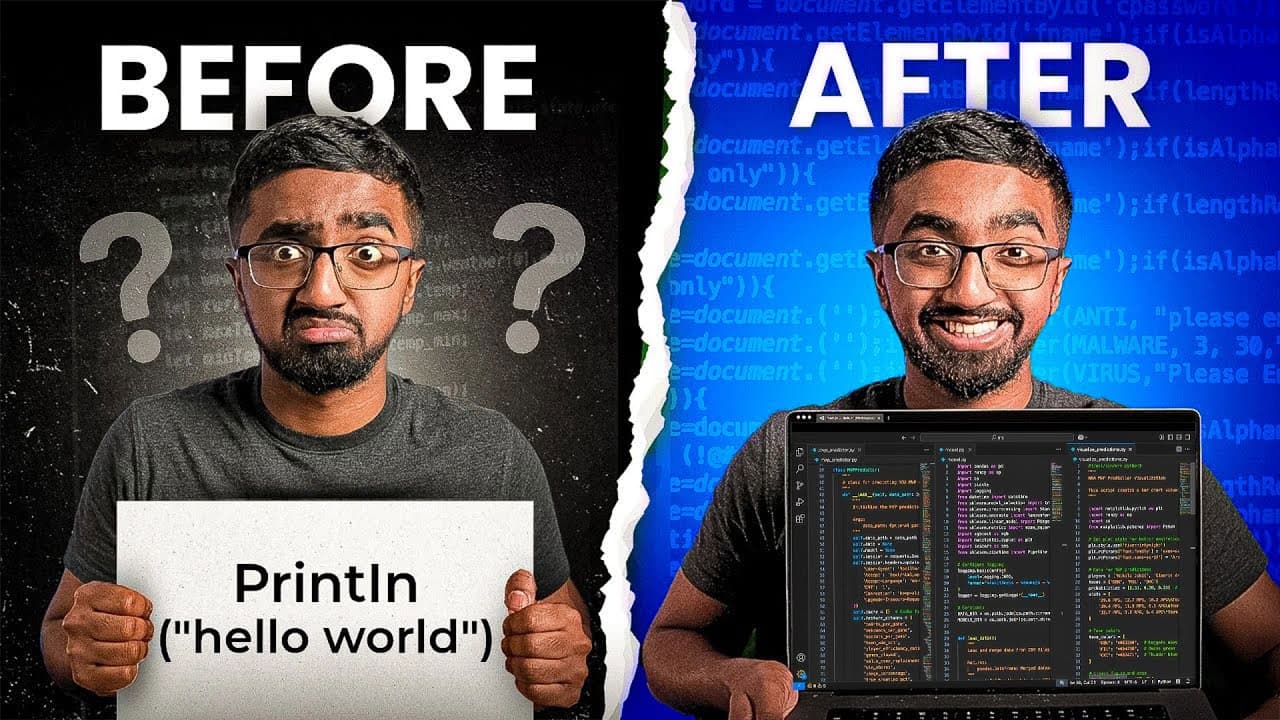
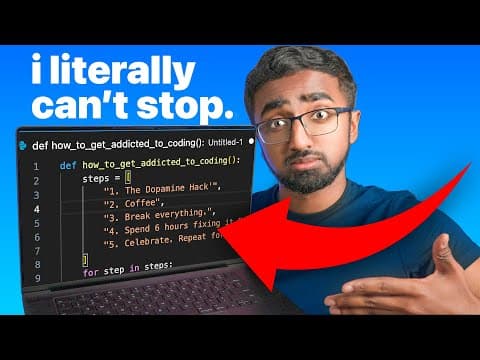
i used to suck at coding I've been working on coding for 6 hours and I haven't even gotten one that done and I feel so stupid That used to be me All those sleepless nights imposter syndrome and general incompetence Like why does coding look like English but act like it's possessed why are there periods in the middle of sentences why do we separate ... Read More
Key Insights
- Programming fundamentals are the preparation required before serious project work. Beginners should identify their current knowledge, select a direction, and create a learning path instead of opening a laptop and typing without a clear objective.
- Deep learning is more useful than rapidly browsing unrelated tutorials. Asking how errors, exceptions, threads, async functions, and language keywords work builds adaptable knowledge that can transfer even when languages, syntax, or project requirements change.
- Project building is the bridge between knowing terminology and becoming capable of programming. Small applications validate what a learner has studied, reveal missing knowledge, and create the practical context in which previously abstract concepts begin to make sense.
- Analysis paralysis is broken by starting before every concept feels familiar. Programming contains more material than any learner can master in advance, so waiting for complete readiness prolongs tutorial consumption without producing the experience needed for larger projects.
- Failure is a necessary part of developing programming mastery. Bugs that take hours or days to solve create a repeated cycle of attempting, failing, learning, and retrying, which gradually makes similar tasks faster and easier to complete.
- Python Tutor is a free debugging resource that visualizes variables, function calls, and the order in which code executes. This step-by-step representation can make program behavior easier to inspect when ordinary code output does not clearly reveal the problem.
- Rest is part of effective problem solving rather than an interruption of it. Repeated 12-hour coding sessions can cause burnout, while stepping away for at least 30 minutes may help a learner return with a clearer and more efficient solution.
- A productive help request includes documented evidence of previous attempts. After working for an hour or two, recording each approach, taking a break, and retrying for about 15 minutes, a learner can explain the blockage to a knowledgeable person or ChatGPT.
Install to Summarize YouTube Videos and Get Transcripts
Explore YouTube Video Summarizer or Get YouTube Transcript Extractor
Questions & Answers
Q: How should a complete beginner start learning to code?
A complete beginner should first assess existing knowledge, decide what they want to learn, and prepare a path toward that goal. The presenter recommends beginning with a foundation-building introduction such as the free CS50 course, which introduces programming through Scratch without overwhelming newcomers. After learning the basics, the learner should choose a direction and begin studying a suitable language.
Q: How can programmers escape tutorial hell?
Programmers can escape tutorial hell by moving from passive consumption to small, concrete projects. Watching many tutorials may create familiarity with terminology, but it does not provide the experience of applying concepts, finding gaps, or debugging mistakes. Building something simple forces the learner to validate what they know, discover what they do not know, and develop usable skills through action.
Q: Why is deep study better than browsing many coding tutorials?
Deep study builds an understanding of how programming concepts work beneath their surface syntax. The presenter contrasts learners who skim numerous videos with learners who investigate questions about errors, exceptions, threads, async functions, and language keywords. That deeper foundation supports adaptability because programming languages may use different ingredients, while many underlying techniques and problem-solving principles remain transferable.
Q: Why should beginners build coding projects early?
Beginners should build projects early because creating software turns abstract information into practical understanding. A project exposes knowledge gaps, demands decisions, and makes concepts click through use. The presenter learned Python while implementing genetic algorithms and machine learning in a resource-allocation simulation, reporting that three weeks of project work taught more Python than many people learn during a semester.
Q: How should a programmer respond when a project or solution fails?
A programmer should treat failure as part of the learning cycle rather than proof of incompetence. The recommended pattern is to try, fail, identify what happened, learn from it, and try again. Early projects may be poor and individual bugs may require days, but repeated encounters with difficulty gradually develop mastery and reduce the time required for comparable tasks.
Q: How can Python Tutor help with debugging code?
Python Tutor helps by visualizing program execution step by step. It displays variables, function calls, and where each call occurs, which can make behavior easier to understand when several operations interact. The presenter recommends it as a free resource for Python learners who struggle to picture what their program is doing and need a clearer debugging process.
Q: What routine can prevent burnout while solving coding problems?
Begin by attempting the problem for at least an hour or two. If the attempt fails, document every approach already tried, then leave the laptop and spend at least 30 minutes outside or away from the task. Return for another attempt of about 15 minutes. If the problem remains unresolved, seek guidance and explain the documented approaches clearly.
Q: When should a programmer ask someone else for help?
A programmer should ask for help after making a serious attempt, documenting the methods tried, taking a restorative break, and testing another possible solution. At that point, they can consult a more knowledgeable person, a senior engineer, or ChatGPT. Sharing the earlier approaches demonstrates preparation and allows the helper to identify the specific limitation or missing perspective more efficiently.
Summary & Key Takeaways
-
Start by assessing what you already know, choosing a direction, and establishing programming fundamentals. Dig into concepts instead of skimming many tutorials, because understanding how features work makes knowledge transferable between languages. Beginners can use structured introductions such as CS50 before selecting a language such as Python, Java, or JavaScript.
-
Convert foundational knowledge into practical ability by building small projects as early as possible. Projects expose gaps, validate concepts, and force you to solve real problems that passive tutorials cannot reproduce. The presenter reports learning more Python during three weeks of project work than many people learn during a semester.
-
Expect early projects and debugging attempts to fail, because repeated cycles of trying, failing, learning, and retrying develop mastery. Balance that persistence with a healthy routine: document attempted solutions, leave the computer for at least 30 minutes, retry briefly, and then request guidance from a knowledgeable person or ChatGPT.
Read in Other Languages (beta)
Share This Summary 📚
Summarize YouTube Videos and Get Video Transcripts with 1-Click
Try YouTube Summary with ChatGPT & Claude or YouTube Transcript Generator
Explore More Summaries from Sajjaad Khader 📚

Summarize YouTube Videos and Get Video Transcripts with 1-Click
Try YouTube Summary with ChatGPT & Claude or YouTube Transcript Generator