How to start coding in 2025 as a beginner
TL;DR
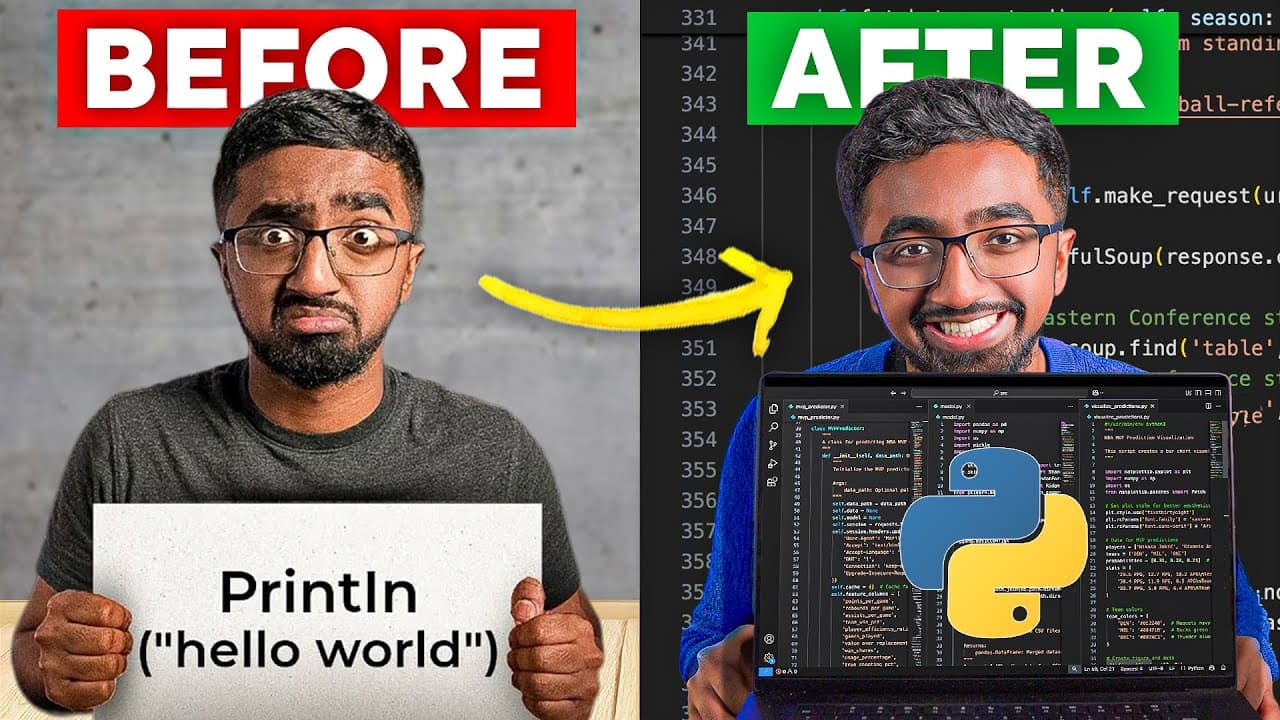
Python is a recommended first language for beginners, followed by JavaScript or other options depending on goals. The plan is to choose a friendly language, avoid tutorial hell, spend most time building, then work on end to end projects and finally network with others to stay motivated and improve faster.
Transcript
This is how I would learn to code if I could start over. If you're new here, hi, my name is Sajad. I'm a computer science masters graduate from Georgia Tech. I landed my first big tech software engineering job at the age of 20, earning $220,000 every single year. I've worked at big tech companies such as Amazon. And now, every single day, I help hu... Read More
Key Insights
- Coding journey should start with a beginner friendly language like Python to keep focus on problem solving rather than syntax.
- Avoid tutorial hell by applying cognitive load management and the 70/30 rule, spending 70 percent building and 30 percent learning new information.
- Use end to end real world projects to learn core skills across backend, frontend, data handling, and deployment.
- Practice with a structured project progression: set up project structure, database, CLI, data analysis, visualization, and a web interface.
- Leverage free learning resources such as CS50 style courses and specific tools like SQL Alchemy, pandas, and Flask to build competence.
- Involve real world practice by creating an expense tracker that covers storage, queries, analysis, visualization, and deployment considerations.
- Build a supportive coder network by connecting with peers, joining communities, and collaborating on projects to accelerate learning.
- Story of progression uses relatable language that compares coding to driving, easing beginners into concepts with familiar analogies.
- More videos from this channel:
- More from this channel: Sajjaad Khader
Install to Summarize YouTube Videos and Get Transcripts
Explore YouTube Video Summarizer or Get YouTube Transcript Extractor
Questions & Answers
Q: A real search query question about the video (e.g. 'How to...', 'What is...', 'Why does...', 'When should...'). Question 1
Python is recommended as the starting language for beginners due to its readable syntax and problem solving focus, making it easier to transition from basics to more complex tasks. The path includes avoiding heavy early specialization, then expanding to other languages like JavaScript or Java based on goals. This approach helps learners gain confidence quickly while building solid fundamentals.
Q: Question 2
One should combine language choice with practical steps such as setting up projects, databases, and a command line interface. Using SQL Alchemy with SQLite for a simple start makes data modeling approachable. This hands on setup reinforces concepts and gives learners tangible outcomes to reference when explaining their skills to potential employers.
Q: Question 3
The video emphasizes a cognitive load aware approach and warns against tutorial hell. By balancing 70 percent building with 30 percent learning, learners anchor abstract concepts in concrete projects. This method reduces overwhelm, lowers frustration, and accelerates skill acquisition by providing frequent, meaningful progress.
Q: Question 4
Real world end to end projects are central to learning. An expense tracker project is used as a step by step example, covering backend, frontend, data analysis, visualization, and deployment. Building such a project demonstrates a range of competencies and creates a portfolio piece that can be shown to recruiters.
Q: Question 5
The learning journey includes using data analysis libraries like pandas and visualization tools like matplotlib to extract insights from projects. This teaches how to handle data, perform calculations, identify trends, and present findings, which are valuable skills for software engineers dealing with real datasets.
Q: Question 6
Deployment and web interfaces are included to show how to take a project from local to production. Steps include creating a Flask based web interface, deploying on services like Render or Heroku, and configuring environment variables. These details prepare learners for real world job oriented tasks and show end to end competence.
Q: Question 7
Networking with other coders is presented as a key part of learning. Building a circle of peers who code and share projects increases motivation and accelerates improvement. Communities, Discord servers, and classmates can provide feedback, collaboration opportunities, and accountability for ongoing progress.
Q: Question 8
The video also suggests using resources like Build Your Own X to explore real world projects across languages, and mentions tools like codi.te for bite sized lessons and AI assistance. These resources support ongoing practice, offer structured learning, and provide extra help when learners encounter roadblocks.
Summary & Key Takeaways
-
This summary captures the core approach of starting to code from scratch as presented. It emphasizes choosing a beginner friendly language like Python, avoiding overwhelm, and balancing building with learning new concepts. It also highlights the value of real world projects and community support in accelerating progress.
-
The guide stresses practical steps such as project based learning, using tools like SQL Alchemy, pandas, and Flask for real projects. It also underscores not to rely solely on tutorials and to progressively tackle real world tasks with end to end projects.
-
The overall message is to adopt a conscious, step by step plan to learn coding that prioritizes hands on practice, project work, and supportive networks to land a job in tech.
Read in Other Languages (beta)
Share This Summary 📚
Summarize YouTube Videos and Get Video Transcripts with 1-Click
Try YouTube Summary with ChatGPT & Claude or YouTube Transcript Generator
Explore More Summaries from Sajjaad Khader 📚

Summarize YouTube Videos and Get Video Transcripts with 1-Click
Try YouTube Summary with ChatGPT & Claude or YouTube Transcript Generator