How Do Common Data Structures Work Efficiently?
TL;DR
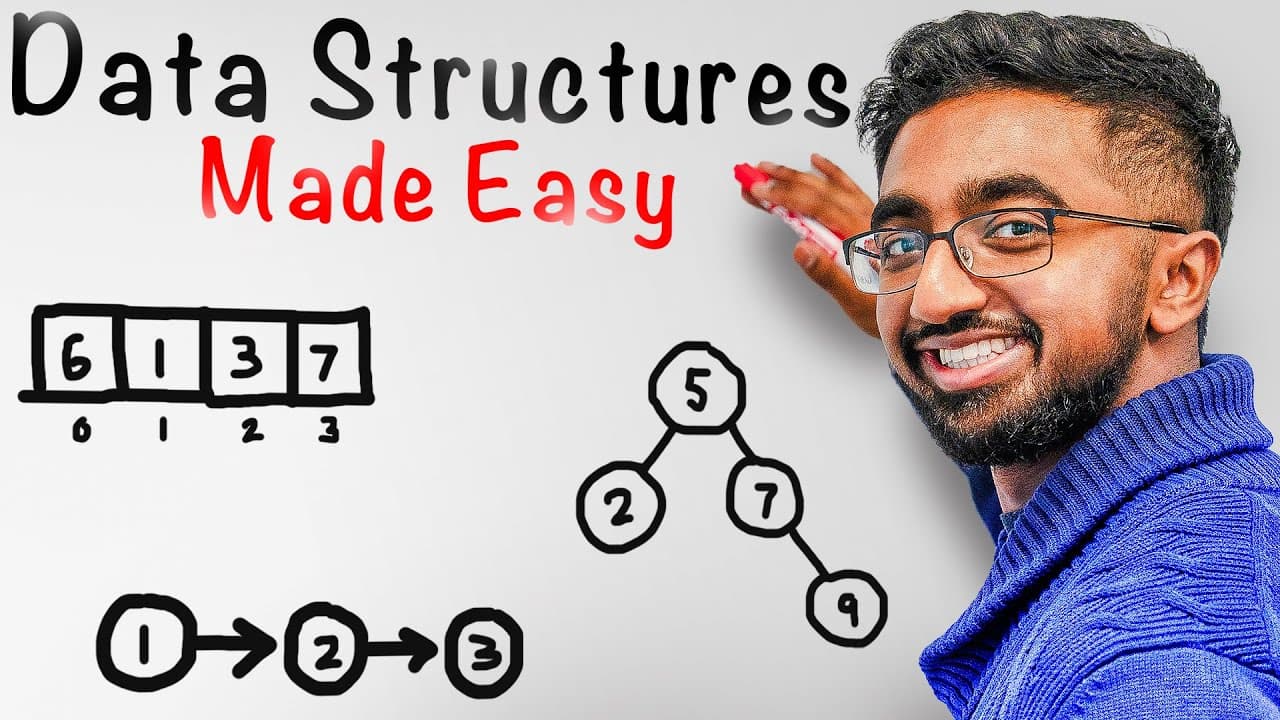
Choose a data structure according to the operations that must be efficient. Arrays provide constant-time indexed access, linked lists simplify insertion and deletion when a node reference is available, stacks process the newest item first, and queues process the oldest item first. Big O notation compares how operation time changes as the amount of data grows.
Transcript
data structures are super important to know for technical coding interviews and computer science in general and so in this video I'm going to be breaking down some of the most popular data structures out there what they look like and how they operate real world examples so you can actually picture what I'm talking about plus their time complexities... Read More
Key Insights
- Big O notation is a way to compare the speed and efficiency of data-structure operations as input size changes. It helps explain why a structure may perform well for one operation but become slower or less suitable for another scenario.
- Constant time, O(1), means an operation takes the same amount of time regardless of how much data exists. Retrieving the first grocery-list item illustrates this behavior because the known position can be accessed without searching through the remaining items.
- Linear time, O(n), means the work grows at the same rate as the amount of data. Searching an unsorted list may require checking every name, so a list of ten names can require ten checks in the worst case.
- Quadratic time, O(n²), occurs when every item must interact with every other item. The classroom handshake example shows how the work grows rapidly, with ten students producing a ten-by-ten operation pattern and one hundred students producing a hundred-by-hundred pattern.
- Logarithmic time, O(log n), repeatedly cuts the remaining search area in half. Looking up a dictionary word by opening near the middle, deciding whether to move forward or backward, and repeating the process avoids checking every page sequentially.
- An array stores elements contiguously and assigns each one a specific index, making indexed retrieval O(1). Growing beyond its fixed size requires creating a larger array and copying existing values, while deletion normally requires later elements to shift.
- A linked list stores each value in a separate node with a pointer to the next node. Access by position is O(n), but insertion or deletion is O(1) when the relevant node reference is already available and only pointers must change.
- A stack follows last in, first out ordering, while a queue follows first in, first out ordering. Stack push and pop operations are O(1), and queue insertion at the back and deletion from the front are also described as O(1).
Install to Summarize YouTube Videos and Get Transcripts
Explore YouTube Video Summarizer or Get YouTube Transcript Extractor
Questions & Answers
Q: What is Big O notation in data structures?
Big O notation measures how the speed or efficiency of an operation changes as the amount of data grows. The transcript compares this with choosing different ways to travel between New York and California. Just as vehicles suit different journeys, data structures are optimized for different operations, so their time complexities help compare those tradeoffs.
Q: What is the difference between O(1), O(n), and O(n²)?
O(1) takes the same amount of time regardless of input size, such as retrieving an item from a known position. O(n) grows in proportion to the data and may require checking every item. O(n²) grows much faster because each item interacts with every other item, as illustrated by students shaking hands.
Q: How does O(log n) time complexity work?
O(log n) works by repeatedly reducing the remaining search space by half. The dictionary example begins near the middle, determines whether the desired word appears before or after that point, and repeats the decision within the remaining section. This approach is faster than checking every page, which would be a linear operation.
Q: Why is array access O(1)?
Array access is O(1) because elements are stored side by side in contiguous memory and each element has a specific index. When the desired index is known, the operation can go directly to that position without examining earlier elements. The transcript compares this organization to numbered lockers arranged in a fixed row.
Q: Why can inserting or deleting array elements take O(n)?
Adding beyond a full array’s fixed capacity requires creating a larger array and copying all existing elements, which takes O(n). Deleting an element normally also takes O(n) because every subsequent value must shift to preserve contiguous storage. Deleting the final element is different because nothing needs to shift, making that operation O(1).
Q: How does a linked list differ from an array?
A linked list stores values in separate nodes, with each node pointing to the next, rather than placing every value contiguously. It can add or remove nodes without shifting all later elements or resizing a fixed structure. However, finding a position is slower because traversal must begin at the front and continue node by node.
Q: How do stack operations work and what are their time complexities?
A stack follows last in, first out ordering, so the newest element is removed before earlier elements. Adding to the top is called pushing, and removing from the top is called popping. Both operations are O(1) because they affect only the top. Searching through the stack is O(n) because it lacks indexed access.
Q: How is a queue different from a stack?
A queue follows first in, first out ordering, while a stack follows last in, first out ordering. A queue adds new elements at the back and removes elements from the front, like people waiting at a store checkout. Those insertion and deletion operations are O(1), while searching through the queue is O(n).
Summary & Key Takeaways
-
Big O notation describes how an operation’s time changes as the amount of data increases. Constant time stays unchanged, linear time grows at the same rate as the input, quadratic time grows rapidly because items interact with other items, and logarithmic time repeatedly reduces the remaining search space by half.
-
Arrays place elements side by side in contiguous memory, giving each element an index and enabling constant-time retrieval. Their fixed size creates tradeoffs: growing beyond capacity requires a larger array and copying, while most deletions require subsequent elements to shift. Removing the final element avoids shifting and takes constant time.
-
Linked lists connect separate nodes through pointers, while stacks and queues restrict where elements enter and leave. Linked lists support constant-time pointer changes when the relevant node is already known. Stacks use last in, first out ordering, whereas queues use first in, first out ordering for processing elements.
Read in Other Languages (beta)
Share This Summary 📚
Summarize YouTube Videos and Get Video Transcripts with 1-Click
Try YouTube Summary with ChatGPT & Claude or YouTube Transcript Generator
Explore More Summaries from Sajjaad Khader 📚






Summarize YouTube Videos and Get Video Transcripts with 1-Click
Try YouTube Summary with ChatGPT & Claude or YouTube Transcript Generator