How to Implement ICT Price Action Model 2
TL;DR
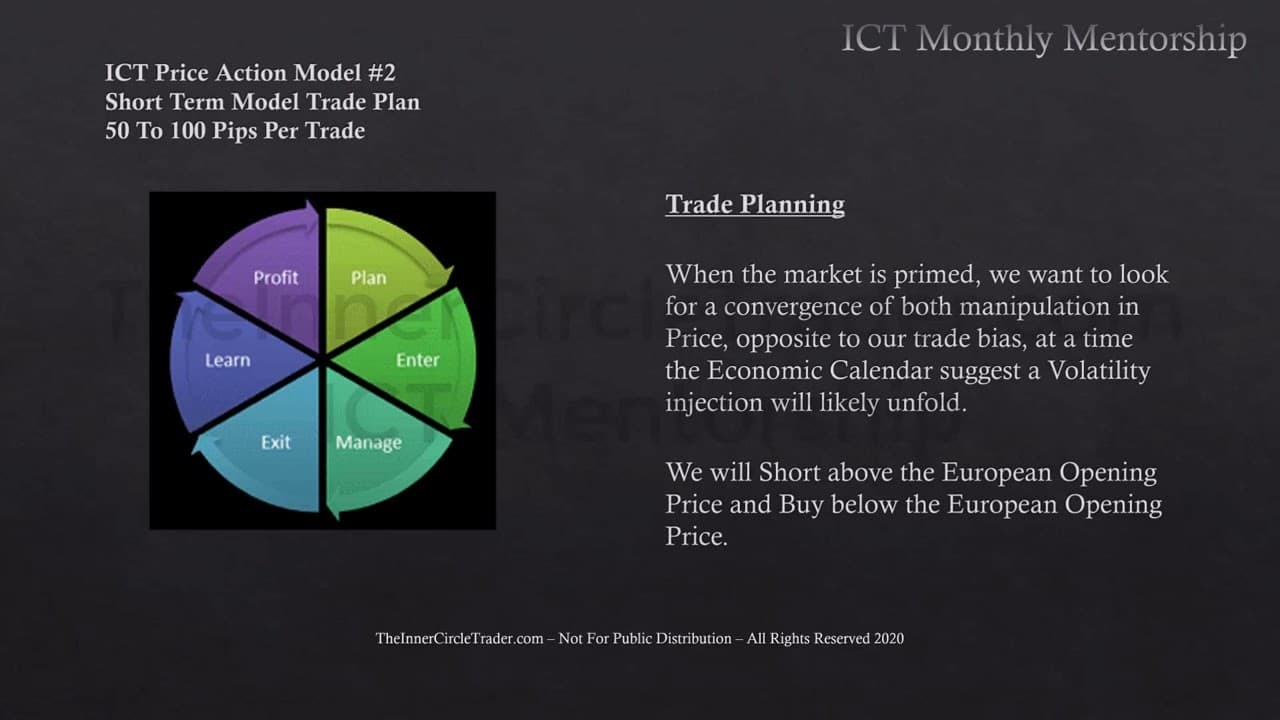
The ICT Price Action Model 2 focuses on achieving 50 to 100 Pips per trade by analyzing weekly market structures and economic calendars. Traders should prepare by identifying high-impact news events, determining the 20-day dealing range, and finding liquidity draws. The model emphasizes disciplined trade management, including stop-loss adjustments and position sizing, to maximize profitability while minimizing risk.
Transcript
okay folks welcome back this is price action model number two short-term trading plan 50 to 100 Pips per trade all right so ICT price action model number two short-term trading model and again the objective is 50 to 100 Pips per trade TR as I warned in the first price action model uh majority of the slides you see in these trade plans are going to ... Read More
Key Insights
- ICT Price Action Model 2 aims for 50 to 100 Pips per trade.
- Preparation involves checking the economic calendar for high-impact news.
- Traders determine the 20-day dealing range by noting the highest high and lowest low.
- Liquidity draws are identified as old highs/lows, fair value gaps, or liquidity pools.
- Trade entries are based on optimal trade entry levels within a defined time window.
- Stop-loss management is crucial, with adjustments at 25%, 50%, and 75% profit milestones.
- Position size is calculated using account equity, risk percentage, and stop-loss in Pips.
- The strategy includes both price and time filters to enhance trade precision.
Install to Summarize YouTube Videos and Get Transcripts
Explore YouTube Video Summarizer or Get YouTube Transcript Extractor
Questions & Answers
Q: How to determine the 20-day dealing range?
To determine the 20-day dealing range, traders look back 20 days from the current date, excluding Sundays, and note the highest high and lowest low within that period. This range serves as the current dealing range, helping traders identify potential liquidity draws and optimal trade entry points. If necessary, traders can extend the look-back period to 40 or 60 days if no clear patterns emerge.
Q: What are liquidity draws in trading?
Liquidity draws refer to price levels where the market is likely to move next, often targeting areas of high liquidity such as old highs, lows, fair value gaps, or liquidity pools. Traders use these areas to anticipate market movements, aligning their trades with the expected direction of the weekly range bias, thus improving the accuracy of their entries and exits.
Q: How does stop-loss management work in this model?
Stop-loss management in ICT Price Action Model 2 involves adjusting the stop-loss as the trade progresses towards profit. When a position reaches 25% of the expected profit, the stop-loss is reduced by 25%. At 50% profit, it is reduced by 50%, and when the position is at 75% of the expected profit, the stop-loss is set to break even or higher, minimizing potential losses.
Q: How is position size calculated in this trading model?
Position size is calculated using the formula: (Account Equity x Risk Percentage) / Stop Loss in Pips. This calculation determines the amount of leverage a trade assumes, ensuring that the risk per trade aligns with the trader's risk tolerance. The formula helps traders manage their exposure effectively, maintaining a balance between potential profits and losses.
Q: What is the significance of economic calendars in trading?
Economic calendars are crucial as they list upcoming high-impact news events that can influence market movements. Traders use these calendars to prepare for potential volatility, aligning their trades with expected market reactions to news releases. By understanding the timing and nature of these events, traders can better anticipate market behavior and adjust their strategies accordingly.
Q: Why is time an important factor in this trading model?
Time is a critical factor because it helps define when trades should be executed and closed. The model specifies time windows, such as the London and New York open, where optimal trade entries are more likely. Additionally, trades must be closed by Thursday New York open, ensuring that traders do not hold positions through potentially volatile market conditions, thus managing risk effectively.
Q: How does the model use price filters?
Price filters in the model ensure that trades are only taken at optimal levels. For example, when bearish, trades should be entered above the European opening price and within a specified range of standard deviations. These filters help traders avoid entering trades at unfavorable prices, increasing the likelihood of successful trade outcomes by aligning entries with expected market movements.
Q: What role does risk management play in this trading strategy?
Risk management is fundamental to the strategy, focusing on controlling losses and protecting profits. The model emphasizes using calculated position sizes, stop-loss adjustments, and specific entry and exit points to manage exposure. By adhering to these risk management principles, traders can maintain a smooth equity curve, minimizing drawdowns and ensuring long-term trading success.
Summary & Key Takeaways
-
ICT Price Action Model 2 focuses on short-term trading with objectives of 50 to 100 Pips per trade. Traders prepare by analyzing economic calendars and identifying 20-day dealing ranges, looking for liquidity draws. The model emphasizes disciplined trade management with specific stop-loss adjustments and position sizing to optimize profitability and minimize risk.
-
Traders identify key market events and determine weekly profiles by comparing economic calendars and market structures. The model uses optimal trade entry levels within defined time windows, ensuring trades align with weekly biases. Stop-loss management and position sizing are critical components, with adjustments made at various profit milestones to secure gains.
-
The strategy involves a systematic approach to trading, focusing on preparation, opportunity discovery, trade planning, execution, and management. By identifying liquidity draws and using price and time filters, traders can enhance trade precision. The model encourages using a disciplined approach to risk management, ensuring consistent profitability.
Read in Other Languages (beta)
Share This Summary 📚
Summarize YouTube Videos and Get Video Transcripts with 1-Click
Try YouTube Summary with ChatGPT & Claude or YouTube Transcript Generator
Explore More Summaries from The Inner Circle Trader 📚
Summarize YouTube Videos and Get Video Transcripts with 1-Click
Try YouTube Summary with ChatGPT & Claude or YouTube Transcript Generator