How to Build Production RAG for Enterprise AI
TL;DR
Production RAG depends primarily on high-quality data processing, accurate retrieval, and infrastructure that can scale across complex documents and siloed enterprise sources. A prototype can be assembled quickly, but reaching production quality requires careful parsing, ingestion, indexing, tuning, and maintenance. Developers should retain enough control to adapt applications as models, retrieval methods, and agentic workflows evolve.
Transcript
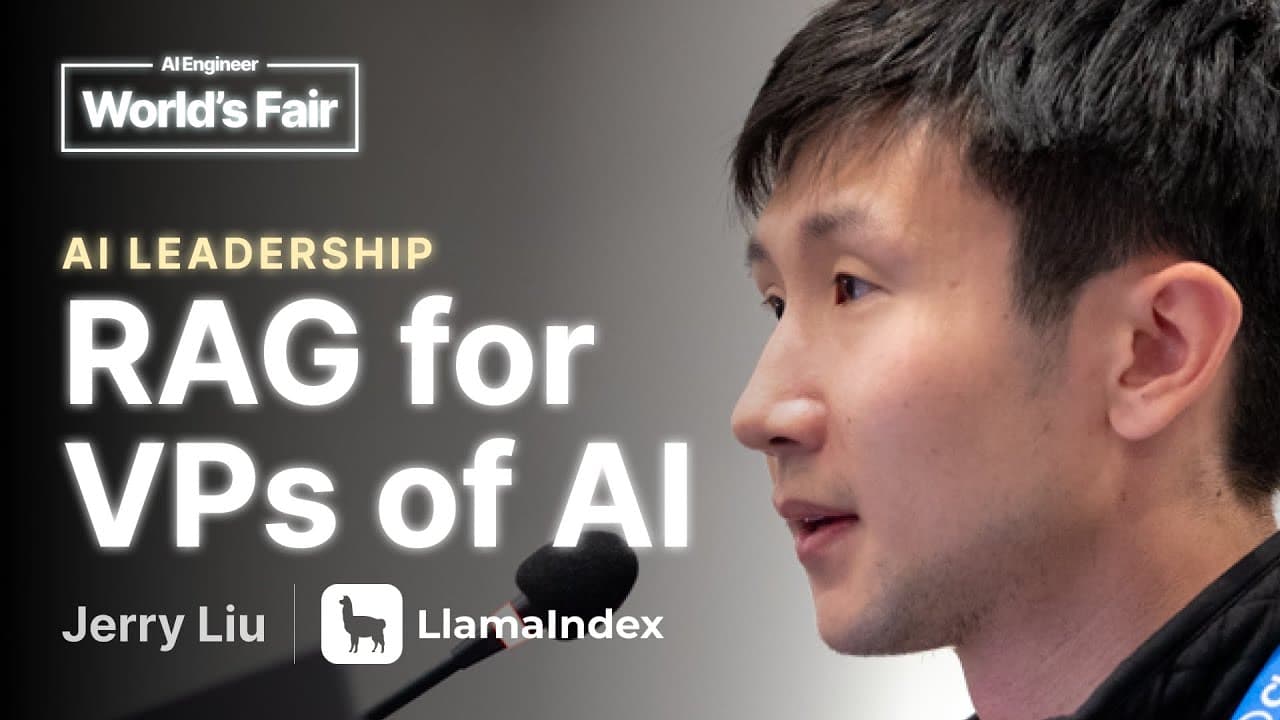
hi everyone I'm Jerry co-founder CEO of uh of llama index and uh I'll probably spend the first 10 minutes just giving like a brief overview I I mean of rag and also just like llama index uh how we see the Enterprise developer space and and how it's progressing as well as give an overview of the product offerings um and then I think in the next 15 m... Read More
Key Insights
- RAG is a collection of techniques for building a question-answering interface over private data. It retrieves relevant information from sources such as file directories, supplies that context to a language model, and uses the model to synthesize an answer grounded in the retrieved material.
- A complete RAG system requires more than a language model. Its main components include an LLM for final synthesis, an embedding model, a database or storage layer, and a data-processing stack that parses, divides, indexes, and represents information for reliable model access.
- The production gap is one of the largest challenges in enterprise RAG. A basic pipeline can be created in about 10 minutes, but increasing document volume, complexity, data-source count, and quality expectations introduces accuracy, tuning, scalability, and maintenance problems.
- Data quality is a primary determinant of response quality in LLM applications. If complex source material is parsed or represented poorly, even a capable language model may receive inadequate context and produce hallucinations or otherwise unreliable answers.
- Enterprise knowledge is distributed across unstructured data, structured data, semi-structured data, and APIs. A centralized knowledge interface can make these silos accessible to LLM applications, supporting answers and actions that draw from information located throughout an organization.
- Developers are well positioned to translate rapidly changing AI technology into enterprise value tailored to specific use cases. Building some custom capabilities can help organizations adapt more quickly than relying entirely on purchased tools designed around a current, fixed pain point.
- The LlamaIndex open-source toolkit orchestrates retrieval, prompting, agentic reasoning, and tool use for context-augmented LLM applications. Its stated goal is to help developers move applications from prototypes toward production while retaining control over custom application logic.
- LlamaParse is an advanced document parser designed for complex source files such as financial reports and presentations. It processes messy layouts, tables, images, and diagrams into representations that LLMs can understand, addressing a central source of poor retrieval quality and hallucination.
Install to Summarize YouTube Videos and Get Transcripts
Explore YouTube Video Summarizer or Get YouTube Transcript Extractor
Questions & Answers
Q: What components are required to build an enterprise RAG system?
An enterprise RAG system needs an LLM for final answer synthesis, an embedding model, and a database or storage system. The storage layer may be a vector database, document store, graph store, or SQL database. It also needs a dedicated data-processing stack that parses source documents, divides them into useful chunks, indexes them, and creates representations that the language model can retrieve effectively.
Q: Why is moving a RAG prototype into production difficult?
A RAG prototype can be assembled in about 10 minutes with suitable tooling, but a system that merely works is not necessarily production quality. Difficulties grow as the number of documents increases, documents become more complex, and additional sources are connected. Teams then face accuracy issues, numerous tuning decisions, higher response-quality requirements, scaling challenges, and ongoing pipeline maintenance that can consume substantial developer time.
Q: How does data quality affect RAG accuracy and hallucinations?
Data quality determines whether the language model receives a faithful and useful representation of the source material. If ingestion or parsing loses structure, misreads tables, or handles complex layouts poorly, retrieval may supply incomplete or misleading context. Even a strong LLM can then generate inaccurate or hallucinated responses. Improving the processing and representation of enterprise documents is therefore essential to improving application response quality.
Q: How is RAG data processing different from traditional ETL?
Traditional ETL is described as being primarily designed for analytics workloads, while RAG requires processing that makes information directly accessible to language models. At a basic level, a RAG pipeline may ingest a PDF, divide it into chunks, determine an effective chunking method, and index the results in one or more storage formats. The objective is to create representations that support accurate retrieval and answer synthesis.
Q: How can enterprises connect siloed data to LLM applications?
Enterprises can create a centralized knowledge interface that brings together unstructured, structured, and semi-structured data, along with information available through APIs. The processing layer must ingest and enhance these sources so language models can understand them consistently. When that foundation works well, applications can synthesize answers and potentially perform actions using knowledge distributed across multiple systems and locations within the enterprise.
Q: Why should enterprise AI teams invest in developers?
Developers can translate changing AI capabilities into applications tailored to an organization's particular data and workflows. The underlying technology evolves quickly, while an out-of-the-box product may address only the pain point that existed during procurement. Retaining custom development capacity helps a team adopt new retrieval techniques, models, and workflows while creating orchestration logic that fits its own enterprise use case.
Q: What roles do LlamaIndex and LlamaCloud play in production RAG?
The LlamaIndex open-source toolkit supports orchestration for context-augmented LLM applications, including retrieval, prompting, agentic reasoning, and tool use. LlamaCloud serves as a centralized knowledge interface that processes, enhances, and manages enterprise data for production applications. Together, they are intended to reduce time spent wrangling data while allowing developers to focus on custom retrieval logic, prompts, agents, and application workflows.
Q: What is LlamaParse used for in an enterprise AI stack?
LlamaParse is an advanced document parser within LlamaCloud that addresses data-quality problems in complex unstructured files. It is intended for materials such as financial reports, PDFs, PowerPoint presentations, and spreadsheets containing messy text layouts, tables, images, and diagrams. By producing representations that language models can understand more reliably, it supports better retrieval and reduces errors associated with poorly parsed source documents.
Summary & Key Takeaways
-
RAG creates question-answering interfaces over enterprise data by combining an LLM, an embedding model, a database, and a specialized data-processing stack. That stack parses source files, divides their contents into useful chunks, and represents the information in storage systems that make it accessible to language models during retrieval and response synthesis.
-
Building a RAG prototype can take about 10 minutes with suitable tools, but production deployment is substantially harder. Accuracy problems emerge as document volume, source diversity, and document complexity increase. Teams must tune multiple components, maintain pipelines, satisfy higher quality expectations, and prevent poor data representations from contributing to hallucinated answers.
-
LlamaIndex offers an open-source orchestration toolkit and LlamaCloud, a centralized knowledge interface for production LLM applications. LlamaCloud focuses on processing, enhancing, and managing enterprise data, while LlamaParse handles complex PDFs, presentations, spreadsheets, tables, images, and diagrams so developers can concentrate on retrieval, prompting, tool use, and agentic reasoning.
Read in Other Languages (beta)
Share This Summary 📚
Summarize YouTube Videos and Get Video Transcripts with 1-Click
Try YouTube Summary with ChatGPT & Claude or YouTube Transcript Generator
Explore More Summaries from AI Engineer 📚





Summarize YouTube Videos and Get Video Transcripts with 1-Click
Try YouTube Summary with ChatGPT & Claude or YouTube Transcript Generator