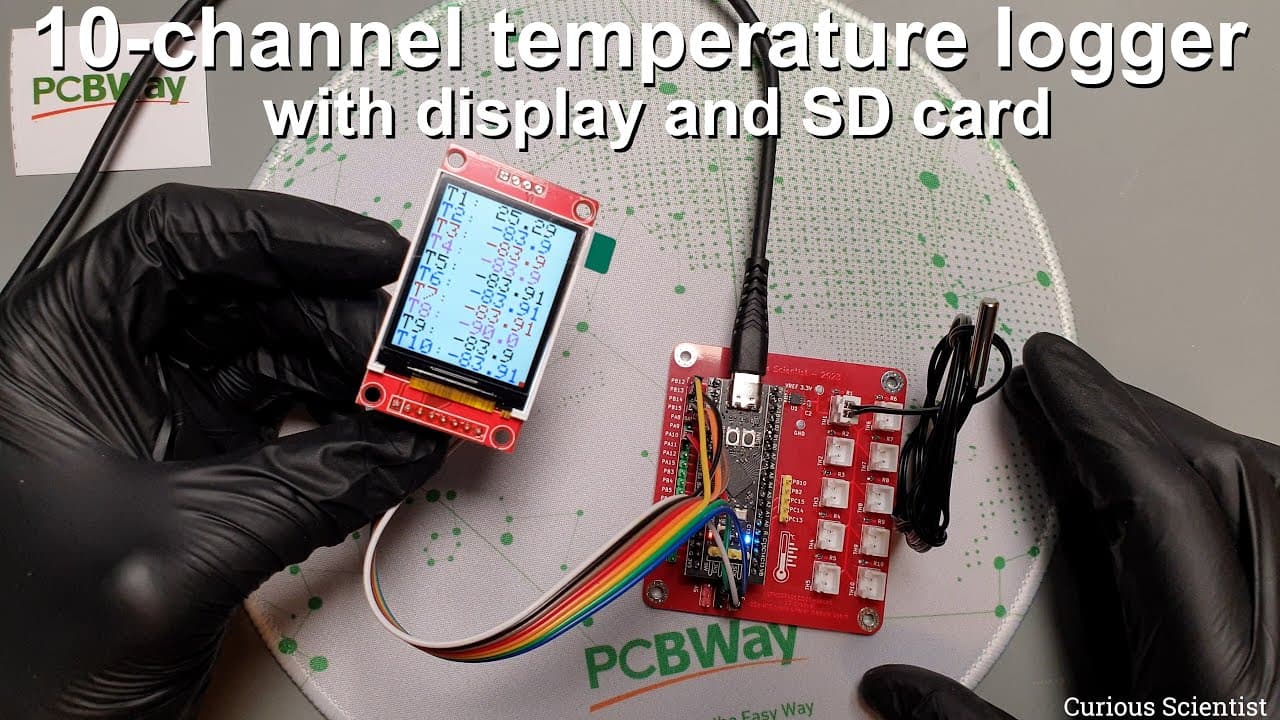
10-channel thermistor-based temperature logger with display and SD card
TL;DR
A comprehensive guide on creating a 10 channel temperature logger using custom PCBs and STM32 microcontroller.
Transcript
this video is sponsored by pcba welcome everyone in this video I'm going to show you my new project which is a quite useful tool I have previously showed you a 10 Channel voltage logger and now I'm going to show you a 10 Channel temperature logger and it is uh working along the same principles as my wattage logger except that now I have custom made... Read More
Key Insights
- 🏛️ The project focuses on building a 10-channel temperature logger, emphasizing practical applications in electronics.
- 🛃 It utilizes custom PCBs to streamline assembly and improve the organization of various components.
- 🖐️ The STM32 F401 microcontroller plays a central role in managing inputs from the NTC thermistors and processing temperature data.
- ⚡ Voltage dividers are crucial for converting temperature changes into readable voltage changes, showcasing fundamental electronics principles.
- 🛩️ The importance of effective soldering techniques and preparation for assembling small and intricate components is highlighted.
- 👻 The user interface for the logging system is designed to be intuitive, allowing easy navigation and temperature display.
- ☠️ Future developments are planned, including potential software enhancements for data logging capabilities on an SD card and improved user interactivity.
Install to Summarize YouTube Videos and Get Transcripts
Explore YouTube Video Summarizer or Get YouTube Transcript Extractor
Questions & Answers
Q: What is the primary function of the 10-channel temperature logger?
The primary function of the 10-channel temperature logger is to measure and record temperature readings from multiple NTC thermistors. By utilizing a microcontroller and a voltage divider circuit, it provides accurate temperature data for further analysis or monitoring. This is particularly useful in scientific experiments or environmental monitoring.
Q: How does the voltage divider circuit work in this logger?
The voltage divider circuit consists of NTC thermistors and fixed resistors connected to the ADC channels of the microcontroller. As the temperature changes, the resistance of the NTC thermistor varies, causing a change in voltage across the divider. The microcontroller reads this voltage drop, which is then converted to temperature through a defined formula, allowing the system to accurately capture temperature data.
Q: What challenges did the creator face while soldering the components?
The creator experienced difficulties during the soldering process due to dried solder paste and inadequate tools for small components. These challenges led to a less-than-perfect soldering job, but ultimately the assembly was successful, highlighting the importance of proper equipment and techniques for such delicate tasks in electronics projects.
Q: What enhancements are planned for the temperature logger project?
Planned enhancements for the temperature logger project include developing an enclosure to improve usability and aesthetics. Additionally, there are intentions to provide thorough documentation of the code used for the microcontroller, allowing users to replicate or modify the project easily, further expanding its functionality.
Summary & Key Takeaways
-
The video introduces a new project, a 10-channel temperature logger, showcasing custom-made PCBs and their components, including NTC thermistors. The STM32 F401 microcontroller reads temperature data from the sensors.
-
The logger operates using a voltage divider to measure temperature changes through ADC channels, implementing a reference voltage chip for stable operation. The data collection and logging functionalities are demonstrated in a user-friendly interface.
-
Testing the assembled equipment demonstrates its accuracy and responsiveness, with considerations for future enhancements like enclosure design and code explanations available on the creator's website.
Read in Other Languages (beta)
Share This Summary 📚
Summarize YouTube Videos and Get Video Transcripts with 1-Click
Try YouTube Summary with ChatGPT & Claude or YouTube Transcript Generator
Explore More Summaries from Curious Scientist 📚
![Building a Peltier cooler-based cooling box - First iteration, improvements [Part 2/6] thumbnail](/_next/image?url=https%3A%2F%2Fi.ytimg.com%2Fvi%2F0YlNw0EGnzI%2Fhqdefault.jpg&w=750&q=75)
Summarize YouTube Videos and Get Video Transcripts with 1-Click
Try YouTube Summary with ChatGPT & Claude or YouTube Transcript Generator