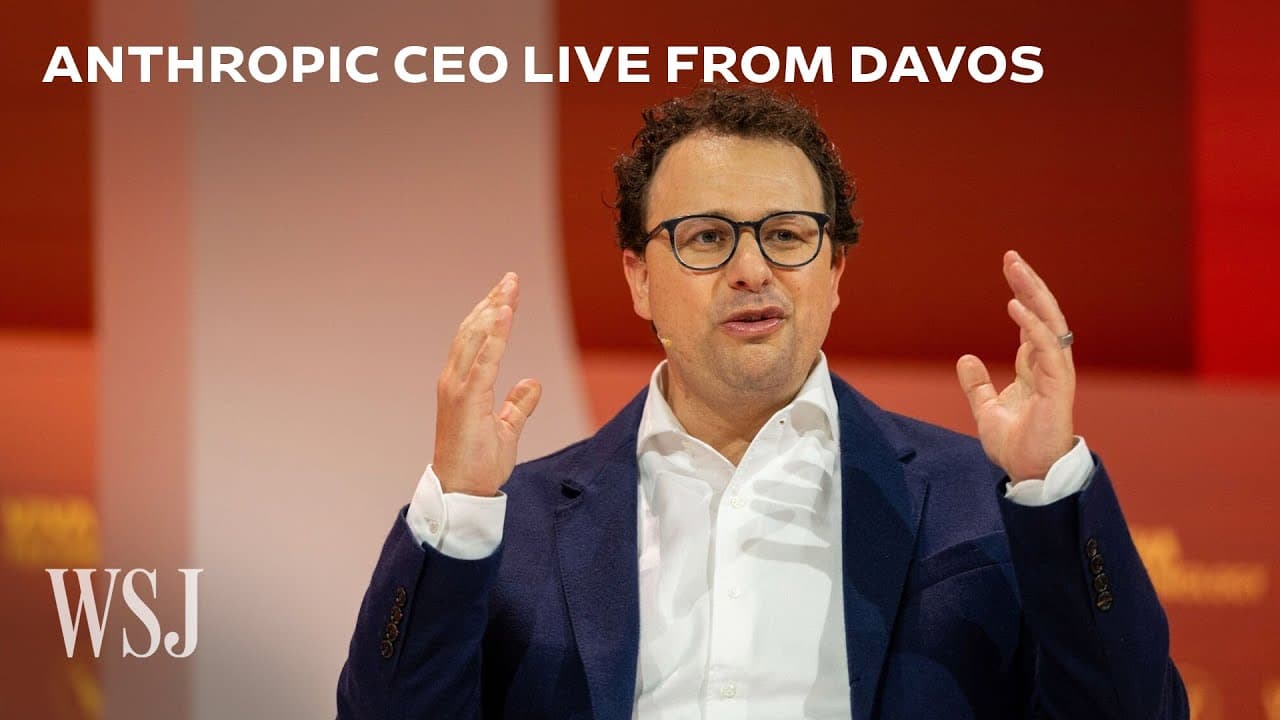
How AI Impacts Global Economy: Dario Amodei Insights
TL;DR
AI's rapid advancement presents both opportunities and challenges, including high GDP growth alongside high unemployment and inequality. Anthropic CEO Dario Amodei emphasizes the need for balanced AI development, measuring economic transitions, and adapting societal structures to ensure equitable distribution of AI benefits.
Transcript
Very well. Um, welcome everybody. Welcome to Journal House and a big welcome to to our audiences that are joining us online. But above all, a big welcome to Dario Amade, the chief exec of Anthropic. >> And thank you for having me. >> Not at all. So Dario, um, we're at Davos. There's a lot going on, but I wanted to start with a a big picture questio... Read More
Key Insights
- AI development is progressing rapidly, akin to a Moore's law for intelligence, with models becoming more capable every few months.
- Public perception of AI oscillates between excitement and skepticism, but the technology's capabilities continue to grow steadily.
- AI can drive high GDP growth but also result in high unemployment and inequality, a unique economic scenario.
- Anthropic focuses on enterprise solutions to avoid consumer-driven engagement pressures and maintain safety principles.
- Mechanistic interpretability is crucial for ensuring AI models are safe and controllable by understanding their inner workings.
- AI's potential to enhance autocracies through surveillance and control is a significant concern, requiring careful policy measures.
- Education systems need to adapt to AI's impact by focusing on character building and broadening skill sets beyond economic utility.
- AI adoption varies across regions and industries, with startups leading the way, highlighting the need for inclusive growth strategies.
Install to Summarize YouTube Videos and Get Transcripts
Explore YouTube Video Summarizer or Get YouTube Transcript Extractor
Questions & Answers
Q: How does AI impact GDP growth and unemployment?
AI can lead to high GDP growth by increasing productivity and efficiency across industries. However, it also poses the risk of high unemployment as automation replaces jobs, particularly in the knowledge work sector. This dual impact creates a unique economic scenario that requires careful policy planning to manage and mitigate potential inequalities.
Q: What is mechanistic interpretability in AI?
Mechanistic interpretability is the science of examining the internal workings of AI models to understand how they make decisions. This approach provides a 'ground truth' for model behavior, ensuring that AI systems are safe, controllable, and align with human intentions. It is crucial for developing reliable and trustworthy AI technologies.
Q: Why is AI considered a risk for autocracies?
AI technologies can enhance autocratic regimes by enabling advanced surveillance, targeted propaganda, and control over populations. The ability of AI to surveil individuals, suppress dissent, and deploy autonomous systems poses significant risks to democratic freedoms and human rights, necessitating international policy measures to prevent misuse.
Q: How should education systems adapt to AI advancements?
Education systems should shift from a purely economic focus to one that emphasizes character building and personal development. As AI disrupts traditional job markets, curricula need to incorporate skills that foster adaptability, creativity, and ethical reasoning, preparing students for a future where AI plays a central role in various domains.
Q: What are the competitive pressures facing Anthropic?
Anthropic faces competitive pressures from larger players like Google and OpenAI, particularly in consumer AI markets. However, by focusing on enterprise solutions, Anthropic avoids the engagement-driven models of consumer AI, allowing it to maintain its safety-first approach and differentiate itself in the AI industry.
Q: How is AI adoption uneven across regions and industries?
AI adoption is faster among startups and tech-savvy regions, while traditional enterprises and certain areas lag behind. This uneven diffusion creates disparities in economic benefits and opportunities, highlighting the need for strategies that promote inclusive growth and ensure that all regions and industries can leverage AI's advantages.
Q: What role does Anthropic see for government in AI transitions?
Anthropic believes that governments have a crucial role in managing the macroeconomic impacts of AI, such as unemployment and inequality. By implementing policies that distribute economic growth equitably and support workforce adaptation, governments can help societies navigate the transformative effects of AI technologies.
Q: Why does Anthropic focus on enterprise rather than consumer AI?
Anthropic focuses on enterprise AI to avoid the engagement-driven incentives of consumer markets, which can compromise safety and ethical standards. By providing AI solutions directly to businesses, Anthropic aligns its business model with its safety principles, ensuring that its technologies deliver value without compromising ethical considerations.
Summary & Key Takeaways
-
AI's exponential growth mirrors Moore's law, with models gaining cognitive capabilities rapidly. This steady advancement contrasts with fluctuating public perceptions, which often swing between optimism and fear about AI's potential impacts on society and the economy.
-
The dual potential of AI to drive significant GDP growth while also increasing unemployment and inequality presents a novel economic challenge. Anthropic CEO Dario Amodei stresses the importance of measuring these transitions and preparing policies to ensure equitable distribution of AI benefits.
-
Anthropic prioritizes enterprise-focused AI solutions to avoid consumer engagement pressures and uphold safety standards. The company advocates for mechanistic interpretability to ensure AI models are safe and controllable, emphasizing the need for responsible AI development and deployment.
Read in Other Languages (beta)
Share This Summary 📚
Summarize YouTube Videos and Get Video Transcripts with 1-Click
Try YouTube Summary with ChatGPT & Claude or YouTube Transcript Generator
Explore More Summaries from The Wall Street Journal 📚



Summarize YouTube Videos and Get Video Transcripts with 1-Click
Try YouTube Summary with ChatGPT & Claude or YouTube Transcript Generator