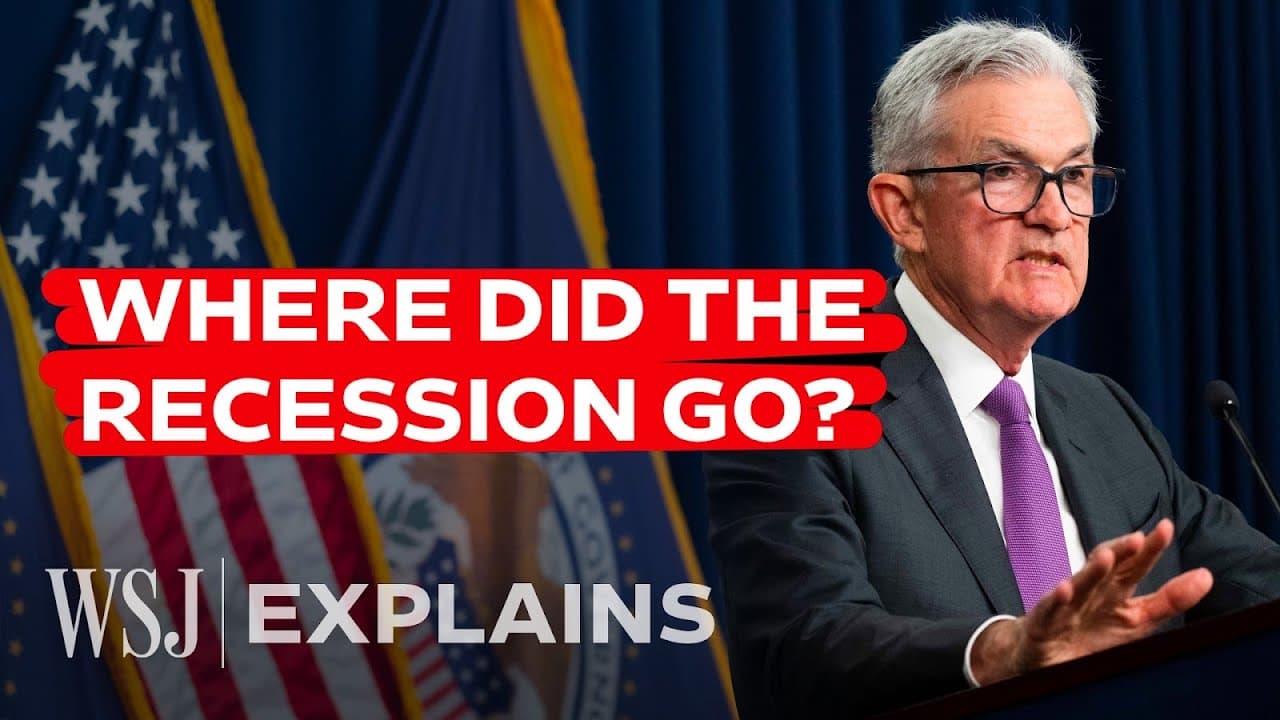
Why Hasn’t the Recession Hit Despite Economic Warnings?
TL;DR
The recession hasn't occurred due to high savings, low unemployment, and a resilient housing market. Factors like substantial pandemic savings, steady job availability, and low corporate debt have boosted consumer spending and business stability. While uncertainties remain, many economists now see a path to a potential soft landing for the economy.
Transcript
(audience applauding) - [Narrator] At the Annual Federal Reserve Symposium in 2022, just a few months after the Federal Reserve began to raise interest rates to fight inflation, Chairman Jay Powell was clear about what those actions might do to the economy. - While higher interest rates, slower growth and softer labor market conditions will bring d... Read More
Key Insights
- 🚩 The Federal Reserve was willing to take a recession to combat inflation, but a year later, the recession has not materialized.
- 💰 People had a lot of money saved coming out of the pandemic, which fueled spending despite inflation.
- 📈 The unemployment rate remains low, reflecting a high number of job vacancies and steady wage growth.
- 💼 Large corporations were able to withstand rising interest rates due to low debt, which protected employment levels.
- 🏠 The housing market, which often triggers recessions when interest rates rise, is not showing signs of a downturn due to low mortgage rates and limited supply.
- ⚠️ Headwinds are building, with concerns about personal debt levels, potential Hollywood strikes impacting employment, and lingering inflation.
- 🔮 While some economists still predict a recession, there is cautious optimism that a soft landing may be possible.
- 📅 Chairman Powell emphasized that there is a path to a soft landing, but it is too early to be optimistic.
Install to Summarize YouTube Videos and Get Transcripts
Explore YouTube Video Summarizer or Get YouTube Transcript Extractor
Questions & Answers
Q: Why did the Federal Reserve raise interest rates to combat inflation?
The Federal Reserve raised interest rates to combat inflation because higher interest rates can slow down economic growth and reduce inflationary pressure.
Q: What was the Fed's perspective on the potential impact of their actions on the economy?
The Fed was willing to accept a recession if necessary to bring down inflation, and believed that higher interest rates would likely result in slower growth and softer labor market conditions.
Q: Why hasn't a recession occurred despite predictions?
A recession has not occurred due to various factors, including high levels of savings coming out of the pandemic, low unemployment, and a strong housing market.
Q: How did savings and stimulus impact the economy?
People had high levels of savings coming out of the pandemic and the stimulus measures contributed to that. When people started spending again, they had the cash to do so, despite inflation.
Q: What role did the housing market play in preventing a recession?
The housing market usually plays a significant role in setting off a recession when the Fed raises interest rates. However, this time, limited supply and low mortgage rates have acted as a buffer against a housing market slump.
Q: What are some potential challenges that could still lead to a recession?
Some potential challenges include high levels of debt, uncertainty surrounding the impact of major Hollywood strikes on unemployment, and lingering inflation that has not yet reached the Federal Reserve's target.
Q: How optimistic are economists about the economy's ability to weather potential challenges?
Economists are more optimistic about the possibility of a soft landing and believe there is a wider path to a soft landing for the economy than previously thought. However, there is still uncertainty, and caution is warranted in using the term "optimism."
Summary & Key Takeaways
-
Chairman Jay Powell emphasized the Federal Reserve's willingness to risk a recession in order to combat inflation.
-
However, a year later, a recession has not materialized due to factors such as high savings, low unemployment, and a strong housing market.
-
While there are still uncertainties and potential headwinds, economists are more optimistic about the possibility of a soft landing for the economy.
Read in Other Languages (beta)
Share This Summary 📚
Summarize YouTube Videos and Get Video Transcripts with 1-Click
Try YouTube Summary with ChatGPT & Claude or YouTube Transcript Generator
Explore More Summaries from The Wall Street Journal 📚


Summarize YouTube Videos and Get Video Transcripts with 1-Click
Try YouTube Summary with ChatGPT & Claude or YouTube Transcript Generator