How Can Tiny AI Teams Achieve Outsized Results?
TL;DR
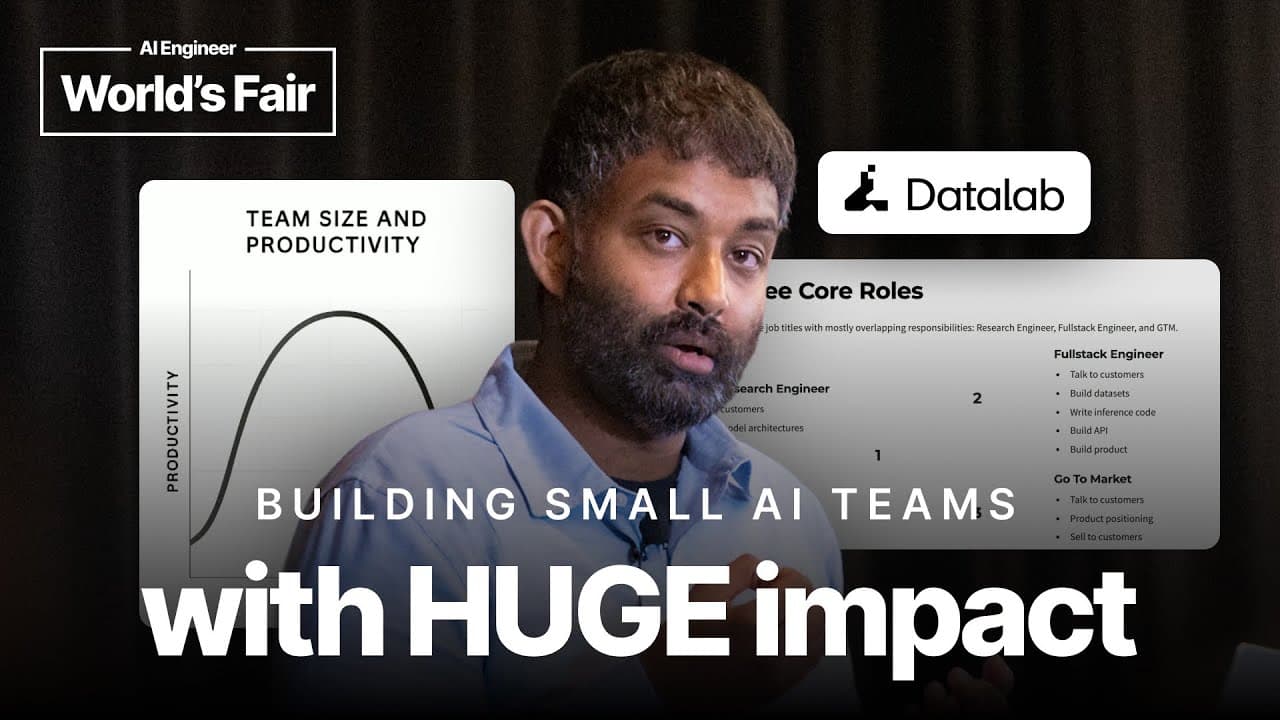
Small AI teams can produce substantial results by hiring mature generalists, keeping technology simple, reusing components, and applying AI to lower-leverage work. Datalab reached seven-figure ARR, accumulated 40,000 GitHub stars, trained state-of-the-art models, and grew revenue fivefold after January while operating with only three people before making an additional hire.
Transcript
okay uh my name is Vicas i'm the CEO of Datal Lab and today I'm going to talk about how we got to 40K GitHub stars seven figure ARR and train state-of-the-art models with a team of three so I spent the last year training these models like Britney mentioned marker and sura I also built repositories around them i left my AI research job and I started... Read More
Key Insights
- • Headcount is not a reliable measure of productivity. Datalab reached seven-figure ARR, accumulated 40,000 GitHub stars, trained state-of-the-art models, and grew revenue fivefold after January with a team that had only recently expanded from three people to four.
- • Specialization can reduce organizational flexibility. At Dataquest, highly specialized employees could not always move across functions to address the company’s most important problems, while senior employees became occupied with managing junior colleagues instead of directly completing high-value work.
- • Smaller teams can become more productive after reducing coordination burdens. Following both rounds of layoffs at Dataquest, productivity and happiness increased after several months, even though the layoffs themselves were painful for the employees who lost their jobs.
- • Mature generalists are defined by ownership rather than years of experience. They can examine an unfamiliar problem, determine how to solve it, do the necessary work, and continue iterating directly with customers until the result addresses the customer’s actual needs.
- • End-to-end ownership preserves context and accelerates feedback. The same Datalab researchers handled customer conversations, paper review, architecture, prototyping, data cleaning, model training, inference code, repository connections, customer delivery, and product integration instead of transferring work across separate teams.
- • Model training depends heavily on data preparation. During development of Surya OCR 3, the team found that work expected to center on architecture instead centered largely on data cleaning, including creating a data pipeline library and assembling the required datasets.
- • Simple architecture makes a tiny engineering team more effective. Datalab reuses components between on-premises and API deployments, uses server-rendered HTML with light HTMX and Alpine, avoids unnecessary infrastructure, and maintains clean, modular, well-documented code that AI can extend more easily.
- • High trust and close collaboration replace heavy management processes. The proposed small-team model favors people who can work without extensive supervision, continuous discussions, minimal bureaucracy, customer focus, and in-person collaboration that avoids the additional coordination processes associated with remote work.
Install to Summarize YouTube Videos and Get Transcripts
Explore YouTube Video Summarizer or Get YouTube Transcript Extractor
Questions & Answers
Q: How can a small AI team achieve high productivity?
A small AI team can achieve high productivity by hiring mature generalists who own problems from customer discovery through implementation, keeping its technology deliberately simple, reusing components across products, and maintaining clean modular code. AI can handle easier, lower-leverage tasks, while people concentrate on customer needs, architectural decisions, model development, data quality, integration, and iteration.
Q: Why does adding more employees not always increase productivity?
Adding employees can introduce specialization, handoffs, meetings, management layers, and coordination costs that reduce the time available for direct work. At Dataquest, specialists could not always shift toward the most important company problems, and senior employees spent time managing junior colleagues. After two workforce reductions, productivity and happiness increased within several months despite the smaller teams.
Q: What qualities should a small AI company seek when hiring?
A small AI company should seek senior generalists, where seniority means maturity rather than a particular number of years worked. These people should take responsibility for solving unfamiliar problems, do whatever the work requires, communicate directly with customers, and iterate until customer needs are met. They should also value simple solutions, require little management, and operate effectively in a high-trust culture.
Q: How does end-to-end ownership improve AI development?
End-to-end ownership prevents context from being repeatedly transferred between customer, research, training, engineering, and product teams. At Datalab, the same researchers gathered customer requirements, evaluated papers, selected an architecture, prototyped, cleaned data, trained the model, wrote inference code, connected repositories, and integrated the result into products. That structure enabled tighter integration and faster customer feedback.
Q: What did Datalab build with its small research team?
Datalab trained Surya OCR 3, a 500-million-parameter model supporting 90 languages. The company reported 99 percent accuracy on challenging internal benchmarks that included mathematics. The model also provided character-level bounding boxes and used PDF text for grounding at the line level. Two people managed the development process from customer conversations through product integration.
Q: Why does Datalab favor simple technology and modular code?
Simple technology reduces the number of systems a small team must build, operate, understand, and coordinate. Datalab reuses components between its on-premises and API deployments, uses server-rendered HTML with light HTMX and Alpine, and avoids unnecessary infrastructure such as a Kubernetes cluster for a three-person company. Its modular, documented repositories also make AI-assisted additions easier to produce and maintain.
Q: What role does AI play inside a tiny development team?
AI fills in easier, lower-leverage parts of the workflow so a small group of generalists can maintain broad end-to-end responsibility. Datalab used AI for work such as helping build a data pipeline library and supporting integration into its API. Human team members still handled higher-level work across customer discovery, research, architecture, training, inference, and product delivery.
Q: Why does Vikas Paruchuri prefer in-person work for small teams?
Vikas Paruchuri argues that a small team moving quickly benefits from in-person collaboration because remote work requires more intentional processes and synchronization. Those mechanisms consume time and can weaken the fast collaboration and tight feedback loops the team needs. His preferred model relies instead on continuous discussion, high trust, minimal bureaucracy, and employees who can make progress without extensive management.
Summary & Key Takeaways
-
Datalab demonstrated that headcount does not necessarily determine output. With three people, the company reached seven-figure ARR, earned 40,000 GitHub stars, and trained state-of-the-art models. Its revenue grew fivefold after January, and its customers included tier-one AI labs, universities, Fortune 500 companies, and AI startups.
-
Vikas Paruchuri developed his small-team philosophy after two rounds of layoffs at Dataquest. Although the reductions were painful, productivity and happiness later increased. He attributed the earlier inefficiency to excessive specialization, remote-work coordination, meeting overload, middle management, and senior employees spending substantial time managing more junior colleagues.
-
The proposed operating model uses fewer than 15 mature generalists, simple technology, reusable components, modular code, high trust, continuous discussion, and strong customer focus. AI and internal tools handle easier, lower-leverage tasks, while people retain responsibility for customer discovery, architectural judgment, model design, data work, integration, and product quality.
Read in Other Languages (beta)
Share This Summary 📚
Summarize YouTube Videos and Get Video Transcripts with 1-Click
Try YouTube Summary with ChatGPT & Claude or YouTube Transcript Generator
Explore More Summaries from AI Engineer 📚





Summarize YouTube Videos and Get Video Transcripts with 1-Click
Try YouTube Summary with ChatGPT & Claude or YouTube Transcript Generator