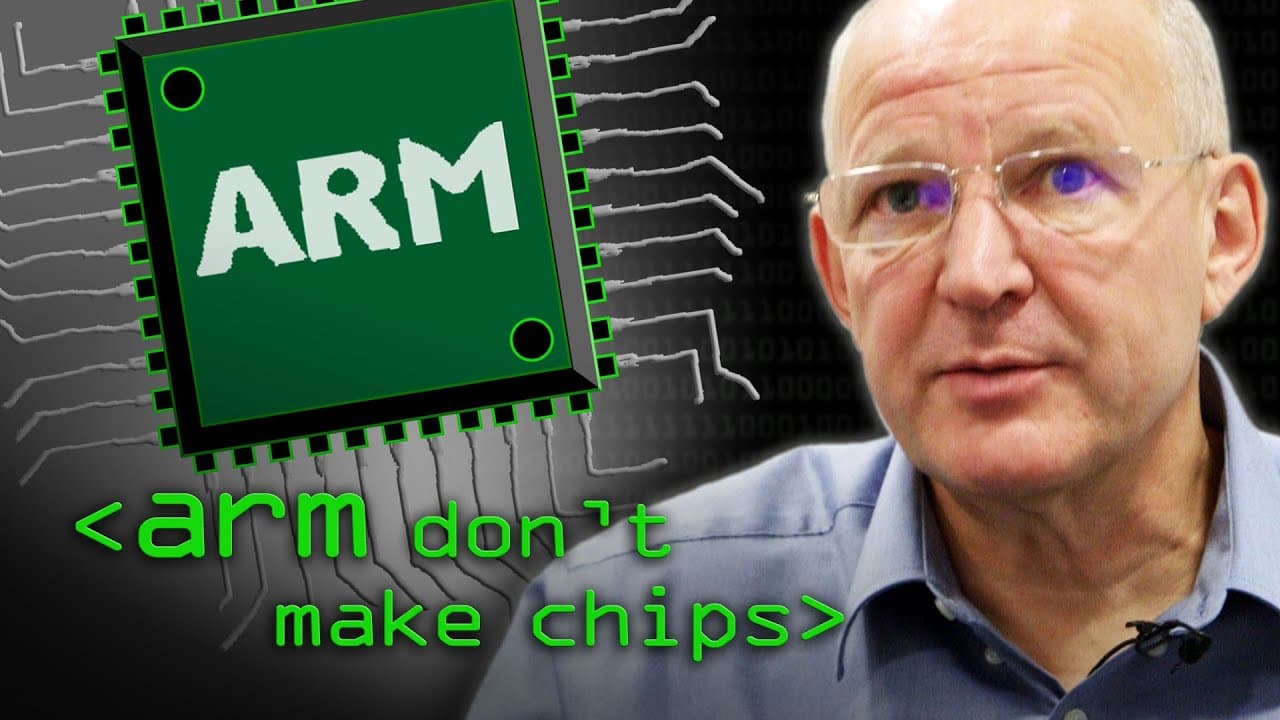
Why Doesn't ARM Make Computer Chips? - Computerphile
TL;DR
ARM does not manufacture complete chips; it designs and sells intellectual-property blocks, such as CPUs and GPUs, that partners combine with memory, interconnects, and their own designs. Before silicon production, ARM simulates its blocks millions or billions of times, while partners decide when to fund masks costing about $1–2 million per print. Read on to understand the full path from ARM’s designs to foundries and consumer devices.
Transcript
our partners now ship about a billion cpus uh a month or rather that's a billion chips containing cpus the graphics processors are still you know we're catching up we will do about 700 million units this year can you tell me about that where's the factory why don't you make the chips here so the factories in taiwan in austin texas and china and you... Read More
Key Insights
- 🦾 Arm partners with companies to provide intellectual property (IP) blocks for chip design.
- 🐿️ The chip manufacturing process involves simulation, testing, and collaboration with foundries.
- 🐿️ Arm's role is analogous to architects who design chip "blueprints" that are implemented by their partners.
- 🏆 Arm's IP blocks are tested extensively to ensure functionality and reliability.
- 🖐️ Simulation software plays a crucial role in evaluating chip performance and identifying potential issues.
- 🐿️ Chip design and manufacturing involve a progressive decomposition process, starting with small blocks and gradually building up to complete chips.
- 🐿️ Arm's partners may also incorporate their own IP blocks into the final chip design.
Install to Summarize YouTube Videos and Get Transcripts
Explore YouTube Video Summarizer or Get YouTube Transcript Extractor
Questions & Answers
Q: Why doesn't ARM make computer chips?
ARM’s products are intellectual-property blocks: sections of a chip that it designs and sells to partners. Those partners assemble ARM CPUs or GPUs with memory, interconnects, other companies’ IP, and their own technology, then decide whether to manufacture the completed design.
Q: What does ARM sell if it does not manufacture complete chips?
ARM sells intellectual property, or IP, representing designed sections of a chip. The speaker compares ARM to an architect selling plans that another company uses as part of a larger product.
Q: Who decides when an ARM-based chip goes into production?
ARM’s partner makes the final decision to proceed with manufacturing after assembling and testing the complete chip design. ARM first applies several quality barriers and may indicate that its IP is suitable for limited or large-scale production.
Q: How are ARM's chip designs turned into manufacturing masks?
ARM writes hardware in a specialized language, much as people write software. Tools compile that description into logic gates and generate the images called masks that manufacturers use in photolithography.
Q: How much do chip-manufacturing masks cost?
The transcript says the masks cost about $1–2 million each time a design is printed. That expense helps explain why partners test designs extensively before committing to production.
Q: How does ARM test its IP before it reaches silicon?
ARM simulates its IP blocks millions or billions of times before silicon production. Computers run programs that model the behavior of silicon gates, their timing, and the way the gates are connected.
Q: What can ARM's electrical simulations evaluate?
ARM adds foundry-provided models of the intended silicon process and simulates the design electrically. These simulations help assess correctness and speed, while estimating heat is described as harder.
Q: How does an ARM design become part of a phone or other consumer device?
A chip company combines ARM IP with other IP and its own components, then may send the finished design to a foundry such as TSMC for manufacturing. The resulting chips are sold to an OEM that builds a consumer device such as a phone, although a company such as Samsung may make chips for its own phone division.
Summary & Key Takeaways
-
Arm designs IP blocks for chips and partners with companies who design and manufacture the full chips.
-
The chip manufacturing process involves designing blocks, simulation and testing, and collaboration with foundries.
-
Arm's role is similar to architects, providing plans for chip design that are then built by companies using various components and manufacturing facilities.
Read in Other Languages (beta)
Share This Summary 📚
Summarize YouTube Videos and Get Video Transcripts with 1-Click
Try YouTube Summary with ChatGPT & Claude or YouTube Transcript Generator
Explore More Summaries from Computerphile 📚





Summarize YouTube Videos and Get Video Transcripts with 1-Click
Try YouTube Summary with ChatGPT & Claude or YouTube Transcript Generator