What Jobs Will AI Replace Next and Which Stay Safe
TL;DR
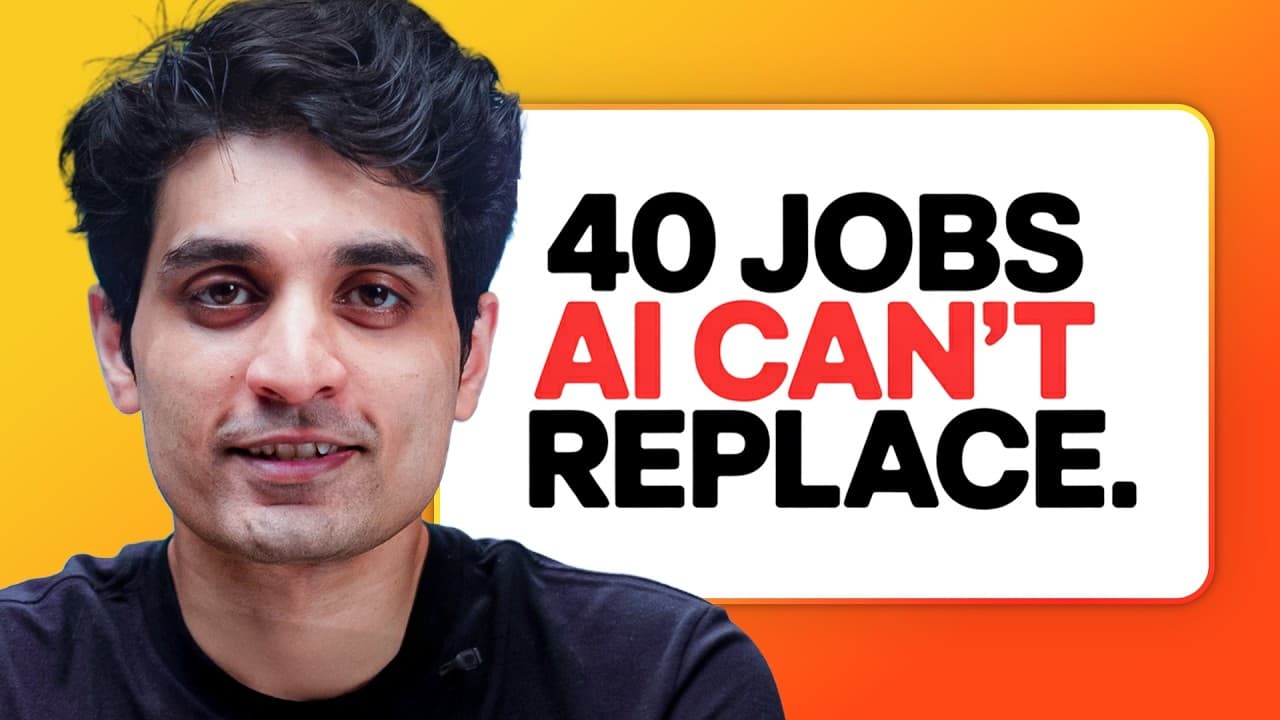
AI is likely to affect many desk and language based roles first, with translators, writers, customer service, and sales reps among the most at risk. Hands on, blue collar work appears safer for now. The video summarizes a Microsoft Copilot based study that ranks 40 risky and 40 safe jobs using an AI applicability score.
Transcript
A new study has come out by Microsoft which talks about the 40 jobs that are most likely to be taken by AI in the near future and also 40 jobs that are relatively safe. Now you might ask me why don't if a big company has put out a paper like this why would you listen to them? They have so much incentive to lie. But the truth is actually in this cas... Read More
Key Insights
- AI applicability is higher for translators, writers, and customer service due to language tasks and scripted responses
- The study uses 200,000 Copilot conversations to determine end to end task completion by AI
- Hands on and blue collar roles show relative safety in the near term
- The ranking collapses the middle skill set into higher risk or safer categories
- The methodology links AI readiness to how well AI can complete tasks end to end
- AI could automate back office sales tasks like writing proposals and emails
- Clerks, attendants, and ticket agents are prone to automation due to structured language needs
- The video argues the incentives of big tech firms may influence how such studies are perceived in public
- More videos from this channel:
- More from this channel: Varun Mayya
Install to Summarize YouTube Videos and Get Transcripts
Explore YouTube Video Summarizer or Get YouTube Transcript Extractor
Questions & Answers
Q: What is the main finding of the Microsoft Copilot study on jobs and AI?
The main finding is that certain desk and language based roles are more vulnerable to AI, such as translators, writers, and customer service, while hands on and blue collar roles appear safer for now. The study creates an AI applicability score by examining Copilot driven task completion in anonymous conversations to assess end to end automation potential in the near term.
Q: How was the AI applicability score determined in the study?
The score was determined by analyzing about 200,000 anonymous Copilot conversations, looking at whether Copilot could complete the work end to end. Based on user satisfaction with Copilot generated work, they assigned a score indicating how likely AI is to perform the task end to end in the next months or years.
Q: Why does the host suggest Microsoft might have incentives not to publish such a study?
The host argues that many predicted replacements involve tasks that AI can perform by leveraging tools that large companies offer, so publishing the study could create fear and panic that would drive demand for and reliance on those tools. The implication is that the findings could influence market dynamics and product adoption.
Q: Which jobs are mentioned as potentially safe from AI replacement?
Jobs described as safer include hands on roles such as phlebotomists, nurses, construction workers and other manual labor roles. The video also implies that certain non routine, highly contextual or experiential roles may be less susceptible in the near term, though it emphasizes ongoing adaptation and skill development.
Q: What examples are given of desk or back office tasks at risk?
Examples include translators, writers and authors who rely on language production, customer service representatives who draft responses, and sales reps who prepare proposals and emails. These tasks involve structured language, information retrieval, and routine decision rules that AI can learn to automate.
Q: How does the video describe the role of AI in customer service?
AI in customer service is described as capable of drafting responses, answering FAQs, and handling many routine queries by retrieving data from a website or knowledge base. The video notes accountability concerns in cases like refunds for large-ticket items, where human judgment may still be needed.
Q: What is the suggested career strategy given by the video?
The suggested strategy is to view AI as an augmentation tool rather than a replacement, focus on skills that are less automatable, and leverage unique life experiences and nuanced human judgment. Adapting and combining AI capabilities with domain expertise is presented as a path to resilience.
Q: What does the host say about the role of AI in two types of workplaces?
The host notes that AI’s impact may vary by how tools are deployed in workplaces, with some environments integrating AI deeply into workflows and others relying more on human judgment. The point is that context matters for how automation will unfold across industries and roles.
Summary & Key Takeaways
-
This video breaks down a Microsoft study on which jobs AI can replace and which are safer, using Copilot conversations to assign an AI applicability score. It argues that desk and language tasks are more vulnerable while hands-on work remains relatively protected for now. The discussion also notes potential pacing by industry and tool integration.
-
The host critiques the study’s incentives and explains that AI’s reach could be shaped by how tools are deployed in real workplaces, not just by the technology itself. The overall message stresses a need to adapt and focus on non automatable human elements.
-
The video ends with practical reflections on career strategy, suggesting that improving life experiences, specialized skills, and the ability to leverage AI as an augmentation rather than a replacement will matter for long term resilience.
Read in Other Languages (beta)
Share This Summary 📚
Summarize YouTube Videos and Get Video Transcripts with 1-Click
Try YouTube Summary with ChatGPT & Claude or YouTube Transcript Generator
Explore More Summaries from Varun Mayya 📚





Summarize YouTube Videos and Get Video Transcripts with 1-Click
Try YouTube Summary with ChatGPT & Claude or YouTube Transcript Generator